Cooking for one without wasting food comes down to three habits: buy only what one person eats, decide what happens to the leftover half of anything that doesn’t come in single portions, and build several meals around one main ingredient so nothing sits in the fridge until it spoils. Most waste for solo cooks is decided at the store, not at the stove.
That sounds simple, but standard package sizes work against you. A can of beans serves three or four, a bunch of cilantro serves maybe fifteen recipes, and most recipes assume you are feeding a family.
So how to cook for one without wasting food in practice? It takes about fifteen minutes of planning before you shop, and a system for storage and freezing afterward. Here is the setup I use, and it has survived several months of cooking for one person in a small kitchen.
- Inventory the fridge, freezer, and pantry before you write a list.
- Buy loose produce, scoop from bulk bins, and ask the deli counter for one portion.
- Plan the second meal before you cook the first one.
- Portion and label food while it is still hot, not the next morning.
- Change the form of leftovers instead of reheating the identical plate.
Each of those is covered below, with the tools and staples that make them easy enough to keep doing.
Table of Contents
- What You Need
- Storage that fits single portions
- Planning materials
- Staples for a nearly empty fridge
- Food safety basics worth memorizing
- Step-by-Step: How to Cook for One Without Wasting Food
- Plan Meals Around Flexible Ingredients
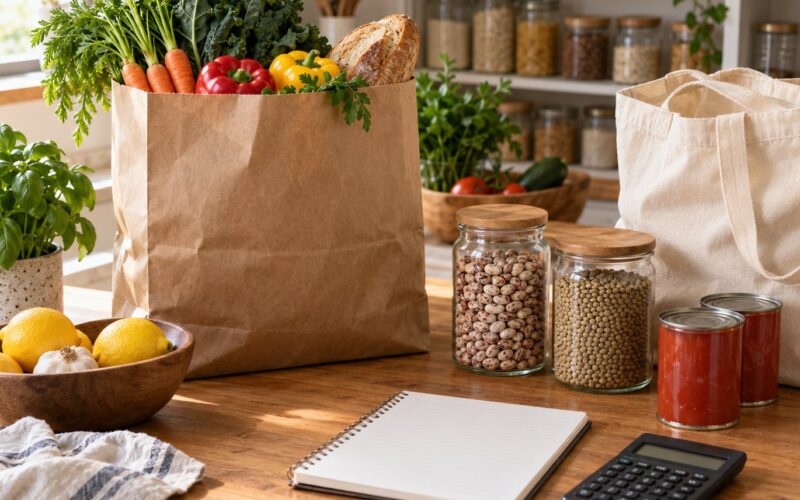
- Shop for Smaller Quantities Without Skipping the Staples
- Cook One Base and Several Flexible Extras
- Portion Before the Leftovers Become a Problem
- Turn Extras Into New Meals Instead of Repeating Dinner
- Common Mistakes
- Frequently Asked Questions
- How should I meal plan when cooking for one?
- What foods freeze well for cooking for one?
- How long can I safely keep leftovers when cooking for one?
- Should I buy single-serving ingredients to avoid food waste?
- How can I stop feeling bored by eating the same leftovers?
- What is the easiest way to cook for one without making too much food?
- Conclusion
What You Need
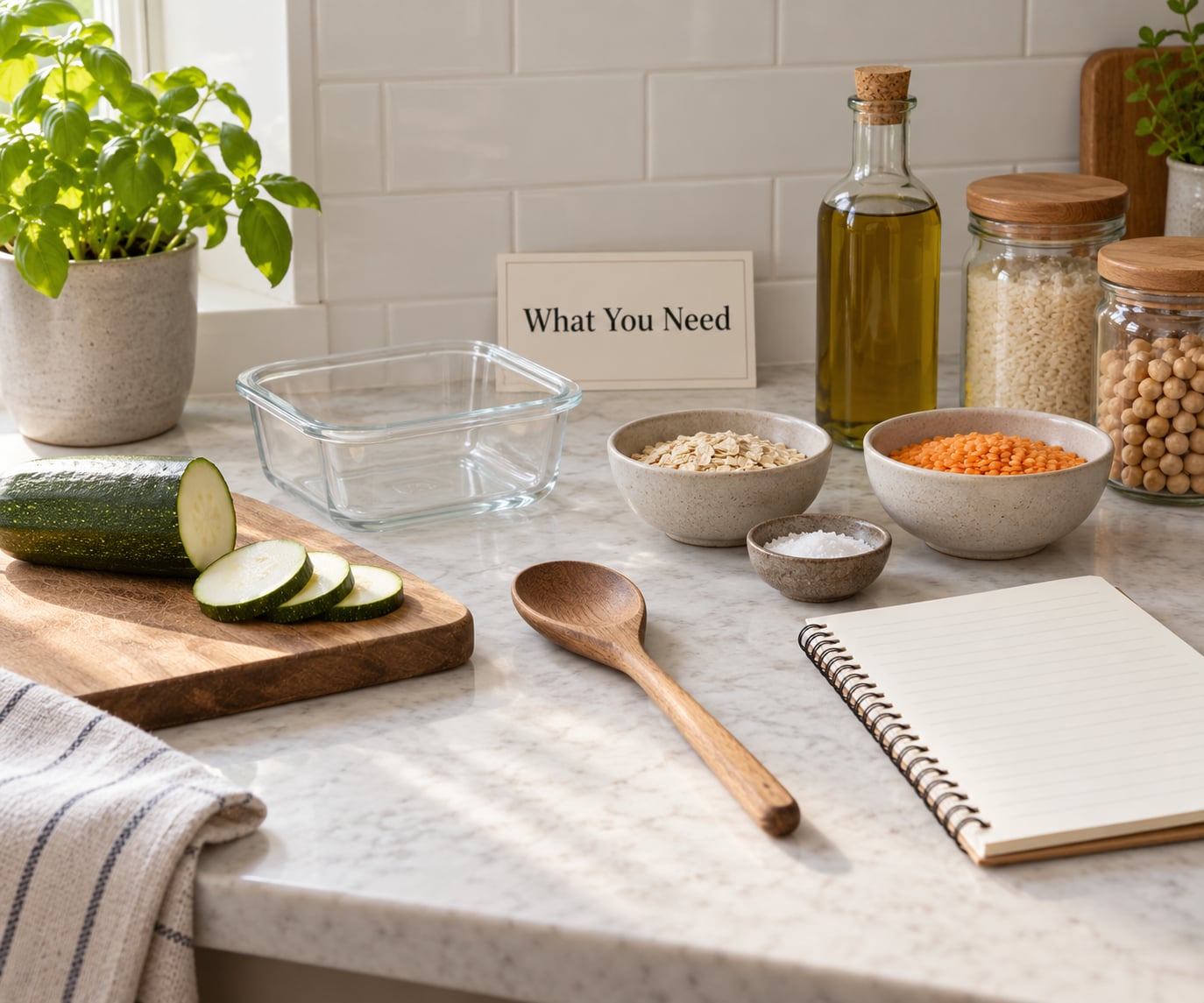
None of this requires special equipment. It requires a few things that make the right action the easy action, plus a short list of staples that cover meals when the fridge is nearly bare.
Storage that fits single portions
Airtight glass containers in one- and two-serving sizes are the workhorse. If your leftovers only fit in a three-cup tub you will never eat, you will not eat them. A set of small containers and a stack of shallow deli containers with snap lids gives you options.
Add an ice cube tray, a muffin tin, and a silicone mat or lined baking sheet. Those three turn tomato paste, broth, sauces, eggs, and butter into frozen single portions instead of a half-used jar in the door of the fridge.
A permanent marker matters more than it sounds. Write the date on the lid of anything you freeze. Old dates wipe off with rubbing alcohol, so the containers stay in rotation for years.
Planning materials
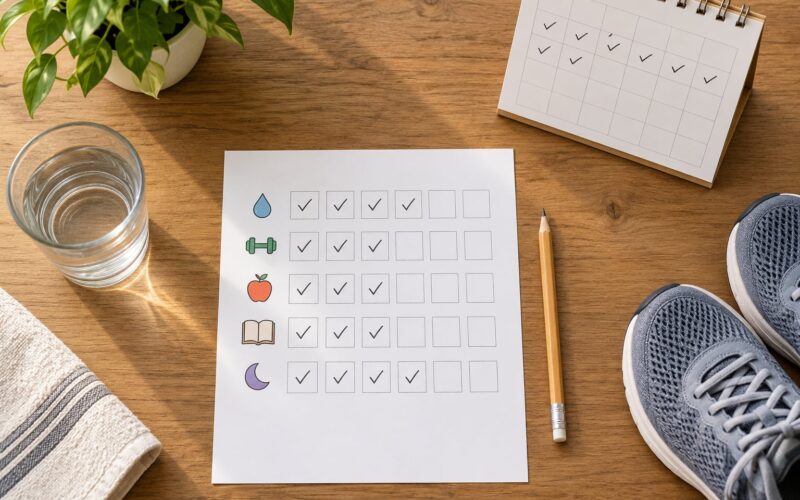
Whatever you already use for lists works, because the format is not the point. A note on the phone, an index card on the fridge, or a small notebook by the door all work. Add one thing to it: a “use first” box for anything already in the kitchen that needs to be eaten before it goes bad.
A kitchen towel or a roll of paper towel earns its place too. Wrapping washed leafy greens in a dry towel, then storing them in a container or a bag, keeps them from drowning in moisture. Greens stored wet are the single most common thing I have thrown out.
Staples for a nearly empty fridge
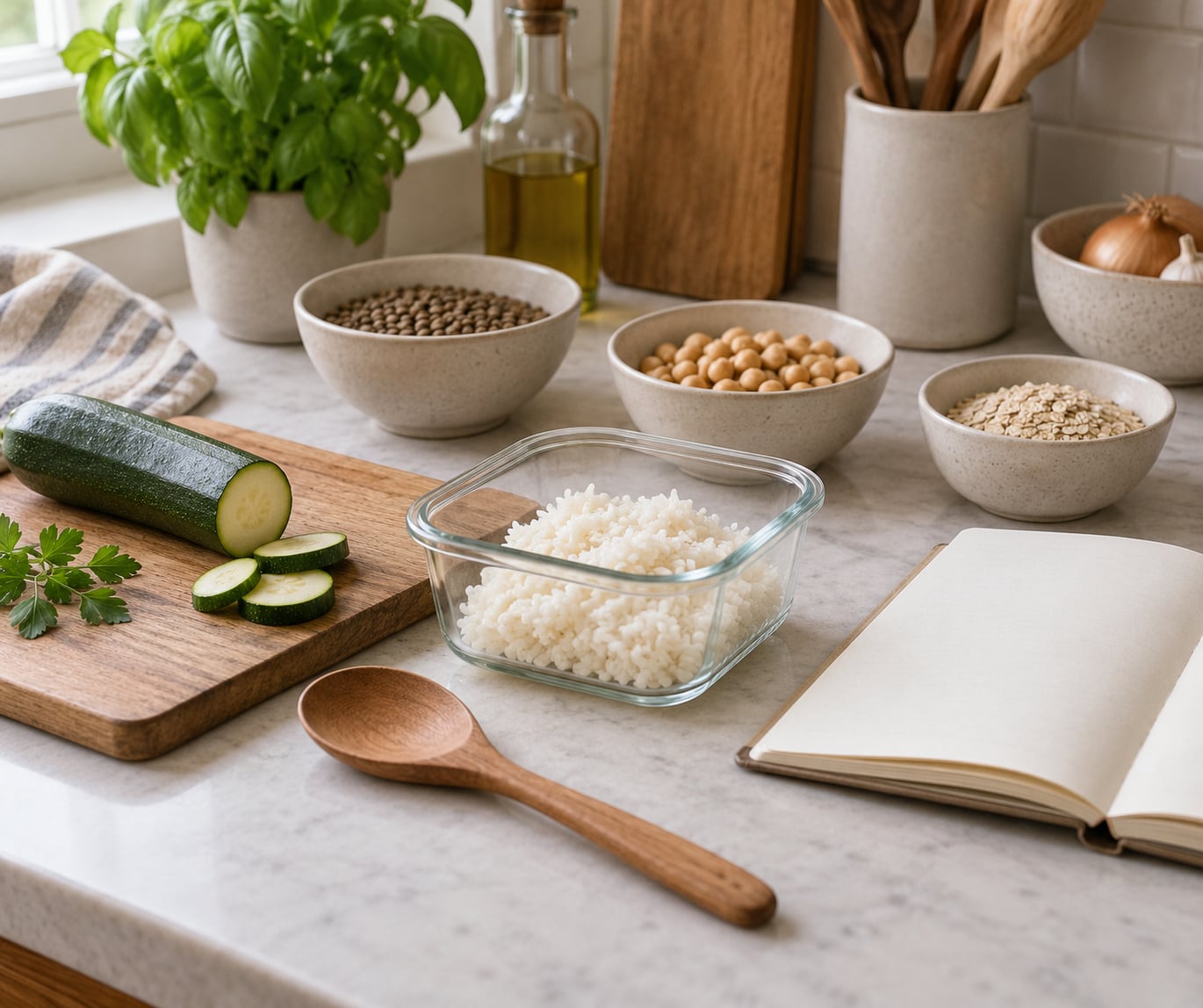
Keep a rotating group of shelf-stable items that turn into a meal without a plan: long-grain rice, dried or canned beans, pasta, canned tomatoes, stock in a carton or cube form, rolled oats, eggs, tortillas, and one or two sauces you genuinely like. Frozen vegetables are the emergency fresh option, and they carry zero spoilage risk because you thaw only what you need.
A small jar of oil and a couple of acid basics do more work than people expect. A can of beans with oil, vinegar, pepper, and garlic is dinner. So is rice with a fried egg on top.
Food safety basics worth memorizing
Cook poultry to 165°F, ground meat to 160°F, and whole cuts of meat and fish to 145°F. Refrigerate cooked food within two hours, keep cooked leftovers in the fridge for three to four days, and freeze what you cannot eat in that window. Reheat leftovers to 165°F. Small portions cool fast, so do not leave them out while you finish another task.
Step-by-Step: How to Cook for One Without Wasting Food
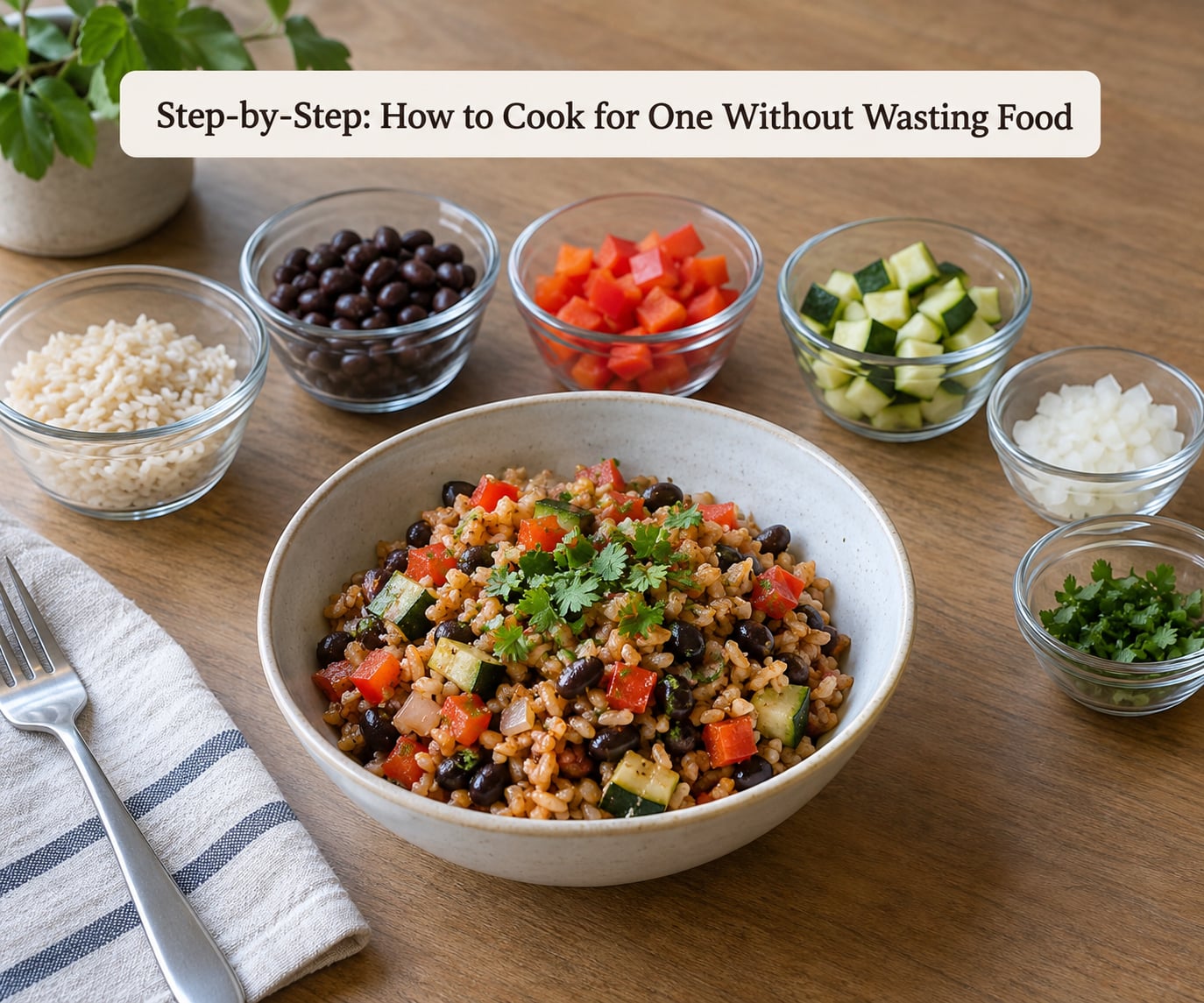
The system runs in seven steps: inventory, plan, shop, cook, portion, store, and transform. You can see how to cook for one without wasting food working or failing at each one, because every step has a visible result you can check.
Plan Meals Around Flexible Ingredients
Pick three or four ingredients that turn into more than one meal before you go shopping. A rotisserie chicken, a can of chickpeas, a head of cabbage, a batch of rice, ground beef, a roast of root vegetables. One of these anchors three or four meals with different flavors and different shapes.
For example, roast a whole chicken on Sunday. Eat the thighs with roasted vegetables on Sunday, shred the breast into tortillas on Monday, toss the rest with greens and lemon on Tuesday, and freeze what remains in single portions on Wednesday. Changing the form is what keeps this from feeling like the same dinner four nights running.
How do you know the planning worked? Write down the second meal before you cook the first. If you cannot name it in a sentence, you are shopping for a meal with no second act, which is where most waste begins.
Shop for Smaller Quantities Without Skipping the Staples
Most waste happens in the aisle. Choose loose produce instead of pre-bagged, scoop rice and grains from bulk bins in the amount you will eat in two weeks, and ask the deli or butcher counter for a single portion of what they would otherwise sell you in bulk. Salad bars are useful for the same reason, since you choose the quantity on the plate.
Compare unit prices rather than sticker prices, but keep in mind that a bulk bag of rice is only cheaper if you actually finish it. For one person, a two-pound bag of rice lasts roughly ten meals and is a reasonable buy. A ten-pound bag is not.
Skip the deals that punish solo cooks: flats of over-ripe strawberries, two-for-one yogurt tubs, family-size bagged chips. If a package is oversized, buy the smaller one and buy it twice. Skip fresh herbs you will not use within four days, and skip the pre-washed salad kits unless you will finish the whole box.
Cook One Base and Several Flexible Extras
Cook one base portion of rice, pasta, or quinoa in a small pot with a tight-fitting lid, then build extras around it. Roasted vegetables and a protein on the same sheet pan takes about 30 minutes at 425°F and gives you two or three edible components at once.
How to cook for one without wasting food here means deciding, while the food is hot, exactly how many servings each component has. One cup of cooked rice, one cup of beans, a small bowl of roasted vegetables. That gives you three containers and a clear count of what you are working with.
One thing that works well: cook more of the base than you need tonight, and less of the perishable vegetable. Frozen rice keeps for months. Roasted broccoli does not.
Portion Before the Leftovers Become a Problem
Portioning while the food is still hot is the step that saves the most food, because the food has not yet had a chance to sit and cool slowly in a deep dish. Divide into single-serving containers, press a layer of parchment or plastic wrap onto the surface of anything saucy or saucy-adjacent, and label with the date.
How do you know portioning worked? Open the fridge the next day and count containers. If the amount in each one matches the amount you would actually eat in a sitting, you did it right. If one container holds three servings, you will see it immediately and split it while it is still safe to split.
Freeze anything you will not eat within three to four days of cooking, which is the standard refrigerated window for cooked leftovers. Freeze flat on a lined tray first for anything you intend to scoop later, then bag or box it once solid.
Turn Extras Into New Meals Instead of Repeating Dinner
Leftover rice becomes fried rice with a scrambled egg and any vegetable in the crisper drawer. Cooked rice keeps three to four days refrigerated, so freeze it sooner if it is not going into a meal this week.
Half a can of beans becomes a taco filling, a stirred-in soup, or a mashed spread on toast with lemon and garlic. A tablespoon of tomato paste gets spooned onto a lined tray in small dollops and frozen, then dropped into sauce or stew later. Broth goes into an ice cube tray. Softening herbs get blended with olive oil and frozen in a jar, then spooned into pasta or potatoes. Cheese rinds go into the freezer bag for stock.
Over-ripe bananas go into pancakes or muffins. Mushy tomatoes become sauce. Sour cream that has turned slightly acidic still works in scones or a smoothie. Softening greens go into eggs or soup first, and wilted greens get cooked rather than thrown away.
How do you know this step worked? Nothing in the fridge has an expiry you are hoping to ignore. The freezer has labeled containers with dates, and each one has a destination meal.
Common Mistakes
Most solo-cooking waste comes down to a handful of repeatable habits. Each one has a specific fix rather than a pep talk.
Buying too many fresh ingredients at once. A week of salads sounds efficient until day five. Buy produce you will eat within four to five days and shop the rest of the week around frozen vegetables, canned goods, and staples. Nobody finishes a head of cauliflower and a bag of spinach in the same week.
Cooking oversized portions. Cook the portion count before you start, not after. If a recipe makes four servings and you want one, that is still fine, as long as the extra three are frozen immediately with a date on them. A recipe that makes four and gets eaten as four unplanned lunches is the problem.
Forgetting what is in the freezer. Frozen food gets ignored because it is invisible. Keep a list on the door of the freezer with what is in it and when it went in. Move older items to the front and use what you have before you buy anything new.
Treating leftovers as a repeat. This is the one that sends food straight into the bin. Same ingredients, different form, different seasoning, different texture. A leftover roast chicken becomes enchiladas, then chicken salad, then a soup. Refrigerated cooked chicken lasts three to four days, and frozen shredded chicken keeps for a few months.
Throwing food out of fear. People discard leftovers because they are unsure, not because they are spoiled. Learn the actual numbers: three to four days refrigerated, three to four months frozen, refrigerate within two hours, reheat to 165°F. Freezing does not make spoiled food safe, so use your nose and your eyes on the food before it goes in.
Ignoring the second half of the package. A can you have to open is a can you have to finish or freeze. The moment you open something you cannot eat whole, ask where the other half is going and write the answer on the lid. That single habit removes most of the half-used-can waste people complain about.
A few smaller tips help. Keep a bag in the freezer for vegetable peelings, ends, and bones, and boil it into stock when it fills up. Wrap greens in a kitchen towel. Freeze herbs in oil. Buy a rotisserie chicken when you have nothing planned, since it gives you four separate meals in one object.
And keep a notepad by the bin for two weeks. Write down what you threw away and why. The patterns are usually obvious, and once you can see them you can shop differently.
Frequently Asked Questions
How should I meal plan when cooking for one?
Start by inventorying what you already have, including the freezer, then plan two or three meals around one flexible ingredient like rotisserie chicken, cooked beans, or a batch of rice. Write down the second meal before you cook the first, and shop only for what those meals need. Plan for what is already in the pantry before adding anything new to the list.
What foods freeze well for cooking for one?
Cooked rice, pasta, soups, stews, shredded meat, cooked beans, roasted vegetables, grated cheese, and dough all freeze well. Freeze sauce in tablespoon dollops on a lined tray, broth in an ice cube tray, and herbs blended into olive oil. Avoid freezing raw lettuce, cucumber, and tomato, since they turn watery and limp when thawed.
How long can I safely keep leftovers when cooking for one?
Cooked leftovers keep in the refrigerator for three to four days, according to USDA guidance. Refrigerate them within two hours of cooking, and reheat to 165°F before eating. If you will not finish them in that window, freeze them instead, where most cooked dishes stay good for three to four months. Freezing does not make spoiled food safe.
Should I buy single-serving ingredients to avoid food waste?
Only sometimes. Single-serving yogurt and pre-portioned produce can cost more per ounce than the larger package, so buying smaller twice is often cheaper. The bigger win is buying loose produce, scooping from bulk bins, and asking the deli counter for one portion. Those options give you the quantity you need without the packaging premium.
How can I stop feeling bored by eating the same leftovers?
Change the form rather than the portion. Shredded chicken becomes tacos, then soup, then a salad. Leftover rice becomes fried rice or a rice bowl with different toppings. Roast vegetables move from a side dish into pasta, into eggs, or into a sheet-pan frittata. Different shape, different seasoning, and the same food stops feeling like a repeat.
What is the easiest way to cook for one without making too much food?
Cook one base such as rice, pasta, or quinoa, then add components that are easy to measure: a canned protein, frozen vegetables, one or two fresh items you will use quickly. Decide your serving count before you start, eat one portion, and freeze the rest in single-serving containers with the date written on the lid while the food is still hot.
Conclusion
Start where the food is, not where the recipe is. Open the fridge and the freezer, write down what needs to be eaten first, and let that set tonight’s meal.
Then pick one flexible ingredient, cook one manageable base, and before the kitchen is clean, portion and label a deliberate second serving. That is the whole system: inventory, plan the second meal, portion it properly, and change its form later in the week. Everything else is a small habit built on top of it.