Shopping for groceries when prices rise comes down to three moves: give yourself a fixed food budget, build meals around what you already own, and read the unit price before you decide anything is a deal. Change how you shop rather than how much you buy, and the same basket costs noticeably less. It takes about 30 minutes of prep before the trip and a few minutes of discipline in the aisle.
Nobody enjoys watching the total climb week after week, and the guilt people put on themselves about it does not help. A working system beats willpower every time. Here is the process I would build from scratch, in the order that matters.
Table of Contents
- What You Need
- Step-by-Step: How to Shop for Groceries When Prices Rise
- 1. Set a grocery spending limit
- 2. Plan meals around food you already have
- 3. Make a price-aware grocery list
- 4. Compare unit prices and evaluate promotions
- 5. Choose practical substitutes without waste
- 6. Shop in a deliberate order
- 7. Check out, save the receipt, and review the total
- Common Mistakes-and How to Fix Them
- Tips for Stretching a Grocery Budget Further
- Frequently Asked Questions
- How can I know whether grocery prices are actually rising?
- What is the best way to compare two grocery products?
- Is buying in bulk cheaper when food prices rise?
- How can I reduce grocery spending without wasting food?
- Are grocery delivery apps cheaper than shopping in a store?
- Where can US readers find help paying for groceries?
- Conclusion
What You Need
None of this needs special equipment. You need a number, a plan, and a way to compare what you are buying against what you paid last time.
- A spending limit. A weekly or monthly figure you commit to before the trip, not after.
- A meal plan. Even a rough one covering dinners for the coming week removes most of the decision fatigue that creates impulse buys.
- A written grocery list. On your phone is fine. It should be built from the meal plan, not written while standing in an aisle.
- A quick inventory of your pantry, refrigerator and freezer. Fifteen seconds of looking prevents buying a fourth jar of the same thing.
- Reusable bags. Small change adds up, and a full cart of bags you have to buy is its own grocery expense.
- A unit price reference. A notes file with the price per ounce or per pound of the items you buy most weeks is the cheapest budgeting tool there is.
Step-by-Step: How to Shop for Groceries When Prices Rise
1. Set a grocery spending limit
Divide the money you can genuinely spend on food among the meals you actually plan to cook, plus snacks, staples you run out of regardless, and a small allowance for items that go bad before you get to them. That last category is the one people leave out, and it is the one that makes a budget feel fake by week three.
You will know the limit is realistic when a normal week lands slightly under it rather than far over it. If you are routinely 40 percent over, your number was written for an imaginary version of your household.
2. Plan meals around food you already have
Check the pantry, the refrigerator and the freezer before you plan a single meal. Then put the oldest and most perishable items at the front of your plan. This is the single biggest lever most people skip, and it is the one people on r/Frugal and r/EatCheapAndHealthy keep naming: eat what is already in the house before you buy anything new.
Build the plan loosely. A freezer bag of peppers and a half bag of rice become a frittata or a stir-fry, and flexibility there means you can adjust when a price moves in your favor instead of feeling locked in.
3. Make a price-aware grocery list
Group your list by aisle or category, then sort each group into essentials and flexible items. Essentials are the ones you would buy no matter what, like milk for a kid who drinks it daily. Flexible items are everything where a substitution costs you nothing.
Write an approximate figure next to each group so you can see the budget taking shape before you reach a register. For anything whose price swings hard, add a backup option on the list itself, which stops you from making a snap decision in the aisle when the shelf tag surprises you.
4. Compare unit prices and evaluate promotions
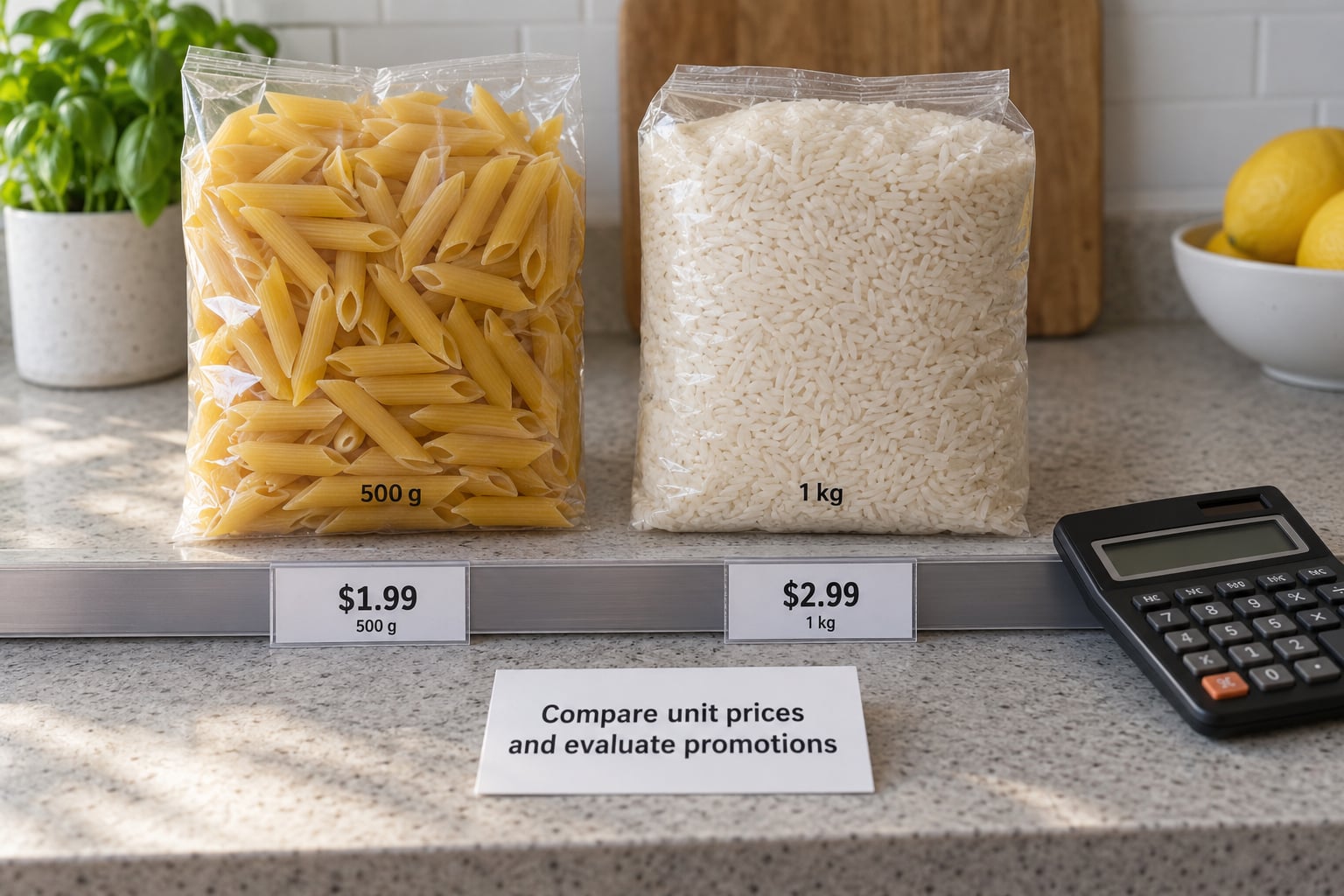
The number on the front of the package tells you what you pay. The number on the shelf tag tells you what you pay per ounce, and those two numbers disagree far more often than shoppers realize. A bag that looks cheaper can cost more per pound than the smaller bag next to it.
Shrinkflation is the reason so many households feel played. The package shrinks, the sticker stays where it was, and the price per ounce climbs anyway. Comparing unit prices across three trips is the only way to catch it, which is why a small notes file of your usual items is worth more than any coupon.
Promotions need the same treatment. A sale is only a sale if it lowers the cost per unit compared with what you paid last time. Multi-buy deals on something your household does not finish are not savings, they are a subscription to waste.
5. Choose practical substitutes without waste
Switching to a store brand is the easiest swap, and the money freed up is real rather than theoretical. Savings of 20 to 40 percent on qualifying items is the commonly cited range, and store brands now dominate many dairy, cereal, and frozen categories outright.
Beyond branding, three substitutions do most of the work. Trade expensive proteins like beef and fish for beans, eggs, and chicken thighs, which carry the same protein at a fraction of the cost. Buy a whole chicken and cut it up yourself, then simmer the carcass into stock. Buy produce frozen or canned at its seasonal peak instead of fresh out of season.
Buy the largest size you can finish before the product expires, not the largest size on the shelf. For one person or a couple, that rule flips completely and the smaller package is usually the cheaper one.
6. Shop in a deliberate order
Work the perimeter first: produce, meat and dairy, then bakery, then the center aisles with shelf-stable items. Layouts are designed so that impulse goods sit in the middle, and walking that path in reverse means you see your staples after the fresh items are already in the cart.
Handle produce and bulk staples early, compare prices on the way rather than at the register, and put anything nonessential back for a second trip. If a coupon in your phone app needs an item you did not plan to buy, the coupon is not saving you anything.
7. Check out, save the receipt, and review the total
Watch the running total rather than staring at a fixed target, because unexpected substitutions add up quietly. Most surprises come from items that were not on the list, so noticing them at the register is the last chance to remove them.
Keep the receipt or a photo of it. Three trips of receipts are enough to build the price book that makes every later comparison fast, and a monthly glance at the total tells you whether the plan is working or whether your prices are actually moving.
Common Mistakes-and How to Fix Them
Shopping without a limit. A list without a number is a wish. Fix: decide the figure before you leave the house and let the list do the work.
Assuming the biggest package is the cheapest. Price per ounce is the only comparison that holds. Fix: divide the shelf price by the net weight on every candidate.
Buying perishables too far ahead. A sale on strawberries means nothing if they turn before you eat them. Fix: buy fresh in small amounts more often, and reach for frozen when you cannot finish a fresh one.
Chasing every promotion. Promotions pull you toward whatever is being discounted, not what you need. Fix: check your list first, then look at the promotional items.
Discarding surplus food. A family of four throws away roughly 1,500 dollars of food a year, which is money already spent and then thrown in the bin. Fix: plan one eat-down meal midweek and freeze extras the same night you cook.
Treating bulk buying as a rule instead of a calculation. Threads on r/budgetfood describe the same pattern repeatedly: bulk works for a four-person household and quietly backfires for a single person. Fix: only buy large when you already know you use that much within the week.
Tips for Stretching a Grocery Budget Further
Check for the yellow or orange discount tags in the produce department. Produce managers mark ripe, perfectly good items for quick sale, and that is where the steepest discounts actually live.
Join the store loyalty program, because the personalized pricing is genuinely lower. Do not buy anything extra to earn points, and do not hand over personal details beyond what the program requires. Forums are split on whether loyalty data pays off, and the honest answer is that it does for a consistent shopper and not much for a sporadic one.
Learn two or three cook-from-scratch staples that replace purchased versions, which is the recurring surprise winner in frugal communities. Mayonnaise, salsa, bread, and blended spices are easy, and buying spices in bulk pays off later even at a higher upfront cost. Scratch bread and a cooked-from-scratch sauce change your cost per meal more than most coupons.
Use community pantry rules as a loose guide rather than a command. The popular 5-4-3-2-1 idea is roughly five canned goods, four boxes, three frozen items, two jars and one fresh item on hand. The 3-3-3 version is three proteins, three produce items and three shelf-stable staples across the week. Families adjust the numbers constantly, so treat them as a check for gaps rather than a shopping list.
Shop at a discount grocer for a monthly bulk run of shelf-stable items, then top up fresh food at whichever store is closest. Several long-running discussions on r/Frugal make this the standard two-store routine.
If your budget is genuinely tight, ask. Food banks, community fridges, and the Supplemental Nutrition Assistance Program exist for exactly this situation, and using them is a practical decision rather than a personal failing. Local 211 lines and Feeding America can point you to the nearest pantry.
Frequently Asked Questions
How can I know whether grocery prices are actually rising?
Track the unit price, not the sticker price. Write down the price per ounce for the five items your household buys most, then check them again every month. The Bureau of Labor Statistics publishes a monthly food-at-home index, and the USDA Food Price Outlook projects where food costs are heading. Comparing your own numbers against those gives you both the national trend and your local reality.
What is the best way to compare two grocery products?
Divide the shelf price by the net quantity and compare the results. Two packages of the same product can look like a deal and be more expensive per ounce than the alternative, especially when the larger one has a steeper discount. Comparing across three trips tells you which price is normal for you, which matters more than comparing on a single day.
Is buying in bulk cheaper when food prices rise?
Only when you already use that quantity before it spoils. For a household of four, bulk dry goods and meat usually lower the cost per meal. For one or two people the math reverses, and a bulk package often ends up in the bin. The rule that works everywhere is to buy the largest size you will genuinely finish, not the largest size available.
How can I reduce grocery spending without wasting food?
Plan meals around what you already have and eat down the oldest items first, rather than buying and then discarding. Freeze extras the same night you cook, use an eat-down meal midweek, and buy produce in smaller amounts more often. Waste is money already spent, so a household of four throwing away roughly 1,500 dollars of food a year is a direct addition to the grocery bill.
Are grocery delivery apps cheaper than shopping in a store?
The item prices are often the same or higher, and the fees sit on top. Delivery is usually priced per order rather than per item, so it works best on large monthly shop-ins, and pickup is cheaper than delivery where it is available. The real comparison is delivery total against your own list total including service fees and tips, not against the sticker price alone.
Where can US readers find help paying for groceries?
Start with the Supplemental Nutrition Assistance Program, applied for through your state agency, and with Feeding America, which runs food banks and mobile pantries across the country. Community fridges and food-sharing apps distribute surplus food at no cost. Calling 211 connects you to local services, and many public libraries also host pantry days. Asking is a practical step, not a personal one.
Conclusion
Start tonight with one action: pick a weekly food number and write it down, then check your pantry and refrigerator before you plan anything to buy. A fixed limit and a flexible list will hold up far better than trying to predict which items rise next.
Review the receipts monthly and adjust the number as prices move. It takes ten minutes a month and keeps the plan honest instead of aspirational.