
To make a simple monthly budget that works, take your real take-home pay, subtract every bill you owe this month, then hand what’s left to the categories you actually spend in. That whole version takes about 45 minutes, needs nothing but your bank statements and a page to write on, and you adjust it next month instead of trying to get it perfect in 2026.
Most budgets don’t fail because the person making them is bad with money. They fail because they were built on numbers from an idealized life — the tidy rent, the cheap grocery run, the car that never needs a repair. Real months are messier, so a plan built on wishful numbers gets abandoned by week three.
There’s also the part nobody puts in the guides: opening your statements feels like being graded. Knowing that upfront tends to help more than it hurts.
Table of Contents
- What You Need
- Step-by-Step: How to Make a Simple Monthly Budget That Works
- Step 1: Calculate Your Monthly Income
- Step 2: List and Date Your Bills
- Step 3: Assign Money to Spending Categories
- Step 4: Build in Savings and a Small Buffer
- Step 5: Track Spending During the Month
- Step 6: Review and Adjust Next Month
- Common Mistakes
- Frequently Asked Questions
- How much should I budget for monthly expenses?
- What is a zero-based monthly budget?
- How do I budget when my income changes each month?
- What should I do with money remaining at the end of the month?
- How do I include irregular bills such as car repairs or medical costs?
- What if I go over budget in one category?
- Conclusion
What You Need
Learning how to make a simple monthly budget that works starts with the raw material. You need five things before you touch a single number, and none of them cost money.
- Income records. Three months of pay stubs or deposit records, so you can see what actually lands in your account rather than what you assume lands there.
- Access to every account you spend from. Checking, credit cards, a second card, any cash, and any shared or joint account.
- A bill list with due dates. Rent, utilities, phone, insurance, subscriptions, loans, minimum payments.
- Spending categories that match your life. Twelve is plenty. Forty is a bookkeeping project nobody finishes.
- One tracking system you’ll actually open. Compared below.
On that last one: a spreadsheet, a free budgeting app, your bank’s own spending categories, or plain cash envelopes all work. Pick the one that asks the least of you.
| System | Cost | Daily effort | Suits you if |
|---|---|---|---|
| Spreadsheet (Excel or Google Sheets) | Free | 5 to 10 minutes | You like seeing the whole picture and don’t mind setting it up once |
| Free budgeting app | Free | 2 minutes | You want categories assigned for you and a running balance on your phone |
| Bank spending categories | Included with your account | Under a minute | You spend almost everything on one card |
| Cash envelopes | Cash on hand | 2 minutes | Shopping in person makes you lose track of what’s left |
Check for an annual fee before committing to anything that bills you monthly, and skip any tool whose free tier expires without telling you.
Step-by-Step: How to Make a Simple Monthly Budget That Works
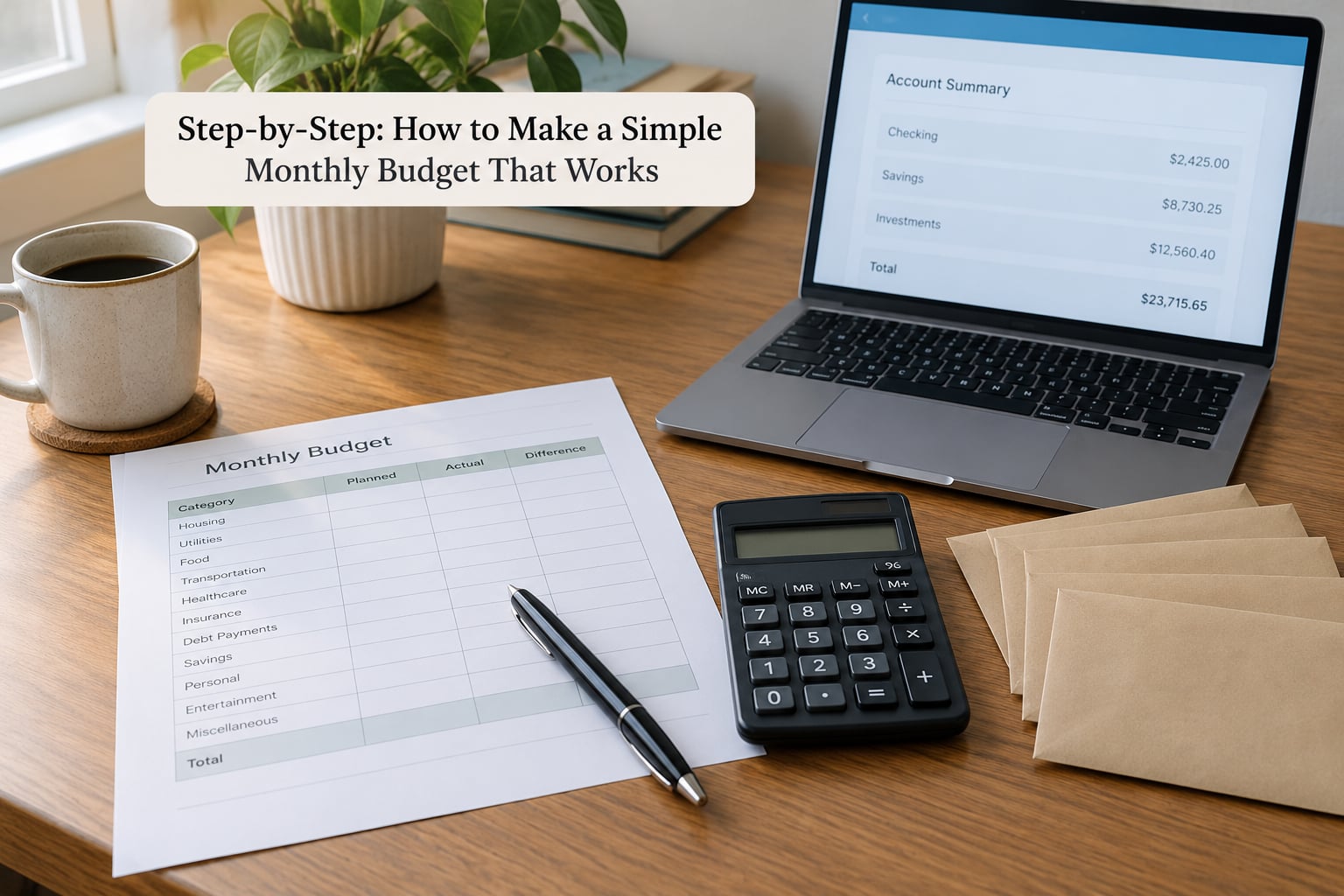
Step 1: Calculate Your Monthly Income
Start with take-home pay, not your salary. Your gross pay is the number before taxes, retirement contributions, and insurance; the take-home amount is what your bank account actually receives.
If you have one paycheck that looks the same each month, that number is your monthly income. If you’re paid biweekly, you’ll get 26 checks a year, so divide the annual amount by 12 to get a monthly figure that doesn’t create phantom surplus weeks.
Variable income needs a conservative average. Take the last six months, add the deposits that were pay, and divide by six — then build the plan on the lowest two months rather than the average. That’s how freelancers and hourly workers avoid planning around a good month.
Check it worked: your income figure matches what arrived in your account, not what you hoped would arrive.
Step 2: List and Date Your Bills
Now write down everything that leaves your account before you spend anything discretionary. Work from your bank app or statements rather than memory — memory is where the surprise subscriptions live.
Sort the list into three groups. Fixed costs land at the same amount each month: rent, car payment, phone, minimum debt payments. Flexible monthly spending moves around but recurs: groceries, fuel, eating out, household goods. Irregular expenses hit a few times a year: car repairs, dental work, gifts, an annual insurance premium.
Then put a date next to each line. Dates matter because they turn a pile of obligations into a calendar you can fund in order.
Check it worked: the total of your fixed costs alone is less than or equal to your take-home pay. If it isn’t, that’s the finding — handle it before assigning anything else.
Step 3: Assign Money to Spending Categories

Subtract your fixed costs from your income. What’s left gets divided among flexible spending, savings, and a small buffer — and every dollar gets a job. That last part is what regular budgeters call zero-based budgeting.
For needs versus wants, use three questions: Do I stop functioning without it? Did I plan this expense in advance? Would I still buy it if the plan in front of me said no? Two yeses usually means it’s a need.
The 50/30/20 rule is a starting point most people recognize: 50% of take-home pay on needs, 30% on wants, 20% on savings and debt. Treat it as a guideline, not a law — in a high-rent city or with heavy childcare costs, needs can eat 70% and still leave you responsible. Set the percentage that fits your actual life.
Here’s the arithmetic on 3,000 a month in take-home pay, with rent at 1,200:
| Category | Planned | Actual |
|---|---|---|
| Fixed costs (rent, utilities, phone, insurance, minimums) | 1,650 | 1,702 |
| Needs that flex (groceries, fuel, household) | 600 | 571 |
| Wants and spending money | 450 | 489 |
| Savings and extra debt payments | 300 | 300 |
| Total | 3,000 | 3,062 |
Two details make the plan livable. Set each cash category up as a separate envelope or a separate account transfer so the money is genuinely hard to spend, and give yourself one category you never touch without a second thought. A budget with no slack in it becomes a budget people quit.
Check it worked: your planned total equals your income to the dollar, and you can name where every dollar went.
Step 4: Build in Savings and a Small Buffer
Savings go in before the discretionary money, not after a good month happens. On payday, move what you’ve assigned to savings and debt before you spend anything, which is the whole idea behind “pay yourself first.” Set it as a standing transfer and let the money leave before your spending impulse shows up.
For an emergency fund, the widely used milestones are 500 first, then 1,000, then one month of essential expenses. The first two are about stopping small emergencies from becoming debt.
Irregular bills get their own reserve called a sinking fund, and the arithmetic is simpler than most people expect: take the expected yearly cost, divide by 12, and save that every month.
If holiday spending runs about 1,200 a year, 1,200 divided by 12 is 100 a month. Insurance at 900 a year is 75 a month. A car repair reserve of 600 a year is 50 a month.
Check it worked: every predictable once-a-year cost has a monthly contribution attached to it, and nothing is left to surprise you.
Step 5: Track Spending During the Month
Record purchases without judgment. The log isn’t an audit; it’s a record. Most people run 10 to 20 percent more than they expect in a category, and finding that out in week two is the whole point.
Community advice on budgeting forums converges on a rhythm: same time, every day, about two minutes. Evening is usually easier than morning because purchases are fresh. A weekly comparison of actual against planned is where you make decisions — daily, you only have numbers, no leverage.
Watch the small purchases, since they’re the ones that hide. A 5 dollar daily coffee is about 1,825 a year. A 15 dollar lunch four times a week is roughly 2,900 a year. Individually harmless, collectively the reason a “tight” month feels tight.
Check it worked: at any point in the month you can say what remains in each category without opening anything.
Step 6: Review and Adjust Next Month
Set aside 20 minutes after your first full month. Compare actual against planned line by line, then write three sentences: what worked, what leaked, what changes next month.
Be specific about the fix. “Spend less on takeout” doesn’t work. “Takeout budget drops from 180 to 120, and the difference goes to the car sinking fund” does.
Then roll the plan forward instead of rebuilding it. Copy last month, apply the changes, update income if it shifted. A budget is a living document that gets corrected monthly, not a contract you’re breaking by editing it.
Check it worked: next month’s budget exists before next month’s bills arrive.
Common Mistakes
- Budgeting gross income. The plan then spends money that was never yours. Fix: use take-home pay, every time.
- Leaving irregular bills out. They arrive as a crisis instead of a line item. Fix: divide each expected annual cost by 12 and fund it monthly.
- Categories so tight they invite cheating. A 60 dollar dining budget when you realistically spend 110 guarantees the overrun. Fix: set the limit at real spending minus about 15 percent, then tighten it once the habit holds.
- Ignoring debt and medical costs. Minimum payments alone let high-interest balances sit. Fix: keep every minimum current, then direct extra money either by debt snowball (smallest balance first, fastest to clear) or debt avalanche (highest interest rate first, cheapest overall). Either works; what matters is that you pick one.
- Tracking nothing between set-up and the first review. Adjusting from memory produces fiction. Fix: a two-minute daily log.
- Quitting after one imperfect month. Month one is data, not a verdict. Fix: change two categories, keep the rest, and go again.
A few habits that hold up: automate the savings transfer, keep your fixed costs flat when income rises and send raises to savings instead of lifestyle, and if you’re sharing finances, review the numbers together with the goal of adjusting the plan rather than assigning blame. If your income genuinely doesn’t cover your essentials, work down the priority list — housing, then food and transport, then minimum debt payments, then everything else — and look for assistance programs, which many people qualify for without realizing it.
If you are still working out how to make a simple monthly budget that works, that priority order is the safest place to start, and it costs nothing to try for a month.
Tax rules, credit terms, and debt law differ by country and state and change over time, so treat these as general principles and check the specifics where you live.
Frequently Asked Questions
How much should I budget for monthly expenses?
Start with your take-home pay and budget against that, not your salary. List every bill you owe this month, subtract the total from your income, then divide what remains among flexible spending, savings, and a buffer. Most people find their fixed costs take 50 to 70 percent of take-home pay. The right number is whatever leaves a plan you can actually follow.
What is a zero-based monthly budget?
A zero-based budget is one where every dollar of income is assigned a job, and the totals come out even. Money sitting unassigned counts as a gap you fill on purpose, usually by adding to savings. The name can mislead people into thinking it means spending nothing, which is the opposite of what it means.
How do I budget when my income changes each month?
Build the plan on a conservative figure rather than an average. Take the last six months, identify the deposits that were pay, and use the lowest two months as your baseline income. Put any surplus above that baseline into savings or toward debt rather than raising your monthly limits. This is the standard approach for freelancers and hourly workers.
What should I do with money remaining at the end of the month?
Decide in advance, because leftover cash usually disappears without you noticing. Common choices: move it to savings, roll it into the next month’s buffer, or build the sinking fund for your next irregular bill. If it keeps happening, your category limits are too tight and the fix is to correct them, not to keep hunting for better spending discipline.
How do I include irregular bills such as car repairs or medical costs?
Estimate the yearly cost, divide by 12, and save that amount every month in a separate category called a sinking fund. For example, if you expect about 1,200 a year in car repairs, set aside 100 a month. Keep that category off your main spending account so it is harder to raid when something else comes up.
What if I go over budget in one category?
Pick one: take the overrun from a category you genuinely underspent, or cut the categories below their targets next month by the same amount. Then check why it happened — a one-off event needs a sinking fund, while a repeated overrun means the limit was unrealistic and needs adjusting. Cutting two limits beats abandoning the whole system over one category.
Conclusion
A budget that works is a short list, a real number, and a monthly appointment to fix it. Take-home pay in, bills dated and sorted, every remaining dollar assigned, savings moving first, irregular costs spread thin across the year, spending logged in two minutes a day, and twenty minutes at month’s end to correct the plan.
Start today with three actions: open your last three months of statements and write down what you actually receive, list every bill with its due date, and pick the three categories that matter most — usually housing, groceries, and transport. Give those three a number, and you already have the first version of a simple monthly budget that works. The rest is adjusting it until it matches the life you actually live.