Learning how to stretch a food budget at the end of the month comes down to four moves: know the exact number you have available, take a full inventory of your kitchen, build meals from low-cost staples you already own, and buy only the gaps. Set the plan up in about an hour and you can cover the week without relying on expensive convenience food.
The tricky part is not cooking. It is that most households shop out of habit at the start of the month and then hit an empty account balance in the final week. This approach flips the order: inventory first, plan second, shop last. It also means treating food safety as non-negotiable, because stretching food is worthless if you end up ill.
Table of Contents
- What You Need
- How to Stretch a Food Budget at the End of the Month
- Calculate the money you actually have left
- Inventory the food you already have
- Plan low-cost meals around pantry staples
- Make one flexible base meal and change the toppings
- Shop for gaps, not a full grocery list
- Use the freezer and leftovers safely
- Create a backup meal for low money or low time
- Track the plan for the next seven days
- Common Mistakes
- Frequently Asked Questions
- How can I stretch my food budget when my funds are gone?
- What are the cheapest meals I can make with pantry staples?
- Should I buy groceries in bulk to save money at the end of the month?
- How do I use frozen or canned foods to reduce food waste?
- What can I eat when the grocery budget is nearly exhausted?
- What to Do First
What You Need
You need very little to run this process. Most of it is attention and a place to write things down.
- A notebook or budgeting app. Paper works fine. An app is better if you want automatic totals and reminders.
- A receipt or a spending estimate. Whatever you have already spent this month on food, so you can subtract it.
- A full inventory sheet. Paper, fridge, freezer, and countertop, written down rather than remembered.
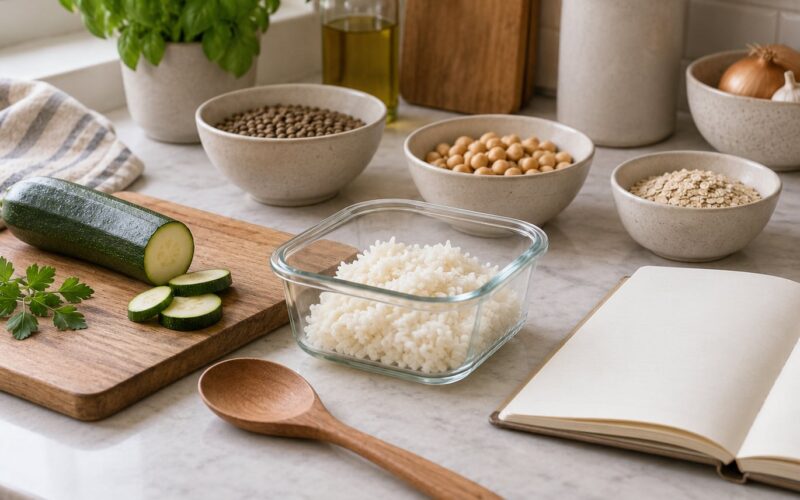
- Reusable containers. Airtight lids let cooked food keep longer and stop you from throwing food away.
- Basic cooking tools. A pot, a skillet, a knife, a cutting board, a can opener, and a measuring cup cover almost everything below.
- Cold storage. A working refrigerator and, ideally, a freezer. If you have neither, buy the cheapest cool storage you can and plan around shelf-stable food.
- Access to a notebook or phone. Needed for the daily check-in that keeps the plan honest.
If you have no freezer and no containers, you can still run the plan. Buy one or two cheap containers first and choose meals that cook and eat in the same sitting.
How to Stretch a Food Budget at the End of the Month
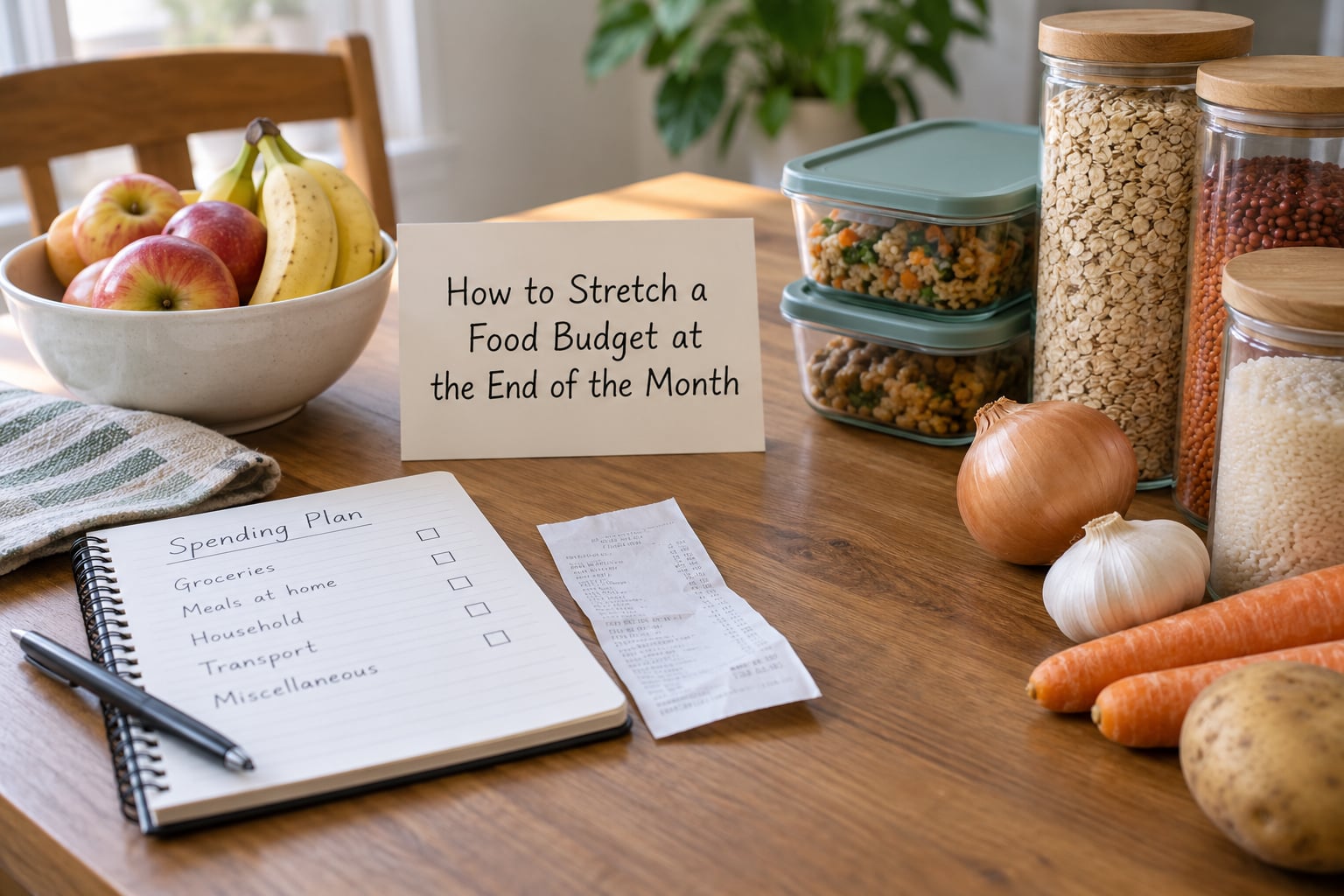
Work through these eight steps in order. The first three take about an hour and give you a realistic number and a realistic picture of your kitchen. Everything after that is fast.
Calculate the money you actually have left
Subtract three things from your total monthly food amount: what you have already spent, what is committed but not yet paid, and what your pantry already holds in value. What remains is the only number you are allowed to shop against.
Say your monthly food amount is four hundred dollars. You have spent three hundred and ten, and you owe twenty-five on a card charge from last week. That leaves sixty-five for the remaining days, not for the month. In my experience, households that do this subtraction realize their real problem is a fixed amount spent unevenly, and that changes what they do next.
Write the daily figure down: divide the remainder by the number of days until your money arrives. Sixty-five dollars across seven days is a little over nine a day for one person. Now you know whether you are shopping or just topping up.
Inventory the food you already have
Walk the pantry, refrigerator, freezer, and countertop before you write a single item on a shopping list. Group what you find by what it can become rather than by where it sits.
Make four piles: things that become breakfast, things that become a main dish, things that go into a soup or stew, and things that are about to spoil. Add the date you opened or froze each item and the date it needs to be used by.
Be realistic about quantities. Half a cup of rice or three frozen tortillas do not make a meal, and counting them as if they do leads to bad plans later. Count what would actually feed people, and put a check next to anything you genuinely will not eat so you can stop thinking about it.
Plan low-cost meals around pantry staples
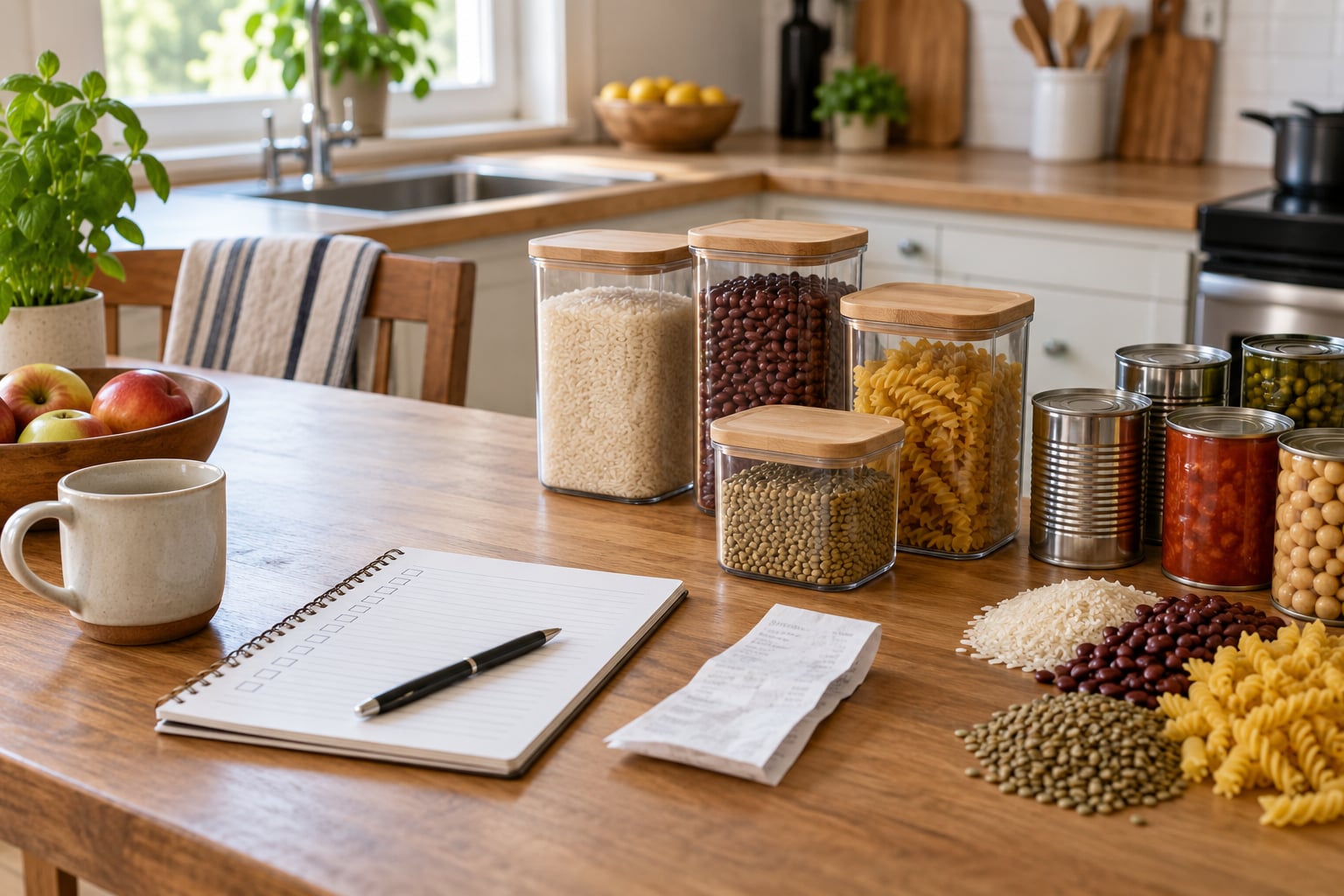
Build the week from foods that keep well and cost little per serving: rice, beans, pasta, eggs, oats, canned tomatoes, canned vegetables, frozen produce, tortillas, and whichever protein you have on hand. Each of these turns into multiple meals, which is the whole trick to planning low-cost meals around pantry staples.
A workable seven-day example for one or two people:
- Day 1: Rice with canned beans and whatever vegetable is closest to going bad.
- Day 2: The same rice base with fried eggs and leftover vegetables.
- Day 3: Pasta with jarred sauce, using the last of a can plus a can of corn or peas.
- Day 4: Bean and rice bowl with hot sauce, leftovers from earlier in the week.
- Day 5: Oatmeal with peanut butter or a spoonful of any jam you have.
- Day 6: Vegetable soup built from frozen vegetables and canned beans.
- Day 7: Tacos or a bowl using tortillas, canned beans, and the last fresh produce.
Notice what repeats: rice, beans, eggs, and canned vegetables carry four or five meals between them. Frozen vegetables and canned tomatoes behave the same way and never spoil while you are deciding.
Make one flexible base meal and change the toppings
One base becomes several meals when you swap what goes on top. Rice, pasta, mashed beans, or a thick soup all work. Keep the base plain and change the protein, the vegetable, and the sauce instead.
Rice with black beans and salsa is a different meal from rice with canned fish and soy sauce, even though the rice costs the same. Pasta with canned tomato sauce on day one and pasta with butter, cheese, and a boiled egg on day five comes out of the same pound of noodles. This is what keeps a stretched food budget from turning into the same dinner seven nights in a row.
Pick two sauces you like and keep them stocked. They carry more variation than any single ingredient you can buy.
Shop for gaps, not a full grocery list
Your list should be short enough to read in the parking lot. Anything you already have does not go on it, even if it is nearly out.
Compare the price per ounce on shelf-stable items, since the same category can vary a lot between a brand name and a store brand. Store brands are usually the better buy on canned goods, rice, pasta, and canned vegetables, and the difference matters more at the bottom of the budget than anywhere else.
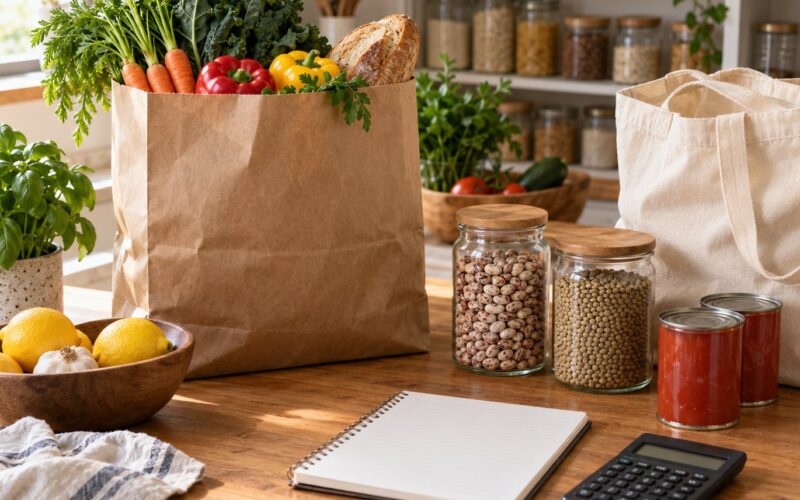
Prioritize items that feed you more than once: a bag of rice, a can of beans, frozen vegetables, and eggs cover more days than a single prepared item does. Buy fresh food only in amounts you will eat within a few days, and pick frozen or canned when you will not.
Shop the clearance and markdown area rather than planning around discounts. Unsold bakery items, produce, and meat are marked down on a schedule, usually later in the evening, and the food is the same food. If you do not have transportation to a discount store, the sales circular from your regular store still gives you the same leverage.
Use the freezer and leftovers safely
Cooked food keeps longer than most people expect when it is handled properly. Refrigerate cooked food within two hours, use it within three to four days, and freeze anything you will not eat in that window.
Cook food to a safe internal temperature: 165°F for poultry, 160°F for ground meat, and 145°F for whole cuts of meat and fish. A cheap instant-read thermometer removes the guesswork and costs very little.
For reheating, bring leftovers to a rolling boil for soups and stews, stir while heating for rice and pasta, and heat baked goods in the oven or toaster instead of the microwave when you want the texture back. Cool cooked food in shallow containers so it chills fast, and date each container with masking tape.
Create a backup meal for low money or low time
Keep two or three options in reserve that cost almost nothing and take under fifteen minutes. White rice and brown rice are the classics because they only need hot water and a pot, and they work with any leftover.
Other reliable backups:
- A bean and rice bowl with hot sauce, using cooked rice from the freezer.
- Pasta with canned vegetables and oil, garlic, and pepper if you have them.
- Oatmeal with peanut butter, which needs one pot and two minutes.
- Eggs and toast, which is the fastest meal in this entire article.
- Any soup or stew from earlier in the week, reheated to a boil.
For dietary preferences, the substitutions are simple: tofu or extra beans instead of meat, gluten-free oats or rice instead of pasta, and corn tortillas instead of wheat bread. Store these alternatives in the same rotation as the main ones so you are not improvising at 6 p.m.
To stop ingredients from spoiling while you wait, move the food most at risk to the front of your cooking order and freeze the rest. A frozen bag of chopped onion or pepper is cheaper than throwing one out.
Track the plan for the next seven days
Spend two minutes a day on a check-in. Write down what you spent, what you ate, and what is still sitting in the kitchen unused.
Eat meals in the order you planned so the most perishable things get used first. Record every extra portion in a container with a date on it, and if you will not eat it within three or four days, freeze it.
Set one rule for a shortfall: if you are lower than expected at the halfway point, drop the most expensive planned item rather than trimming everything. That keeps the plan workable instead of turning it into a list of vague intentions.
Common Mistakes
Most failed budgets fail for the same handful of reasons. Each one has a direct fix.
Buying duplicates. You bought rice on Tuesday and forget you already have a half bag in the pantry. Fix: keep the inventory sheet near the refrigerator and take a photo of it before every shop.
Planning unrealistic portions. A recipe written for four people does not mean four meals for one person. Fix: cook once, then plan the extra portions as separate meals from the start, not as a bonus.
Relying on one giant meal. A single expensive dinner does not cover a week and leaves nothing for the days around it. Fix: one cheap base repeated with different toppings, which costs less and spreads the food out.
Ignoring expiration dates. Food you throw away at the end of the month is money you spent and never ate. Fix: move the soonest-to-expire item to the front of the cooking order, and freeze it if the date is more than three days out.
Treating coupons as the savings plan. A coupon saves a few cents and costs time. Fix: use store brands and unit price comparisons as the main strategy, and treat sales and markdowns as the bonus.
Shopping hungry and without a list. Impulse buying is the fastest way to blow a small budget. Fix: eat something before you go, carry the short list, and pay with cash or a separate payment method so the total is visible when it leaves.
Frequently Asked Questions
How can I stretch my food budget when my funds are gone?
Start with the number you actually have, not the number you planned. Subtract what you already spent and what you owe, then divide what remains by the days until your money arrives. Inventory your pantry, refrigerator, and freezer, and build meals from what you already own. Buy only the missing ingredients, and pick two backup meals you can make tonight with no new purchases.
What are the cheapest meals I can make with pantry staples?
The lowest-cost meals come from a short list: rice, beans, pasta, eggs, oats, canned tomatoes, canned vegetables, frozen produce, and tortillas. Cook a base of rice or pasta once, then change the protein, vegetable, and sauce each day. A bean and rice bowl, pasta with canned tomato sauce, and oatmeal with peanut butter cover breakfast, lunch, and dinner without a single fresh purchase.
Should I buy groceries in bulk to save money at the end of the month?
Usually not at the end of the month. Bulk packaging makes sense when you have the storage space and cash to buy it before the balance drops. In the final week, buy small quantities of the items you will actually eat within days. Bulk dry goods become a good deal again once you have room to store them and a plan that uses them before they go stale.
How do I use frozen or canned foods to reduce food waste?
Frozen and canned food is waste insurance because it does not spoil while you wait. Keep frozen vegetables, canned beans, canned tomatoes, and canned fish on hand so you always have something for dinner. Thaw frozen items in the refrigerator and use them within a couple of days. Open cans into a container rather than leaving them in the can, and refrigerate within two hours.
What can I eat when the grocery budget is nearly exhausted?
Eat from what you already own in the order it will spoil: eggs and toast, rice with canned beans, pasta with canned vegetables, oatmeal with peanut butter, or a reheated soup from earlier in the week. These need ten to twenty minutes and no new spending. If the cupboard is genuinely empty, local food pantries and community fridges are the next step, not convenience food.
What to Do First
Check the balance you actually have, inventory the kitchen, and choose two inexpensive meals before you shop for anything. That sequence takes under an hour and stops the cycle of buying the same food twice.
A flexible plan beats a rigid one, because the balance changes while you are living in it. Run this system one week at a time, check in daily for two minutes, and adjust at the halfway point instead of at the end when there is nothing left to adjust with. If the cupboard is genuinely bare before payday, a local food pantry is a practical step, not a last resort.