
To improve your credit score step by step, do three things in this order: dispute anything inaccurate on your report, cut your revolving card balances, and make every payment on time. Those three steps carry roughly two-thirds of your FICO score, so they move the number faster than anything else you can do this month.
Most people start in the wrong place. They pay off a small balance while a collections account sits unchallenged for a year, or they close an old card the week before a loan application and their score drops for no good reason.
The plan below runs in the order I would use. It takes an afternoon to start and most of the heavy lifting happens over six to twelve months. Rules, score models and lender criteria vary by state and by lender, so treat the numbers here as typical ranges rather than promises.
Table of Contents
- What You Need Before You Change Anything
- How to Improve Your Credit Score Step by Step
- Start with a complete credit review
- Correct inaccurate or fraudulent information
- Bring revolving balances down
- Make every payment on time
- Reduce balances before applying for new credit
- Build a healthy mix of credit
- Monitor progress and protect your score
- Common mistakes that set people back
- Frequently Asked Questions
- What is the fastest way to improve my credit score?
- How do I raise my credit score by 100 points?
- How can I raise my credit score from 500 to 700?
- How do you raise a credit score 200 points in 30 days?
- Does checking my own credit score hurt it?
- What credit score do I need for a mortgage?
- Conclusion
What You Need Before You Change Anything
Gather these first. Working without them is how people miss the one error that is costing them 40 points.
- Your three credit reports. You are entitled to a free report from Equifax, Experian and TransUnion at AnnualCreditReport.com. Pull all three, because they rarely match.
- Your scores from each bureau. Most card issuers show one score on your account dashboard. Compare it against the bureau reports, since lenders often use a different model.
- Statements for every open account. Credit cards, student loans, auto loans, medical bills, anything in collections.
- Proof of any late payment you dispute. Bank statements, email confirmations, a receipt that shows the date.
- Your current balances and limits. You need both numbers per card to calculate your utilization ratio.
How to Improve Your Credit Score Step by Step
Start with a complete credit review
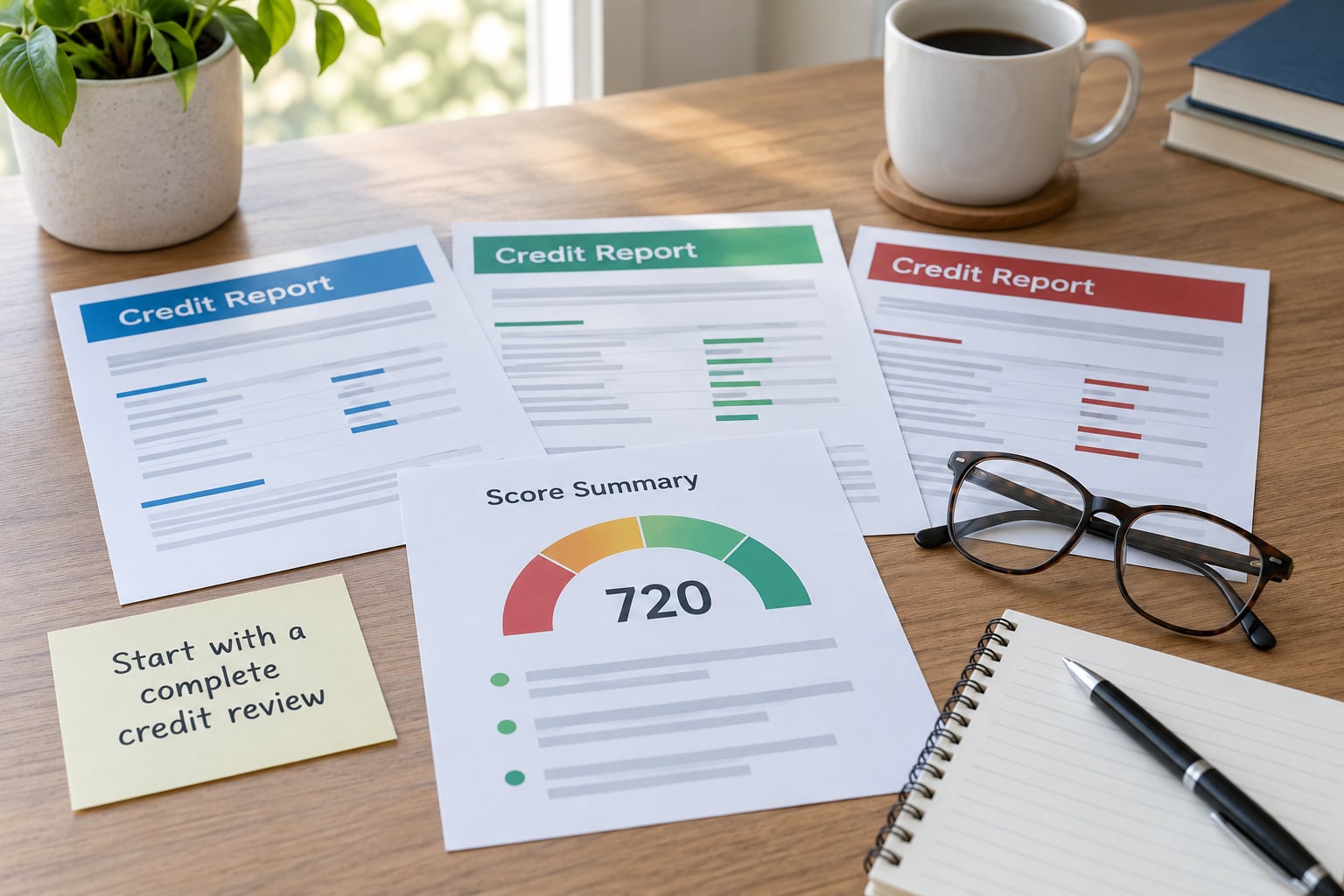
Open all three reports and read every account line by line, not just the summary. Look for accounts you do not recognize, balances that are wrong, a status that says charged off when you paid the account, and duplicate entries for the same loan.
Note the reported date of your oldest account and your newest one, too. Length of credit history is about 15 percent of your FICO score, and it is the one factor you cannot rush.
Correct inaccurate or fraudulent information
Errors are more common than people expect, and they hit hardest when the report feeds a mortgage application. Send a written dispute to the bureau that holds the bad information, or to the creditor, naming the item, why it is wrong, and what documents prove it. Many bureaus have online dispute forms that accept a file upload.
Keep copies of everything you send. A bureau has about 30 days to investigate and must report back within five days of the result. If the entry is wrong, it is removed. If they call it accurate, you can ask the creditor to add a statement of dispute, or pay the debt and then send a goodwill letter asking to have it removed.
If you see accounts you never opened, treat it as identity theft rather than a credit problem. File a report at IdentityTheft.gov, freeze your credit at each bureau, and place a fraud alert.
Bring revolving balances down
Credit utilization is about 30 percent of your score, and it responds faster than almost anything else. Here is the math: a card with a 5,000 limit and a 2,500 balance is 50 percent utilization. A 5,000 limit with a 400 balance is 8 percent.
Two details catch people. Your issuer usually reports the balance on your statement closing date, not the balance you pay down to zero by the due date. And the ratio is calculated per card, so a maxed card hurts even if your total across all cards looks modest.
Ask your issuer for a higher credit limit, which lowers the ratio without you borrowing more. If you do carry a balance, pay more than the minimum each month, and pay it down before the statement closes rather than before the due date.
Make every payment on time
Payment history carries about 35 percent of a FICO score, and a single 30-day late can follow you for seven years. Set up autopay for at least the minimum on every account, including the ones you never use, then schedule a manual payment for anything larger.
If you have fallen behind, prioritize accounts that are already 30 days past due. Bringing the newest delinquency current stops the damage from compounding before you work on the oldest balance.
Reduce balances before applying for new credit
Lowering balances before you apply improves your score at the moment the lender pulls it, which is the only moment that counts. Applying also creates a hard inquiry, and a cluster of applications in a short window reads as financial stress.
A mortgage or auto lender usually treats rate shopping inside a 14 to 45 day window as one inquiry rather than several, so shopping within that window is reasonable. Card applications do not get that treatment. Space them out.
Build a healthy mix of credit
Credit mix is about 10 percent of the score, and the scoring model just wants to see both kinds: revolving credit, such as cards, and installment credit, such as an auto or student loan that you pay on a fixed schedule. Lenders like borrowers who manage both responsibly.
You do not need a new loan to hit that bucket. An existing card you use a small amount each month and pay in full already counts. If you have no history at all, a secured card or a credit-builder loan is the usual starting point, and being added as an authorized user on a family member’s card with years of clean payments can transfer that history to your file.
Monitor progress and protect your score
Check your reports at AnnualCreditReport.com every three to four months, and glance at your score monthly so you can tell whether a change came from something you did. New accounts appearing that you did not open are worth chasing immediately.
Use a free or low-cost score service rather than paying for a monthly subscription you will forget about. Once your file is clean, freeze your credit. A freeze costs nothing, does not affect your score, and stops new accounts from being opened in your name.
Common mistakes that set people back
- Closing the oldest card. It removes a chunk of credit history at once and cuts your total available limit. People report drops of 20 to 40 points.
- Paying every balance to zero each month. A permanently at-zero balance gives the model nothing to score.
- Applying for three cards in a week. Multiple hard inquiries read as desperation, and the new limits do not help the utilization on your old cards.
- Paying for monthly score monitoring. Checking your own credit never lowers your score. Paid services that promise a specific jump, or ask for a fee upfront, are selling something.
- Believing quick-fix promises. Nobody can add 200 points to your file in 30 days. Anyone who says otherwise is either describing a removal of an error or preparing to take your money.
Frequently Asked Questions
What is the fastest way to improve my credit score?
Dispute inaccurate items on your report first, then cut your revolving card balances below 10 percent of your limits. Payment history is about 35 percent of a FICO score and utilization about 30 percent, so those two changes carry the most weight. Results vary, and removing an error often moves the number faster than any payment you can make.
How do I raise my credit score by 100 points?
A jump of 100 points usually takes several months and usually means more than one change at once. Combining a removed error, a large utilization drop, and six months of on-time payments can do it. Anyone promising 100 points quickly is describing a repair that you can do yourself for free, or a sales pitch.
How can I raise my credit score from 500 to 700?
A 200-point climb is a twelve to twenty-four month project, not a weekend one. It usually means removing collections or inaccurate entries, paying down balances on cards with small limits, adding a secured card or becoming an authorized user, and keeping every payment on time for a full year so your file builds history.
How do you raise a credit score 200 points in 30 days?
You usually cannot, unless an error is being corrected. Real changes to payment history and balances need at least one billing cycle to show up, and lenders may not see an updated file the same week. Services advertising a 200-point jump in 30 days charge fees and produce very little.
Does checking my own credit score hurt it?
No. Checking your own score or pulling your own report is a soft inquiry and has no effect on your credit. Hard inquiries come from applications for credit, and only those get recorded, typically staying on your file about two years while hurting your score for roughly a year.
What credit score do I need for a mortgage?
Many conventional lenders look for at least 680, and some use higher cutoffs for lower down payments. FHA and VA loans often work with scores from around 580 to 620. These thresholds change with market conditions and are set by the lender, so ask yours directly before you start counting months.
Conclusion
Start this week with three tasks. Pull all three reports from AnnualCreditReport.com and compare them line by line. Send a written dispute for anything wrong, fraudulent or duplicated. Then call your credit card issuers, ask whether your balance was reported on the statement closing date, and pay those balances down before the next statement closes.
After that it is repetition: pay on time, keep revolving balances low, keep your oldest account open, and apply for new credit only when you need it. People who follow that sequence for six to twelve months see real movement, and the habits that produced it stay in place after the score catches up.