The most common renting mistakes happen in four places: budgeting for the true monthly cost instead of just the rent, trusting a listing or landlord without verifying it, signing a lease nobody read closely, and failing to protect yourself once the keys are in hand. Almost every expensive renter story traces back to one skipped step in one of those four places.
Learning how to avoid common renting mistakes takes an afternoon, not a degree. Set an all-in budget, verify the property before you send a cent, tour slowly, photograph everything before a single box is unpacked, read the lease line by line, and keep written records. The renters who lose deposits or get evicted rarely lost because of bad luck. They lost because there was no record.
One thing to say plainly at the start: a lease is a binding legal contract, and you bring less information and less bargaining power to it than the other side does. That gap is real and it has not closed. What has changed is that documentation is cheap, phone cameras are good, and the small habits below cost nothing but attention.
Table of Contents
- What You Need Before You Evaluate a Rental
- Step-by-Step: How to Avoid Common Renting Mistakes
- 1. Set a Complete Monthly Budget
- 2. Research the Landlord and Neighborhood
- 3. Read Every Fee and Lease Term
- 4. Ask Questions Before You Pay
- 5. Inspect and Document the Unit
- 6. Sign Only What You Understand
- 7. Protect Your Deposit and Records
- Common Renting Mistakes and What to Correct
- What to Do When a Landlord Breaks the Rules
- Frequently Asked Questions
- What is the 50/30/20 rule for rent?
- What will disqualify me from renting an apartment?
- How do I know if a rental listing is a scam?
- Can I negotiate the rent on a listed apartment?
- How expensive is it to break a lease early?
- How do I get my security deposit back?
- Conclusion
What You Need Before You Evaluate a Rental
Gather this once and the rest of the process gets much easier. Most first-time renters arrive at a tour with nothing but a phone and enthusiasm.
- Photo identification and, in some buildings, a second form of ID such as a passport or a state ID card.
- Proof of income: usually the last two or three pay stubs, sometimes a bank statement or offer letter. Freelancers and students need a different set, and asking about that upfront saves an awkward rejection later.
- References with real contact details. A previous landlord, not just a friend who will say nice things.
- A written list of every fee before you pay anything: application fee, screening fee, deposit, first and last month, parking, pet rent, amenity charges.
- The lease draft itself. Plenty of landlords will send it before you commit. Not all will.
- A renters insurance quote, which is often required before move-in and takes about ten minutes to get.
- A phone or camera for dated photos, and ideally a second person who walks through with you.
- A question list written down in advance, which matters more than it sounds if touring feels like an improvised conversation.
- Local numbers: your city tenant hotline, a legal aid office, and the housing court for your county.
Knowing where to file a complaint is part of knowing your rights, and it is worth doing before you have a problem. Renting rules and protections vary a lot by city and state, so the hotline in your area is the first call when something does not match the paperwork.
Step-by-Step: How to Avoid Common Renting Mistakes
1. Set a Complete Monthly Budget
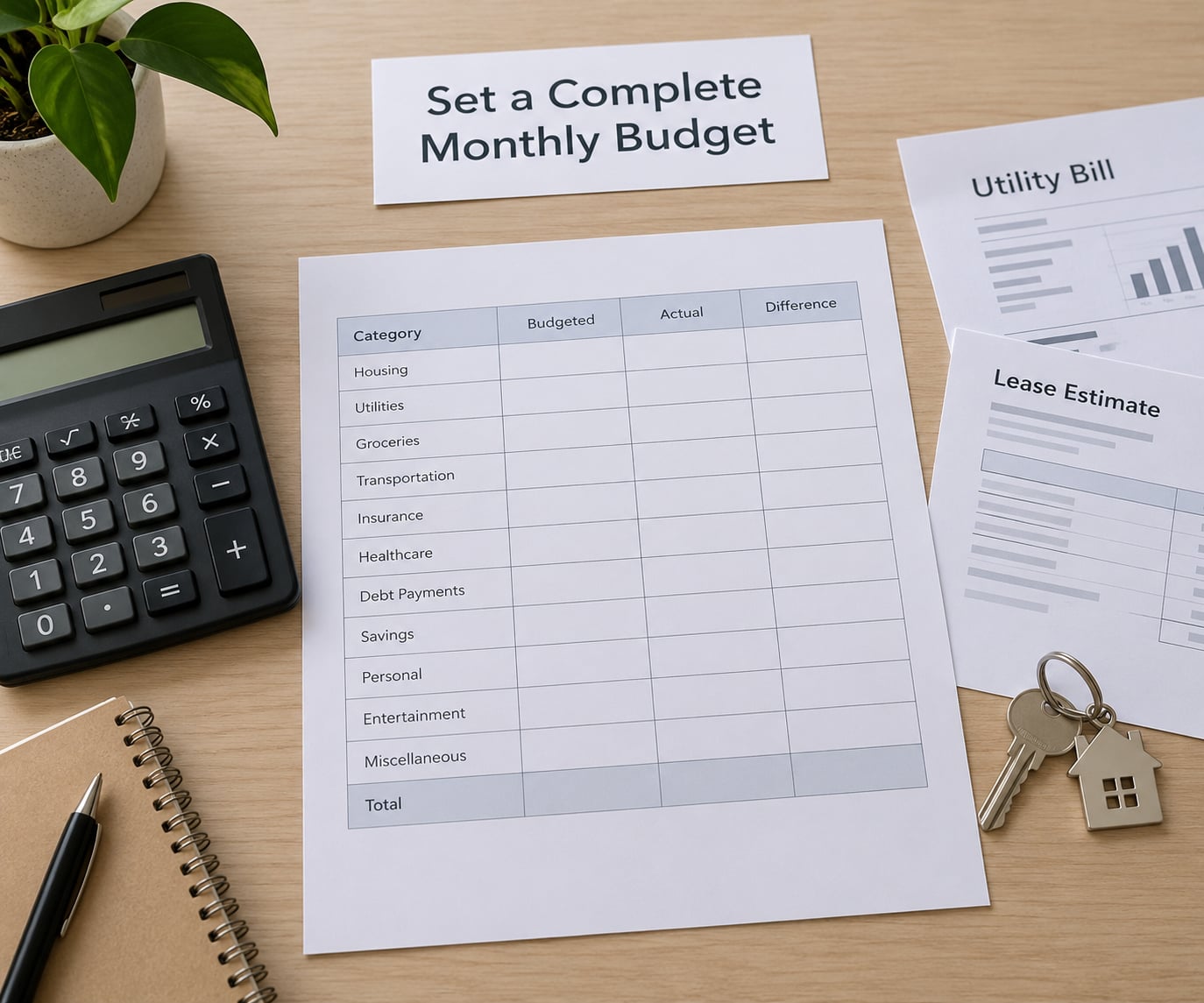
The single most expensive renter error is treating rent as the cost of the apartment. Rent is one line among eight or nine, and the others are where budgets quietly break.
Build the all-in monthly number: rent, electricity, gas, water and sewer, internet, renters insurance, parking, pet rent, amenity or service fees, and any required utility transfer or administration charges. Then add a realistic figure for how you actually live. Food, transport, phone, household supplies and a little slack for a repair that will not wait for payday.
Work the income math out loud rather than trusting a rule of thumb. At an hourly wage of 20 working full time, gross monthly income lands near 3,470. Rent of 1,000 is about 29 percent of gross, which looks comfortable on paper. Take-home pay after taxes, insurance, transport and retirement contributions is lower, so 1,000 becomes closer to a third or more of what actually reaches your account, before any utilities or fees. Most landlords and property managers screen against the gross figure, so a place can qualify you and still strain you.
The 50/30/20 rule is the other yardstick people mention: half for needs, 30 percent for wants, 20 percent for savings and debt. It is a good budgeting habit and a bad affordability test at the same time. For a renter earning a modest wage, needs can easily eat 70 percent of take-home pay, which leaves nothing for savings.
My rule: if the all-in total leaves no room for a slow month, the apartment is too expensive no matter how good the listing photos look. Have the honest conversation with yourself here rather than in month three.
2. Research the Landlord and Neighborhood
You are interviewing the landlord as much as the apartment. That idea comes up constantly in renter communities, and it is right, because the condition of a place tells you a great deal about how it will be maintained later.
Check property ownership through your county assessor or recorder search. The owner’s name on the record should match the name on the lease. If they do not, ask why once, plainly, and see whether the answer is reasonable.
Then look for unresolved complaints. Court records, landlord licensing boards where they exist, and local tenant association notes will sometimes turn up patterns involving the same property manager. A single old judgment means very little. Three filed complaints about the same unrepaired heating in two years means something.
Visit the building more than once, at a different time of day on a weekday and again at night. Note noise, hallway lighting, parking availability, how many people come and go, and what the transit actually looks like at the hour you will commute. Talk to a current resident if the door allows it. People are usually honest when you are polite about asking.
Scam signals are worth taking seriously, because rental fraud runs on urgency and stolen photos.
| Red flag | What it usually means | What to do |
|---|---|---|
| Rent far below the neighborhood | A copied listing or a bait price for a unit that does not exist | Compare with recent local listings; reverse image search the photos |
| Owner is out of the country and cannot show the place | The person does not control the property | Refuse to proceed until ownership is verified in county records |
| Pressure to sign or pay before touring | Wire fraud, or a fast pivot to a fake unit | Slow down. A real landlord can wait |
| Request for wire transfer, gift cards, or payment through an app | Once sent, the money is almost never recovered | Pay only through a traceable method after you have seen the place and signed a lease |
| Photos that appear on several different listings | The photos were stolen from another advertisement | Reverse image search before you visit |
| No written lease, or a lease with blank spaces | Terms can be filled in later against you | Refuse to sign anything incomplete, and insist on a document you can keep |
| Free viewing but no interior access | Nobody actually has access to a vacant home | Ask to see every room before discussing money |
One rule covers most of it: never send money to someone who has not shown you the apartment in person, and never pay before a signed lease exists. Walking away from a listing that will not allow that costs you nothing, because it was never real.
3. Read Every Fee and Lease Term
People lose money in the fees section because the amounts feel small when they are listed one after another. Twenty-five dollars here, forty there, a parking charge nobody mentioned. Add them up before deciding whether the rent works.
Working through how to avoid common renting mistakes means reading the fee section like a contract, because it is one. Get clear answers on the application fee and any separate screening or credit check charge. Ask whether the fee is refunded if you are declined, and whether it is per person or per household. Multiple adult applicants can multiply this quickly.
Then read the terms that shape your life for the next year. The rent increase clause tells you whether rent can move during the term and by how much. The renewal section tells you what happens if you want to stay or leave. The notice period tells you how much warning you owe, and it often interacts with rent increase notices.
Other clauses worth reading closely: which utilities are included in rent and which you must arrange yourself, whether parking is assigned or first-come, what counts as an unauthorized guest and how long they may stay, whether pets require written approval and additional deposit, what the rules are for wall hanging and paint, how entry with notice works, and who pays attorney fees in a dispute.
One last line to look for: whether the landlord charges a fee for late payment, and whether there is a grace period. Small, but it shapes a bad month more than most renters expect.
4. Ask Questions Before You Pay
A written question list is not fussiness. It is the difference between a confident decision and a memory of a conversation that ended six hours ago. It also helps if you are touring alone, or if touring makes it hard to think on your feet.
Ask about availability and the exact move-in process, including what has to be paid and when. Ask how maintenance requests work and how quickly someone will respond to a heating or plumbing problem. Ask which utilities are included, whether water is metered or shared, and what the building does about pests. Ask about parking, laundry, trash, pets, guest limits and quiet hours.
Ask about the building’s history: how often rent has gone up, how many units are currently vacant, and whether anything major was renovated recently. Ask what the application actually checks, what documents are required, and roughly how long decisions take.
Finally, ask what the landlord is willing to add to the lease. That last question turns a tour into a negotiation and gives you a natural opening on price, deposit, a longer term, or a small concession like a month free in exchange for a longer commitment.
5. Inspect and Document the Unit
This is the step where knowing how to avoid common renting mistakes turns directly into money back. The condition of the apartment on day one is the reference point for every argument about the deposit at the end.
Walk through with your list and your phone. Run every faucet and check water pressure in the kitchen, both bathrooms, and the shower. Test every outlet you can reach safely. Press the test button on each smoke and carbon monoxide detector and note the date. Check that windows open and lock, and that screens are intact. Run the appliances you are allowed to run. Look under sinks and along baseboards for damp, and around windows and bathroom ceilings for stains.
Turn on lights in closets, hallways and the balcony. Check whether the hallways are well lit. Open the cabinets and look at the inside of the walls. Look for pest evidence: droppings, gnaw marks, oily trails along baseboards. Look at the parking situation with your own eyes at the hour you will use it.
Photograph everything in good light. Wide shots for each room, then close-ups of every mark, scratch, dent, stain, chip, loose tile, and every existing hole in the wall. Take a continuous video walking slowly through the entire apartment with the date shown in the frame. Send the same set to the landlord or property manager in writing that day, and ask for confirmation that it was received.
Record the meter readings for electricity, gas, and water if they are individually metered. Note the condition of the smoke detectors, the filters if there are any, and whether the appliances are clean. Keep the written checklist that came with the keys, fill it in honestly, sign and date it, and get a copy.
Ten minutes of photographs costs nothing and settles arguments that otherwise turn into a he-said-she-said standoff months later, which is exactly the situation that appears over and over in renter forums.
6. Sign Only What You Understand
Promises made during a tour are not terms. If the landlord says the broken window will be replaced before move-in, if utilities are included, if the deposit is capped at one month, put it in writing as an addendum attached to the lease. Both of you sign it. Without that step, it is a memory that only you have.
Before signing, confirm you are holding the final version. Check for blank lines, missing dates, or initials missing from pages, and have anything ambiguous edited rather than initialed. Never sign a document with an empty space in it, because that space can be filled in later without your involvement.
Read what happens at the end of the term, not just the beginning. Look at early termination, subletting and assignment, attorney fees, and any clause that automatically adds fees as rent. Ask about anything you cannot parse in plain language. You are entitled to take the time; leases are not impulse buys.
Then keep a copy. Scan every signed page, save it somewhere that is not the landlord email account, and send yourself a note with the move-in date, the deposit amount, and the day each notice period ends.
7. Protect Your Deposit and Records
Build one folder and keep everything in it: the lease with all addenda, every receipt, the move-in report and photos, and every message about the apartment. Save messages as text or email rather than only as phone calls, since the record of what was promised and when is what makes a dispute winnable.
Keep a calendar with a reminder a month before any rent increase notice deadline, any non-renewal deadline, and the end of the lease term. Most lease terms run month to month after the initial term unless you renewed, and plenty of renters find that out a few weeks before a rent change they did not expect.
At move-out, do a final walkthrough with photos and a written list, send it in writing, and give the address you are returning the keys to. Then expect the deposit back within the deadline your state requires, with an itemized statement of any deductions. If the deadline has already passed in your state and no statement arrived, that is the first thing to escalate.
Common Renting Mistakes and What to Correct
These are the mistakes first-time renters regret most, with the specific correction for each. Reading through them before you sign is a cheap way to learn how to avoid common renting mistakes without learning them the expensive way.
- Budgeting on rent alone. Fix: write the all-in monthly cost, then compare it with your take-home pay rather than your gross income.
- Applying before the numbers work. Fix: decide your maximum all-in monthly figure before you tour, so you do not fall in love with something you cannot carry.
- Trusting a listing without verifying it. Fix: confirm ownership in county records, and never pay before seeing the place and signing a lease.
- Skipping the walkthrough because you want the place. Fix: tour anyway, and view at least twice. Excitement is not information.
- Not testing anything during the walkthrough. Fix: run the faucets, test the detectors, check the outlets, open the windows.
- Signing before reading. Fix: read the whole lease, including fees, notice periods, increases and entry, then sign a version with nothing blank.
- Believing a verbal promise. Fix: attach a signed addendum to the lease for anything the landlord said out loud.
- Moving in without documentation. Fix: dated photos, a walkthrough video, meter readings and a signed checklist, all delivered in writing that day.
- Leaving with no renters insurance. Fix: get a policy before you sign. Personal property coverage is cheap, and a stolen laptop is a real loss.
- Hiding a pet, a roommate or a job change. Fix: disclose everything on the application. Undisclosed occupants and pets are among the few things that justify denial or eviction on a first lease.
- Ignoring the rules after move-in. Fix: read the quiet hours, guest, parking and alteration clauses once, and put reminders in your calendar.
- Not knowing where to escalate. Fix: save your local tenant hotline and legal aid number before you need them.
What to Do When a Landlord Breaks the Rules
Prevention gets you most of the way, and it is where most advice stops. But some problems show up after move-in, and knowing the escalation ladder in advance changes how a bad month feels.
Send every complaint in writing, dated, and describe it as a request with a reasonable deadline. Keep the replies. A written trail does two things: it shows good faith, and it creates the evidence a housing court or an attorney needs later. Follow up on the same channel, so the history stays in one place.
Every state has a habitability standard that applies regardless of what the lease says, covering things like heat in winter, working plumbing, safe wiring, pest control, and sanitation. If a serious condition goes unrepaired after a documented request, most states let you take steps that range from paying for the repair and deducting it to filing with code enforcement, though the exact rules and the required notice periods differ widely by city and state.
Security deposit disputes have their own timelines. Many states require the landlord to return the deposit with an itemized statement within roughly two to three weeks of move-out. For entry without notice, look at your lease and your state rules, because permitted reasons and required notice periods vary widely.
When the direct conversation stops working, escalate in order: a written complaint to the property manager, a written complaint to the actual owner, your local tenant hotline or code enforcement, a legal aid office, and then housing court. Retaliation for raising a repair or discrimination complaint is illegal in every state, so keep documenting anything that happens shortly after you speak up.
Nothing here is legal advice for your specific situation, and the details really do change at the city and state level. A twenty-minute call to legal aid before you send an angry letter is often worth more than the letter.
Frequently Asked Questions
What is the 50/30/20 rule for rent?
The 50/30/20 rule splits take-home income into 50 percent for needs, 30 percent for wants, and 20 percent for savings and debt payments. Rent is usually counted as a need. It works well as a general budgeting habit, but it is a blunt tool for renters, because needs such as rent, utilities, transport and insurance can exceed 50 percent on a modest wage, leaving nothing to save.
What will disqualify me from renting an apartment?
The usual disqualifiers are an eviction history, unpaid judgments owed to that landlord, an application that does not meet the stated income or credit threshold, and falsifying the application. Undisclosed pets, roommates or other occupants are also common reasons for denial, because they can breach the lease. Some buildings also enforce screening criteria that a specific building may apply.
How do I know if a rental listing is a scam?
The reliable check is simple: verify the property in your county assessor records, see the apartment in person, and never send money before a signed lease exists. Warning signs include asking for wire transfers or gift cards, a price far below the neighborhood, photos that appear on many listings, an owner who cannot show the unit, and pressure to pay quickly.
Can I negotiate the rent on a listed apartment?
Sometimes. Listed rent is an asking price, and landlords usually hold some room, particularly on a slower month or when a home sits vacant longer than expected. A longer lease, a larger upfront payment, or a modest concession can all be traded for a lower monthly figure. Make your offer by email, keep it specific, and be ready to walk away.
How expensive is it to break a lease early?
It depends entirely on the lease and your state. Common costs include remaining rent charged as damages, an early termination fee, and lost rent until a replacement tenant is found. Some clauses require a notice period or limit subletting. A few situations allow a lawful break regardless of the lease, including military service under the federal protections, and some states add protection for domestic violence and disability.
How do I get my security deposit back?
Start with your move-in documentation: dated photos, a walkthrough video, and a written checklist delivered to the landlord on day one. At move-out, repeat the record and return keys in writing to a named address. Many states require return of the deposit with an itemized statement within a set window, so check your state deadline before assuming the money is simply gone.
Conclusion
Five things to do, in order, before you sign anything. Write down your real all-in monthly budget and compare it with your take-home pay, not your gross income. Verify the property and the landlord, and pay nothing before you have seen the place and signed a lease. Read every fee and term in the lease, and get verbal promises attached in writing.
Then photograph and document the unit on day one, and keep every receipt, message and record in one place for the length of the tenancy. That is the whole practice. Knowing how to avoid common renting mistakes is not about finding a perfect apartment, it is about never being the person without evidence.