Tenants have the right to live in housing that is safe, sanitary and fit to live in, and a landlord who ignores a repair request after reasonable notice can be held responsible in court. The short version of what are tenant rights when a landlord ignores repairs is a documented, deadline-based sequence, and the details depend on your state, your city and your lease: document the problem, give written notice, wait out the legal deadline, then use a remedy.
This guide walks through that sequence. It covers which problems count as repair issues, how to build a written record, how much notice your landlord actually needs, and what you can do when the deadline passes without a fix.
One thing to flag early. State law sets the floor here, and local ordinances sometimes set a higher one. This is general information, not legal advice about your specific situation.
Table of Contents
- What Are Tenant Rights When a Landlord Ignores Repairs?
- What Counts as a Repair Issue?
- How Do You Document the Problem and Make a Repair Request?
- How Much Notice Must a Landlord Receive?
- What Can You Do After the Landlord Misses the Deadline?
- Can You Withhold Rent or Make the Repairs Yourself?
- What Evidence Helps in a Housing Dispute?
- How Do Housing Codes and Local Ordinance Affect Your Rights?
- What Should You Do First?
- Frequently Asked Questions
- Can I sue my landlord for not fixing a repair problem?
- How long can a landlord take to make a repair?
- What if the landlord says the repair is an emergency but does nothing?
- Can a landlord retaliate after I request a repair?
- Should I call the police if there is no heat, a gas smell, or an electrical hazard?
- What if I cannot afford to keep paying rent while repairs are delayed?
- Where To Start If You Are Dealing With This Now
What Are Tenant Rights When a Landlord Ignores Repairs?
Your core right is the implied warranty of habitability, a legal standard that applies to nearly every residential lease whether or not the lease mentions it. It requires the unit to be fit for human habitation, which in practice covers working heat, hot water, plumbing, electrical safety, pest control, sanitation and structural soundness.
On top of that standard, most states give tenants a second layer: the right to notice and a chance to fix. Your landlord generally has to be told about the problem in writing and given a reasonable window to act before you can escalate.
From that starting point, tenants typically have five options, and they are the ones to use in order:
- Deliver a written repair request and keep a copy.
- Send a second, more formal notice after the first goes unanswered.
- File a complaint with the local housing code or code enforcement office.
- Take a tenant remedy such as rent withholding or repair and deduct, where your state permits it.
- File a claim in court, break the lease, or both.
Most tenants never need step five. A dated letter and a code complaint solve the majority of ignored-repair situations, because a landlord with an open code violation on file is a landlord who suddenly finds contractors available.
What Counts as a Repair Issue?
The short answer is that a repair issue is any defect that affects your health, safety or ability to use the home normally. Courts look at severity, not whether the problem annoys you.
Problems that most commonly qualify include:
- No heat in winter, or a furnace that fails and stays failed
- Loss of hot water or a failed water heater
- Plumbing leaks, backups and sewage overflows
- Electrical hazards, including exposed wiring and dead outlets
- Broken locks, windows or doors that do not secure
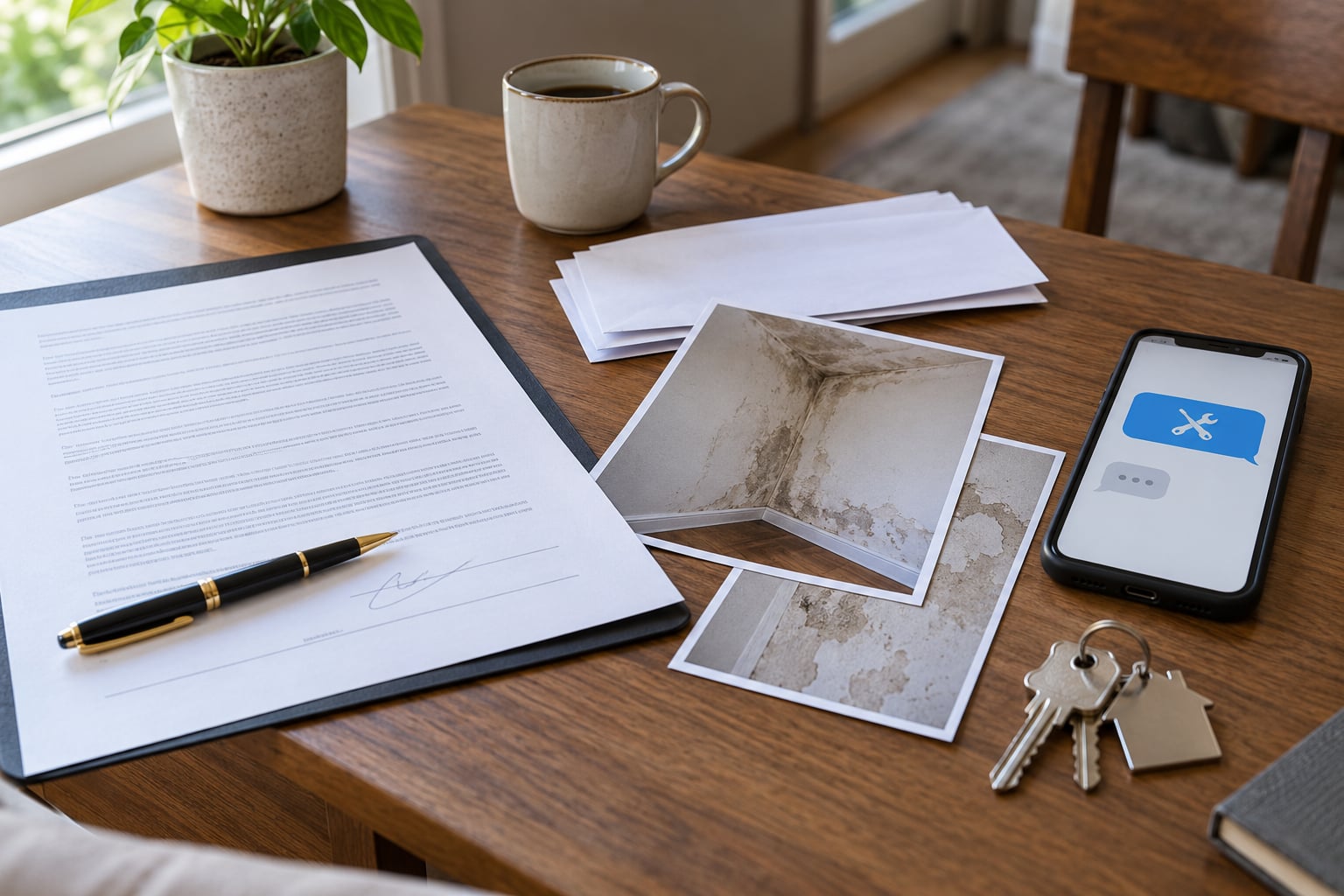
- Mold and moisture damage from an unrepaired leak
- Infestations of rodents, insects or bed bugs
- Sanitation problems, including non-working toilets and sewage
- Smoke or carbon monoxide detector failures
- Structural concerns such as unsafe ceilings, balconies or railings
- Failed appliances the landlord supplied, including the refrigerator, oven, washer and dryer
- Unsafe common areas, including broken lighting, elevators and stair rails
Urgency changes the timeline, not the classification. An emergency is anything that puts people or the building at immediate risk: a gas smell, a sparking outlet, a sewage backup, a carbon monoxide alarm going off, an active ceiling collapse, a burst pipe.
Routine maintenance sits in a different bucket. A running toilet, a slow drain, a sticky window or cosmetic scuffing usually sits under normal maintenance duties, and ordinary wear and tear on things like faded paint or worn carpet is generally the tenant’s responsibility.
One common source of confusion is the ticket that gets closed without work. Renters describe landlords and property managers marking a maintenance request as resolved when nothing was actually repaired, or canceling requests outright. If that is what happened to you, treat the closed ticket as proof you asked and got nowhere, and reopen it in writing.
Amenities are fuzzier. Removal of a shared feature such as a gated parking area, laundry room or on-site gym is not always a habitability violation on its own, though it can matter if the amenity was part of what you were promised in writing, if it affects health or safety, or if the loss makes the unit uninhabitable under local rules.
How Do You Document the Problem and Make a Repair Request?
Documentation is the part people skip and then wish they had done. Build the record first, while the problem is visible, because a photo with no date and no context is nearly worthless later.
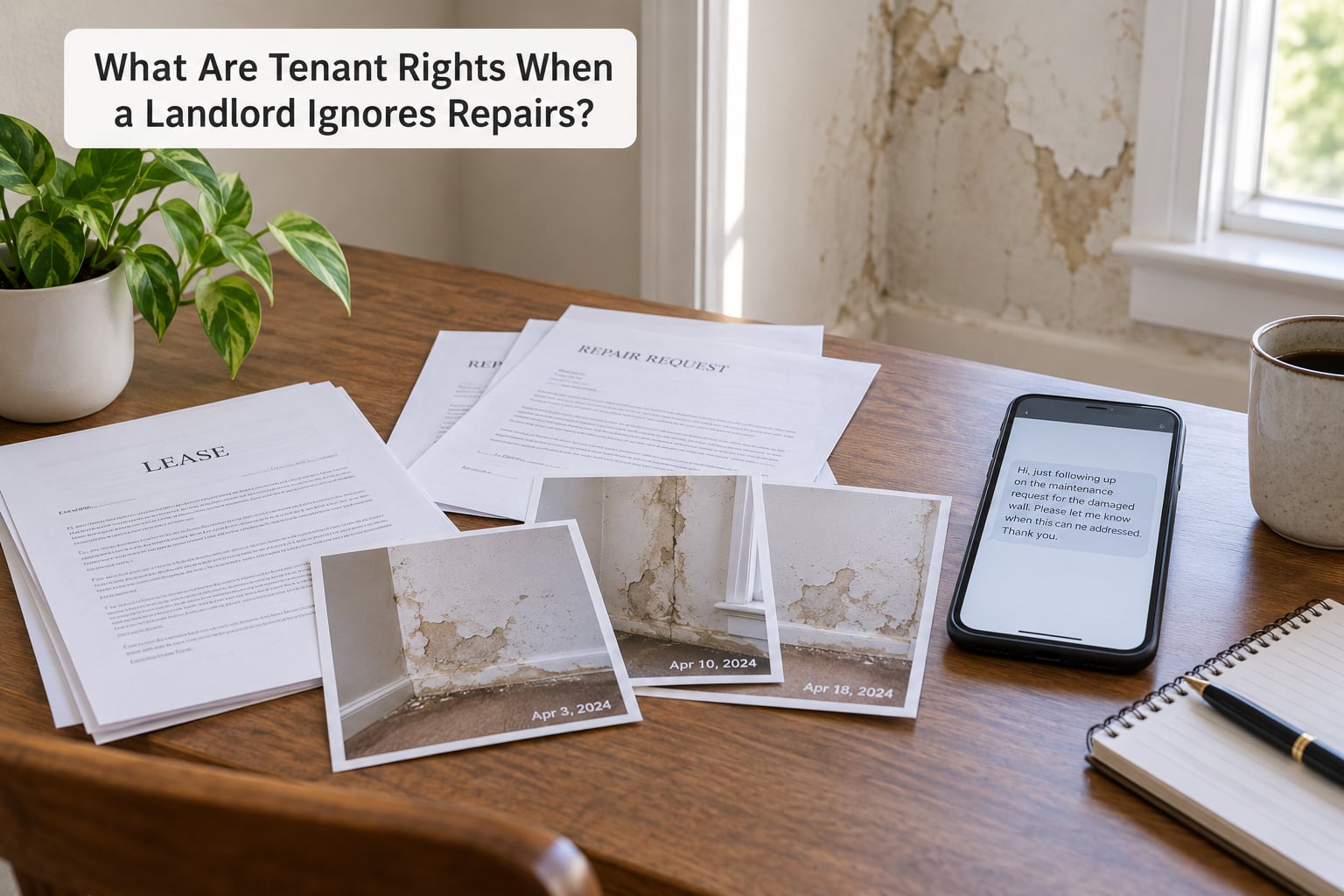
- Create a dated log. A one-page chronology with dates, what you noticed, who you told and what happened next. Even a notebook works if you keep it.
- Describe the issue precisely. “Kitchen faucet drips continuously and the cabinet floor underneath is swollen” beats “leak in kitchen.” Specifics get repaired; vague complaints get ignored.
- Photograph and video safely. Wide shot for context, close shot for detail. Include something with a date in frame, like a dated bill or your phone’s date setting.
- Note the affected area. Which room, which unit, whether it spreads to neighbors or common areas.
- Send a written request. Use the portal, email, text, letter or whatever channel your lease gives you, and keep the submission confirmation or a screenshot.
- Follow up in writing. If nothing happens in a few days, send a second note that references the date and ticket number of the first.
Write the request so it is easy for someone else to act on: the problem, the location, the date you first noticed it, the effect on the unit, and a plain request to fix it by a date you name. Avoid accusations. Neutral, factual language is more useful to you later if a landlord ever claims you were hostile.
Save everything in one folder and keep the originals. Screenshots of portals, headers on emails, and delivery confirmation for anything you mailed or hand-delivered all matter, because the question in a dispute is usually not whether you complained but whether you can prove when.
How Much Notice Must a Landlord Receive?
There is no single national deadline. Your lease may state one, your state statute sets a default, and a local ordinance can be stricter than both. Check all three before you assume you are on a clock.
Notice generally comes in three forms:
Emergency notice. For gas leaks, electrical hazards, flooding, sewage, fire damage and carbon monoxide, the duty to respond is immediate. Many states give landlords a window measured in hours, commonly one to three days, and some require repair before the tenant is allowed back in.
Ordinary repair request. For habitability problems that are not emergencies, states commonly allow anywhere from a few days to about 30. Serious conditions like a failed furnace in winter or a loss of hot water often sit at the shorter end of that range.
Formal notice. This is a second-stage document that tells the landlord you consider the request ignored, names the deadline that has passed, and states the remedy you intend to use. Some states require a specific form, a specific delivery method, or a waiting period between the two notices.
Delivery method matters more than people expect. Several states limit repair-and-deduct or rent-withholding rights to tenants who sent the notice by a traceable method such as certified mail or a documented electronic channel. A verbal request or a phone call to a property manager usually does not satisfy that requirement.
After you send the second notice, set your own calendar date based on the statutory deadline plus a small buffer. Courts tend to count from the date of delivery, not the date you wrote it.
What Can You Do After the Landlord Misses the Deadline?
Once the deadline passes without a fix, escalate in order and keep the paper trail at every step. Rushing straight to the strongest remedy usually costs you more protection than it gains.
- Send a final written notice. Reference the original request, the deadline, and the specific remedy you will use next, including rent withholding or repair and deduct where your state allows it.
- Contact a tenant rights organization. Legal aid societies and local tenant hotlines will read your notice, tell you whether your state’s requirements are met, and often send their own letter, which carries more weight than yours.
- File a code complaint. Local building, housing or sanitation departments inspect for violations and can cite the landlord or issue a correction order.
- Organize with other tenants. Building-wide problems get resolved faster when they are raised as a pattern rather than one tenant at a time.
- Send a demand letter from an attorney. Even a short letter on a law office’s letterhead often ends the stalemate.
- File in court. Small claims, housing court, or a civil complaint for damages, rent abatement, attorney fees and in some places a temporary restraining order or a receiver to oversee repairs.
Several tenants also negotiate directly once they have leverage in hand. An offer to release everything else in exchange for the repair by a specific date, documented in writing, is a reasonable option and much faster than court.
Keep paying rent until you have a solid basis for withholding, and keep paying even after you start withholding, in a separate account, if your state allows it. Courts in several states view the rent as still owed, held in escrow, and asking for its return.
Can You Withhold Rent or Make the Repairs Yourself?
Sometimes yes, but only under specific conditions that vary a great deal by state. Rent withholding and repair and deduct are statutory remedies with prerequisites, and a tenant who misses a prerequisite can end up in eviction court with no defense left.
Rent withholding usually requires that the condition be a serious habitability violation, that you gave proper written notice, that the landlord had a reasonable chance to fix it, and in many states that the rent is not simply unpaid. Common requirements include keeping the money in a separate escrow account, continuing to offer the landlord a chance to cure, and notifying the landlord in writing where the money is being held.
Repair and deduct usually requires notice first, a real landlord refusal or a missed deadline, and that the repair be necessary and reasonable. States set a cap, and the caps differ sharply: some limit you to one month’s rent per repair, others set an annual ceiling across several repairs. Massachusetts, for example, caps deductions at four months’ rent over a twelve-month period. California allows up to one month’s rent for repair and deduct and permits withholding in cases of egregious conditions under a separate statutory process.
Only deduct costs you can prove. Get two or three written estimates, keep every receipt, photograph the finished work, and never deduct for upgrades or repairs that improve the unit rather than restore it.
Self-repair carries real risk. Do not open electrical panels, gas lines, water lines behind walls or anything structural yourself. Hire a licensed contractor and keep the invoice in your name with the property address on it.
Before you act, confirm three things in writing: the state statute, any lease terms, and what your local legal aid organization says about the procedure. A fifteen-minute call with a tenant hotline costs nothing and prevents the most common mistake in this entire area, which is acting without the paperwork your state requires.
What Evidence Helps in a Housing Dispute?
Evidence decides cases. Build the file so a stranger could follow the story without asking you a single question.
- Your lease and any addenda or move-in condition report
- Every repair request, with delivery proof and dates
- Emails, texts and portal messages, with headers or screenshots showing timestamps
- Dated photographs and videos, plus the original files with metadata intact
- Inspection or code enforcement reports and citations
- Repair invoices, estimates and receipts if you paid for anything
- Utility bills showing abnormal usage, such as a spike in water use during a leak
- Medical records or pharmacy receipts where an illness is tied to the condition, such as a child with asthma in a moldy unit
- Witness statements from neighbors who saw the same conditions
- A one-page timeline of every event, from first notice to today
Organize it chronologically and keep a printed copy as well as a digital one. Email in particular is fragile: accounts get closed, platforms get migrated, and phones get lost. Export messages to PDF, back them up somewhere outside your own device, and stop deleting anything once a dispute starts.
Build the timeline last so it reflects what the other documents actually show, not what you remember. Where memory and paper disagree, paper wins in front of a judge.
How Do Housing Codes and Local Ordinance Affect Your Rights?
Housing codes give your landlord a written standard to meet, and they give you an outside party who can enforce it. State building and sanitation codes set baseline requirements, and cities and counties often add local ordinances on heat, rodents, ventilation, lead paint, bedding, garbage and lighting.
Most code enforcement offices work on complaint. You submit a report, an inspector visits, and if the inspector finds a violation, the landlord gets a citation and a deadline to correct it. Citations are public record in many jurisdictions, which changes how a landlord treats the rest of the building afterward.
A code violation does not fix your unit on its own, and it does not resolve a dispute over every repair. What it does is create an independent, official record that the condition was serious, which supports a rent abatement claim, a constructive eviction argument, or a damages case.
Know the risk before you file. A serious complaint can lead to condemnation or a citation that makes the property harder to rent or refinance. In some buildings, tenants have reported losing housing as a result of an enforcement action that made the property uninhabitable or moved the owner to sell. If you are in that situation, talk to a tenant organization about how the building is likely to be classified and what happens to tenants in a condemnation before you file.
For subsidized housing, the complaint path is different. Public housing authorities and agencies administering housing vouchers usually have their own inspection process with faster timelines and remedies that include rent recalculation and rehousing. If your rent depends on a voucher or a housing authority, contact the agency’s own maintenance line first.
You may also be able to reach the landlord through a licensing board, a consumer protection agency, or an ombudsman for aging or disability tenants. Which one exists depends on where you live.
What Should You Do First?
If you have read nothing else, work through this list in order.
- Make it safe. For gas smells, electrical hazards, active flooding or sewage, leave the area and call emergency services or the utility before anything else.
- Read your lease. Find the maintenance clause, any notice requirement, and the name and address of whoever handles repairs.
- Check your local rules. Your city or county housing department website usually publishes habitability requirements and code complaint procedures.
- Document the condition today. Dated photos, a short written description, and a one-page timeline.
- Send a clear written request. Name the problem, the location, and a date by which you would like it fixed. Use a traceable method.
- Keep copies of everything and set a calendar reminder for a follow-up.
- If nothing happens, send a second notice that references the first, names the missed deadline, and states the remedy you will use.
- Contact a tenant rights organization or legal aid office before withholding rent or hiring anyone, and let them check your notice before you use it.
- File a code complaint if the condition is serious and your legal aid contact thinks it is safe to do where you live.
Most people only need the first five items. The rest is there for when those fail.
Frequently Asked Questions
Can I sue my landlord for not fixing a repair problem?
Yes, in most states, but the claim depends on how you proceeded. Courts generally want to see that the condition violated the habitability standard, that you gave proper written notice, that the landlord had a reasonable chance to fix it, and that you did not cause the damage yourself. Common claims include back rent or rent abatement, damages for moving costs and lost belongings, attorney fees where the statute allows, and damages for a breach of the quiet enjoyment of your home. A tenant organization can review your paper trail before you file.
How long can a landlord take to make a repair?
It depends on the type of problem and your state. Emergencies such as gas leaks, electrical hazards, sewage backups and active flooding usually trigger a duty to act within hours to a few days. Serious habitability problems like a failed furnace or loss of hot water often get a window of several days to roughly two weeks. Ordinary maintenance can take up to about 30 days in many states, and cosmetic work longer. Check your lease and your state statute, because a local ordinance can set a shorter deadline than either.
What if the landlord says the repair is an emergency but does nothing?
If your landlord labels the issue an emergency, that usually raises the urgency rather than lowering it, and you can point to the classification they used. Put it in writing: state that you agree the issue is an emergency, note the date of your first notice, and ask for a response within the emergency timeframe your state sets. Keep sending messages, keep photographing the condition, and if your safety is genuinely at risk, treat the emergency as the emergency it is and contact emergency services or the utility rather than continuing to wait for a text reply.
Can a landlord retaliate after I request a repair?
Most states protect tenants who complain about conditions, join a tenant group, contact code enforcement or exercise a remedy like withholding rent, so long as the tenant acted in good faith and the landlord’s action is close in time to the complaint. Protected conduct typically includes eviction, raising rent, reducing services, or removing an amenity in response to your complaint. Retaliation is usually proven by timing and proximity. Keep a dated timeline of your complaint and any change in how you are treated, and take it to a tenant lawyer or legal aid office if that pattern shows up.
Should I call the police if there is no heat, a gas smell, or an electrical hazard?
It depends on the situation, and safety comes first. For a gas smell, leave the building, call the gas utility emergency line or 911 from outside, and do not use switches, flames or elevators inside. For an electrical hazard such as sparks, burning smells or a hot outlet, cut power only if it is safe to reach the breaker, and call the fire department or an emergency electrician. For a lack of heat, police are usually not the right contact: the better path is your landlord or property manager in writing, your local code enforcement office, and a legal aid organization that can act faster. Police can help with safety and certain code violations, but they rarely resolve repair disputes.
What if I cannot afford to keep paying rent while repairs are delayed?
Talk to a tenant legal aid organization as soon as the repairs stall, because they can tell you whether withholding rent is available in your state and exactly what paperwork it requires. Many jurisdictions let you place withheld rent in a separate account rather than simply not paying, and some let you deduct repair costs instead, which offsets what you owe rather than creating a new debt. While you decide, keep paying on time and keep every receipt, because an unexplained gap in rent is what turns a habitability dispute into an eviction case in most courts.
Where To Start If You Are Dealing With This Now
The single most useful thing you can do in the first week is get a written record in place. Most ignored-repair disputes are decided by whether the tenant can show they asked clearly, in a traceable way, and gave the landlord a fair chance to respond.
Then find out what your state requires before you use any remedy. Rent withholding, repair and deduct and breaking a lease all carry conditions, and a legal aid office or tenant hotline will walk you through them in a single conversation at no cost.
Knowing what are tenant rights when a landlord ignores repairs is the easy half. The other half is documentation, patience and a local rulebook you have actually read.