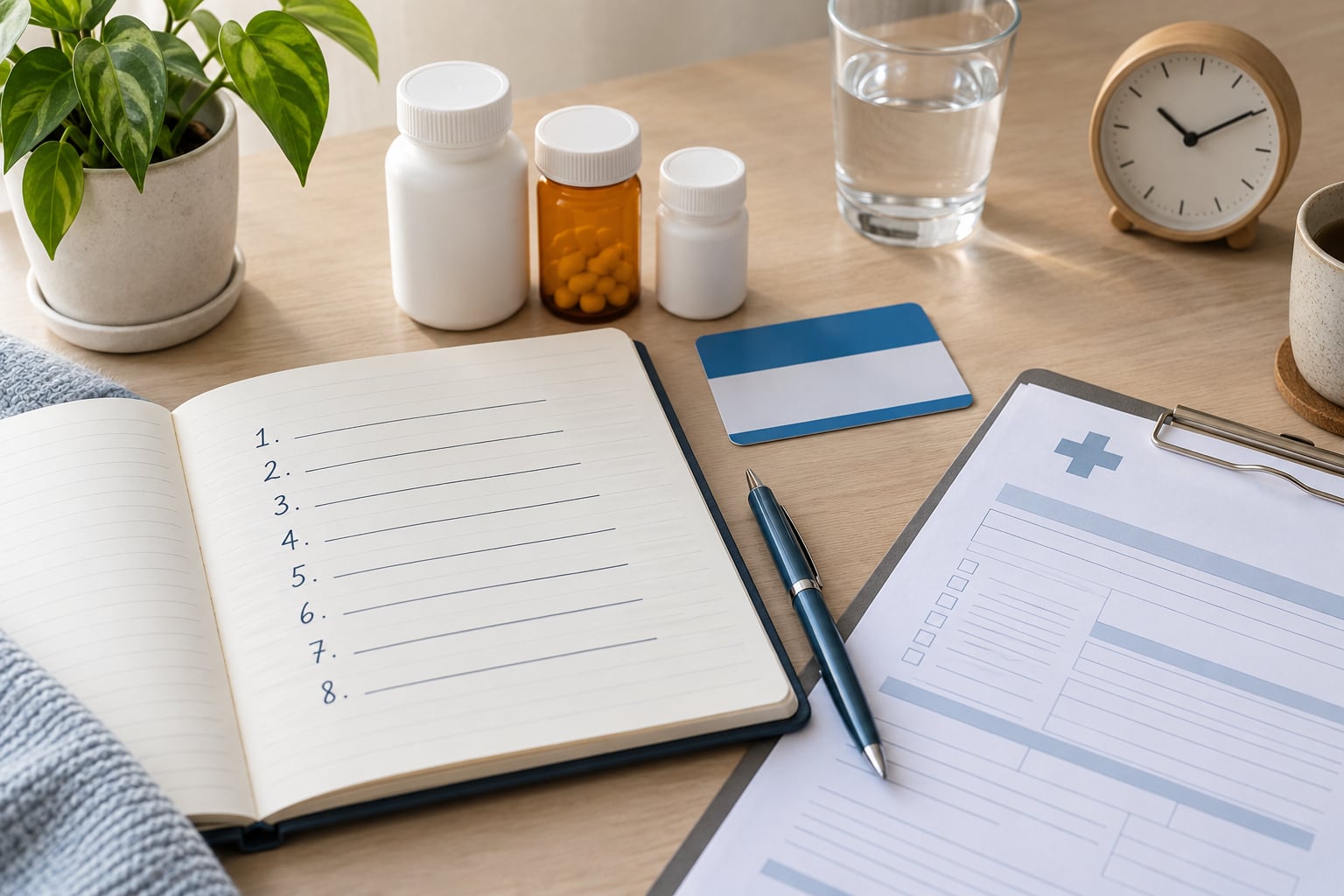
How to prepare for a doctor appointment and remember questions comes down to writing instead of remembering. Put your main concern in one sentence, track your symptoms on a timeline with dates, list every medication and supplement with doses, and turn each worry into a numbered question you hand over at the start of the visit. Ten focused minutes the night before is usually enough.
That matters more than it sounds. A routine primary care visit is often ten to twenty minutes, and the topics that get discussed are largely the ones that come up first. If your blood pressure question only surfaces in the parking lot, the visit is over before it starts. Writing your questions down fixes that, and it takes less time than most people expect.
This guide is about preparation only. It is not medical advice, and it does not replace anything your clinician tells you. Decisions about symptoms, doses, tests, and treatment belong with a doctor, nurse practitioner, or pharmacist who knows your history.
If you are looking for related reading, our Health And Well-Being and Community Voices sections cover the care experience more broadly.
Table of Contents
- What You Need
- Step-by-Step: How to Prepare for a Doctor Appointment and Remember Questions</
- Write Down Your Main Concern
- Create a Symptom Timeline
- Make a Medication and Health History List
- Prepare Questions in Priority Order
- Plan What to Bring and How to Take Notes
- Review the Plan Before You Leave
- Common Mistakes
- Preparing for a Doctor Appointment by Relying on Memory
- Saving Every Question for the End of the Visit
- Listing Only Your Prescriptions
- Skipping Insurance and Referral Details
- Leaving Without a Written Plan
- Waiting on a Scheduled Appointment With a Red-Flag Symptom
- Helpful Tips for Remembering Your Questions
- Frequently Asked Questions
- What should I do to prepare for a doctor’s appointment?
- What not to do before a doctor’s appointment?
- What are the 5 phrases that will get your doctor’s attention?
- Can I record my doctor’s appointment?
- How do I list my medications for the doctor?
- What if I forget a question during the visit?
- Conclusion
What You Need
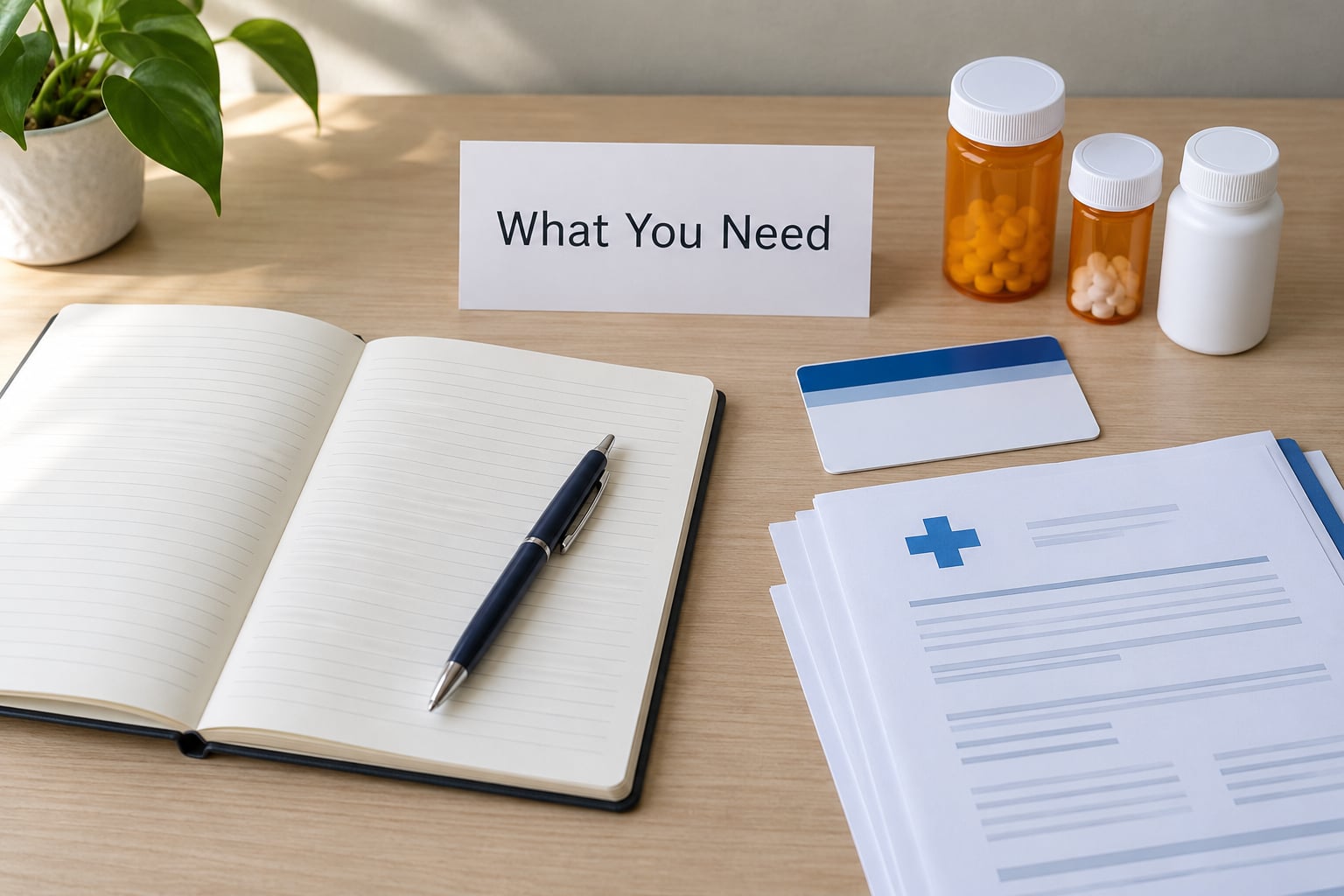
Preparation is mostly paperwork, and almost all of it can live in one place: a single notebook, a phone note, or a printed sheet you keep together. Gather these six things before you start writing questions.
- A symptom timeline. Dates, frequency, severity, and what makes it better or worse. A running log is easier than a memory, and it stops you describing a month of symptoms in two sentences.
- A medication and supplement list. Name, dose, how often, and why you take it, including over-the-counter medicines and vitamins. Interactions between common items get missed when the list is incomplete.
- Relevant medical records. Recent lab results, imaging reports, discharge paperwork, and notes from other clinicians. If you saw someone else about the same problem, those records often decide whether a repeat test gets ordered.
- Insurance and contact information. Your card, your pharmacy’s phone number, and your primary doctor’s office number. Referrals and prior authorization often stall without them.
- A written question list. Numbered, in your own words, ordered by how much the answer matters to you.
- A notebook or phone note for during the visit. This is separate from the question list. One is what you plan to ask; the other is what you need to walk out with.
You do not need all six to be complete. A symptom timeline and a question list will do most of the work on their own.
Step-by-Step: How to Prepare for a Doctor Appointment and Remember Questions</
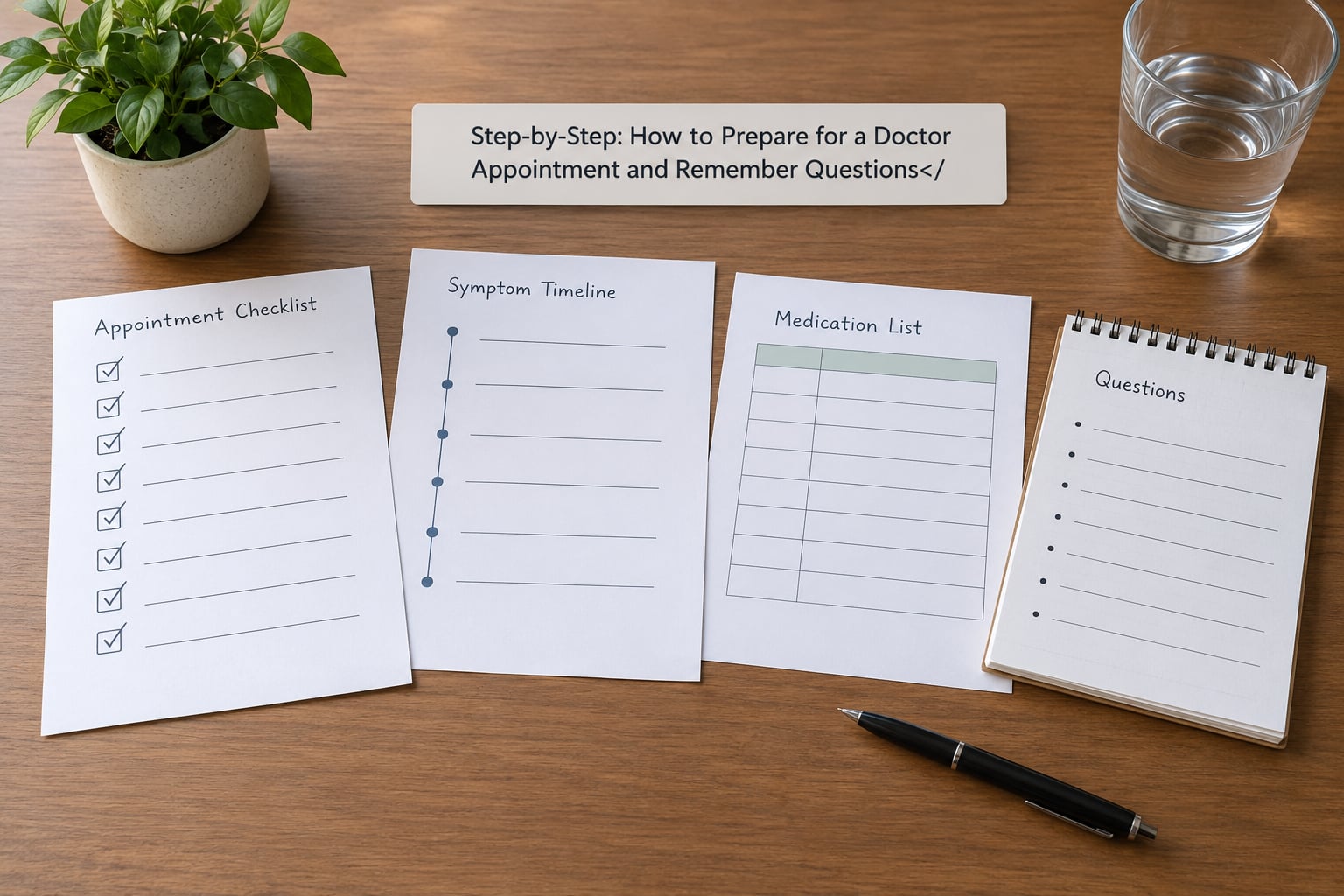
Work through these six steps in order. The order is deliberate: each one feeds the next, and doing them out of sequence is what leads to a visit that gets cut short.
Write Down Your Main Concern
Most people arrive with nine things they want to discuss. Pick one to lead with and put it in plain language: I have had a dull headache most afternoons for three weeks, worse when I bend forward, not something’s wrong with my head. Plain sentences give your clinician something specific to work with.
Then mark your second and third priority. When the clock runs down, having a ranked list means the things that matter most to you are the things that get discussed.
How do you pick the first one? Rank by urgency first, then by how much it is affecting your daily life, then by how long it has been sitting there unaddressed. A minor complaint you have had for two years usually should not outrank a symptom that is new and changing.
Create a Symptom Timeline
A timeline beats a narrative because it survives interruption. For each symptom, capture six things:
- What the symptom feels like, in your own words.
- Where in the body it shows up.
- When it started, and whether the start was sudden or gradual.
- How often it happens, and whether that frequency is changing.
- How severe it gets at its worst, and what it stops you doing.
- What changes it — what helps, what makes it worse, what you were doing at the time.
Dates are the part people leave out. “A few months ago” is hard to work with; a start date of March 14 lets your clinician line the symptom up against what else was happening then, including a medication change or a new job.
Bring any change you noticed recently: a new prescription, a new supplement, a change in sleep, a move, a new job, or a death in the family. Those details sit in a different part of the history and sometimes explain more than the symptom itself.
Make a Medication and Health History List
Write down every prescription, over-the-counter medicine, supplement, and vitamin you take, including the ones you take occasionally. People leave things off this list because they assume they are not important, and then a decision gets made without that information.
Add your allergies and reactions, past surgeries and hospital stays, current diagnoses, and the family history you actually know: what your parents and grandparents were treated for, and anything that runs in your family. “Both parents had cancer in their fifties” is more useful than a vague note.
Use this format so nothing gets left blank:
| Medication | Dose | How often | Why you take it |
|---|---|---|---|
| Example: one prescription name | Written from the label | Once daily, morning | For blood pressure |
| Example: one over-the-counter name | As labeled | As needed | For occasional pain |
| Example: one supplement | As labeled | Once daily | For vitamin D |
The “why you take it” column is the one people skip and the one that catches my attention. It tells your clinician whether a medicine is still needed, and it catches duplicates, where two products quietly contain the same active ingredient.
Prepare Questions in Priority Order
Write your questions down before the visit, in the order you want them answered. Number them. A numbered list protects your time, because it turns a vague worry into something concrete you can point at.
Three parts make a question easier to answer and easier for you to remember:
- What you want to know. “Is this worth testing for?”
- Why you are asking. “My sister had it in her forties and I want a baseline.”
- What you will do with the answer. “If it is high, I want to change what I eat first.”
Group the questions by topic so the visit runs in order: symptoms, then medications, then test results, then referrals and insurance. Mark the two or three you most need answered so you can say at the end of the visit, “I still have two questions.”
Some questions are worth asking about any treatment decision, whatever it is: what are the benefits, what are the risks, what are the alternatives, and what happens if I do nothing for now. Four questions, and they work for a prescription, a referral, or a screening test.
If a question shows up while you are doing dishes rather than at your desk, capture it right there. A voice memo or a phone note the moment you think of it is worth more than trying to reconstruct the thought a week later.
Plan What to Bring and How to Take Notes
Put the practical items in one bag the night before: photo ID, insurance card, your question list, the medication and supplement list, recent lab results or imaging reports, referral paperwork if another clinician sent you, and a pen.
Decide in advance how you will take notes. Paper and a pen are the simplest and most reliable. A phone note works if you can type fast without missing what is being said. Recording is often allowed, but always ask first, and start by asking whether recording is fine with them rather than just pressing the button.
Ask for a printed or portal copy of the treatment plan before you leave. A summary you can read later beats your own shorthand from a fast conversation.
A support person helps in a specific way: they catch what you miss. Brief them beforehand with your two or three priorities and ask them to write down anything unfamiliar. Tell them plainly what you want them to do, because a supportive person with no instructions often takes over the conversation.
If you would rather have the conversation in another language, request an interpreter when you book, not when you arrive. Most clinics can arrange a qualified interpreter, and family members, especially children, are not the right substitute for medical questions.
For telehealth, the same preparation applies plus a few extras: test your camera and microphone the day before, have the medication bottles in your hand so you can hold them up, and write down your pharmacy and address so you can dictate it.
Review the Plan Before You Leave
The last two minutes of a visit are the most useful and the most commonly wasted. Before you stand up, ask:
- What is the diagnosis or the working explanation right now?
- What are we doing about it, and how will we know whether it is working?
- What are the benefits and risks of that plan, and are there alternatives?
- Which medications should I keep taking, which should I stop, and can I stop any of them myself?
- What should make me call sooner rather than waiting for the next visit?
- When and how do we get the results, and who do I call if nothing comes back?
Repeat the plan back in your own words before you leave. It catches misunderstandings while the clinician is still in the room, and it takes fifteen seconds. If something was said too fast to catch, say so: I want to make sure I have that right, can you say it a different way? Most clinicians would rather repeat it than have you mishear it.
Book the follow-up before you leave the building, even if it is months out. Backfilling that date three months later is how things quietly fall through the cracks.
Common Mistakes
Each of these is easy to fix and shows up constantly.
Preparing for a Doctor Appointment by Relying on Memory
Spoken questions evaporate under pressure, and you usually remember the thing you meant to ask in the car afterward. Fix: keep one running note on your phone and add to it the week of the appointment. Nothing to organize, nothing to lose.
Saving Every Question for the End of the Visit
Holding everything back means you hand over the whole list with five minutes left. Fix: say the top item as your first sentence and hand over the numbered list. Then ask for the last two minutes to go through what is left.
Listing Only Your Prescriptions
The over-the-counter painkillers, the allergy tablets, the new supplement, the occasional antacid. Those add up, and interactions get missed when the list is partial. Fix: photograph each label and keep the photos, so a bottle you cannot find does not become a blank on the form.
Skipping Insurance and Referral Details
A missing authorization turns a completed visit into a billing problem that follows you for months. Fix: carry the card, and confirm before you leave whether the visit needs a referral or prior authorization on file.
Leaving Without a Written Plan
You will not remember the dosage change, the date, or which test is still pending. Fix: ask for the plan in writing through the patient portal, and put the follow-up in your calendar before you drive home.
Waiting on a Scheduled Appointment With a Red-Flag Symptom
Preparation is not the right tool for an emergency. Symptoms such as chest pain, trouble breathing, sudden weakness or numbness on one side, trouble speaking, heavy bleeding that will not stop, or thoughts of harming yourself need a call to emergency services or urgent care now, not a note to bring to your next appointment.
Helpful Tips for Remembering Your Questions
A few habits consistently help people get their questions answered, especially when the visit feels rushed or the room feels intimidating.
Number your list and mark your top three. Ask permission at the start to say all of your questions before you begin, something like: I have five things I would like to go through, is that okay? Most clinicians welcome the structure because it speeds the visit up.
If you are interrupted, wait for the pause and repeat it: Can I finish my thought? I want to make sure I explain it properly. If you are told your symptom does not need attention, it is reasonable to ask what would make you check, and whether you can agree on what to watch for.
Use plain language over clinical terms. You do not need to know the name of the test you are asking for. “Is there a standard blood panel I should have as a baseline, since we have never checked” is a complete question.
Send a short message through the patient portal with one or two extra questions afterward. It is much easier than raising them in the room, and it keeps the thread alive.
If you have felt dismissed or rushed before, bring one person whose job is to write. And if you want a second opinion on a decision, that is a reasonable thing to ask for directly, in those words.
Frequently Asked Questions
What should I do to prepare for a doctor’s appointment?
Write your questions down before you go and put them in priority order. Track your symptoms in a short log with dates, frequency, and severity. Build one page listing every prescription, over-the-counter medicine, and supplement with doses. Bring photo ID, insurance card, referral paperwork, and recent results, and decide how you will take notes during the visit.
What not to do before a doctor’s appointment?
Do not rely on memory, hold every question to the end, or list only your prescriptions. Skipping insurance details, arriving without results from another clinician, and leaving without a written plan cause most of the problems people report. Avoid new medications or supplements in the days before the visit unless a clinician asks, since they can muddy the picture.
What are the 5 phrases that will get your doctor’s attention?
Try these. One: I have written this down so I do not forget. Two: What makes this symptom better or worse? Three: What would make you want to check this? Four: What are the benefits, risks, and alternatives? Five: Can you say that another way? None of them are confrontational, and each one hands the conversation back with something specific to answer.
Can I record my doctor’s appointment?
Ask before you record, every time. Say I would like to record this so I can review it later, is that alright? Rules vary by clinic and by state, so the answer is not guaranteed. Keep the recording for your own review and never share it publicly without written permission. A written summary of the plan works nearly as well if a recorder is not welcome.
How do I list my medications for the doctor?
Use one row per product with four columns: name, dose, how often, and why you take it. Include prescriptions, over-the-counter medicines, vitamins, supplements, and anything you take only occasionally. Add your allergies and what happened when you reacted. Keep it on one page and photograph each label so the list can be rebuilt when a bottle is not at hand.
What if I forget a question during the visit?
Ask before you leave. Say there is one more question I wanted to ask, and the visit is still worth five minutes for it. Most practices will allow it even after the slot ends. If the answer needs a few days of thought, write it down and send it through the patient portal, or ask for a call back. Leaving the building is the only point where the question is truly gone.
Conclusion
Start with one page and one evening. Write your main concern in one sentence, put your symptoms on a timeline with dates, list every medication and supplement with doses, and number your questions with the top three marked. Bring it, hand it over in the first minute, and repeat the plan back before you leave.
That is the whole job. Everything else is detail, and the visit you get afterward will be measurably better for it.