
Mutual aid is a voluntary, reciprocal exchange of resources among people in the same community: everyone gives what they can and receives what they need, with no applications, no means testing and no gatekeeping. It works when a group identifies a need, pools skills, goods and time, and hands those resources directly to whoever asks.
That is the short answer. If you are after what is mutual aid and how does it work beyond the textbook definition, this guide unpacks the idea, shows how it differs from charity, walks through six common types, and explains what a group actually does on a Tuesday afternoon when someone needs groceries or a ride to a doctor’s appointment.
I have found the concept easier to grasp by watching it rather than reading about it. The mechanics are simple; the culture around it is the part that takes some unpacking.
Table of Contents
- What Is Mutual Aid and How Does It Work?
- How Is Mutual Aid Different From Charity?
- What Are the Main Types of Mutual Aid?
- Resource sharing
- Emergency response
- Food support
- Skill-sharing and time banking
- Emotional and peer support
- Housing, transport and direct cash support
- How Do Mutual Aid Networks Work?
- What Makes Mutual Aid Effective?
- How Can Someone Start or Join a Mutual Aid Project?
- What Are the Limits and Risks of Mutual Aid?
- Power does not disappear
- Informal exclusion
- Burnout
- Resource and space gaps
- Co-optation and pressure
- Limits
- How Does Mutual Aid Support Equity and Social Justice?
- Frequently Asked Questions
- Is mutual aid free to receive?
- Who can take part in a mutual aid group?
- How do people share resources without someone taking advantage?
- How do I avoid scams when joining a mutual aid project?
- When should a mutual aid group turn to nonprofits or public services?
- Conclusion
What Is Mutual Aid and How Does It Work?
Mutual aid is organized support that runs on reciprocity instead of one-way giving. People pool what they have, including time, skills, money, food, space and labor, and the group works out together how to meet the needs that show up.
Several principles show up again and again in mutual aid groups:
- Reciprocity. Everyone is a giver and a receiver at different moments. You may deliver meals this month and need a car next month.
- Solidarity, not charity. The premise is that we are all in the same situation, not that some people are above and some below.
- No gatekeeping. There is usually no application and no rule about taking too much.
- No stigma. Needing help is treated as ordinary rather than as a personal failing.
- Community-led decisions. Flat structures or consensus, with the people affected holding real power.
- Direct exchange. Resources move person to person rather than through a distant institution.
The basic cycle has three moves. First, a need becomes visible, whether that is a spike in rent arrears on a block or a family dealing with a diagnosis. Second, people organize around it, deciding who can do what. Third, resources move directly to the people who asked.
The idea is not new. Peter Kropotkin argued in Mutual Aid: A Factor of Evolution (1902) that cooperation, not competition, is the more powerful force in nature and in society. Mutual aid networks in the Black Panther Party, which ran free breakfast programs, clinics and legal defense, turned that argument into infrastructure. Most neighbors today never see those lineages clearly, which is one reason the word feels invented.
How Is Mutual Aid Different From Charity?
The distinction is about power and direction. Charity typically flows downward: someone with more gives to someone with less, and the giver decides who deserves help. Mutual aid runs sideways, with the people affected deciding what they need and how support is organized.
| Criterion | Mutual aid | Charity and philanthropy | Nonprofit services | Government programs |
|---|---|---|---|---|
| Who decides | The community receiving help | The donor or board | Staff and funders | Lawmakers and agencies |
| Direction of support | Reciprocal and sideways | One-way, downward | One-way, downward | One-way, downward |
| Eligibility checks | Usually none | Varies, often means tested | Common for eligibility and funding | Formal rules and documentation |
| Stigma around receiving | Low, treated as ordinary | Varies, sometimes high | Varies | Varies |
| Typical scale | Block, neighborhood, campus | Any scale | Neighborhood to national | National to local office |
| Accountable to | Participants | Donors and mission | Board and funders | Law and public |
| Long-term goal | Skill, capacity and relationships | Relief or impact | Program outcomes | Public provision |
In practice the lines blur. Food banks are charities that use volunteer labor. Mutual aid groups sometimes take a grant to buy supplies, and nonprofits often run projects with no gatekeeping and no means testing. The useful question is not which label applies but who holds the decision-making power in the room.
What Are the Main Types of Mutual Aid?
Resource sharing
Tools, clothing, baby gear, books and household supplies move between neighbors. A tool library on a shared shelf with a sign-out sheet is the simplest version, and it works because the need repeats.
Emergency response
Groups that show up during fires, floods, freezes and outages with generators, hot meals, charging stations and transport. The point is speed, so these networks rehearse contact lists and roles before the emergency arrives.
Food support
Community fridges and free pantry shelves run on a take what you need, leave what you can rule. Some larger groups redistribute surplus from restaurants and grocers, which cuts waste and gets food to people who would otherwise be missed.
Skill-sharing and time banking
Time banking credits an hour of work as one hour of credit, so mowing a lawn can earn a mechanic’s hour. It works because the exchange is measured in time rather than in money, which keeps the balance between what different people can offer.
Emotional and peer support
Support groups, listening sessions and check-in networks for people facing isolation, grief, chronic illness or burnout. A peer who has been through the same thing often has more to offer than a leaflet.
Housing, transport and direct cash support
Rent relief pools, bail funds, eviction defense, childcare swaps, rides to appointments and utility assistance. These tend to be the hardest to run well because the money and the stakes are high.
How Do Mutual Aid Networks Work?
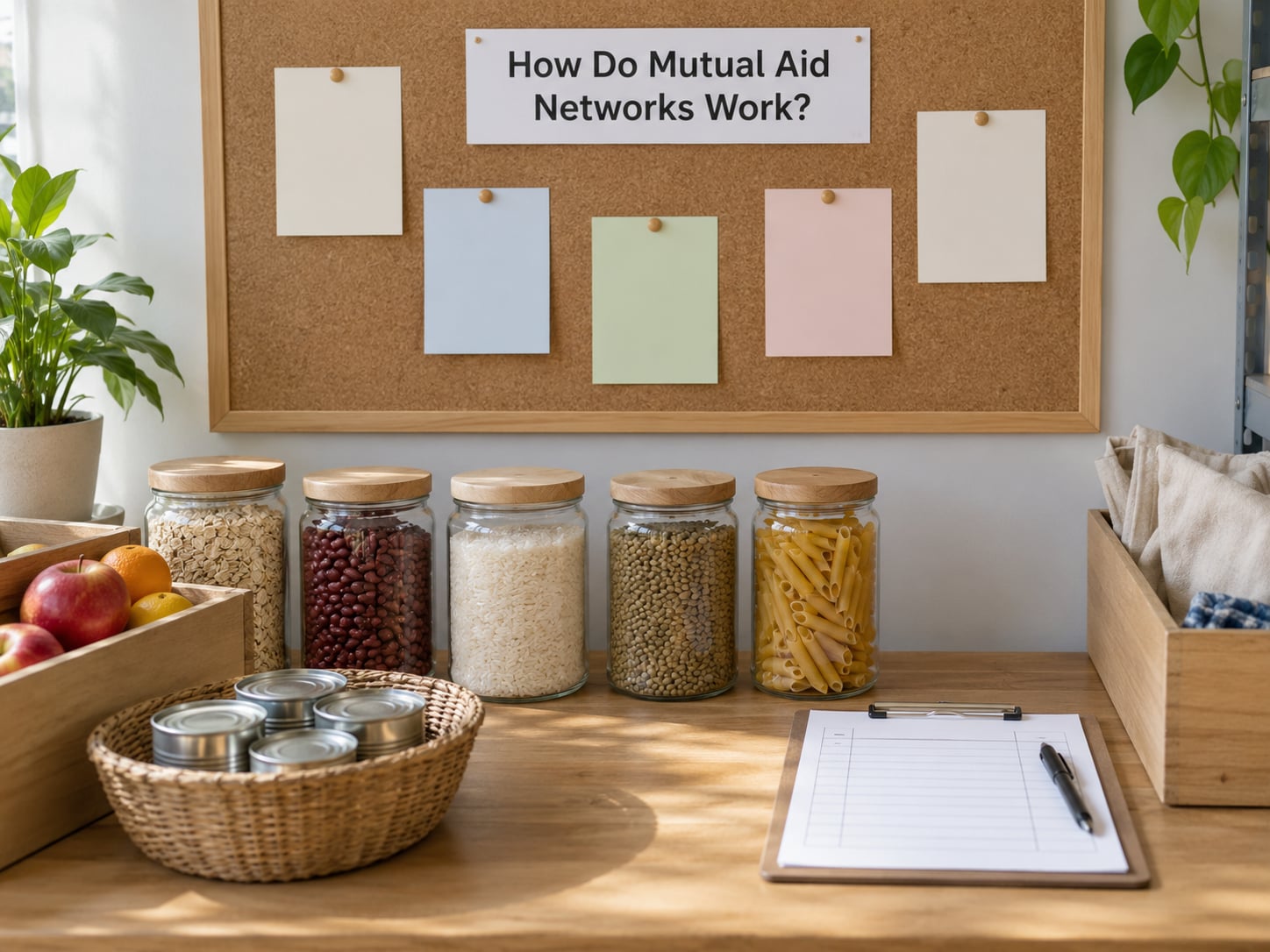
So what is mutual aid and how does it work on a normal week? A functioning network runs on five steps, and skipping any of them tends to produce a group that burns out or drifts.
- Surface the need. Start with listening: knocks on doors, a survey at the laundromat, a form with three questions. Vague intentions are the main reason new groups guess wrong about what people actually need.
- Collect offers and requests. A shared board or group chat holds both. Neighbors write that they can cook on Thursdays, or that they need a ride on Monday morning.
- Agree on roles. Someone coordinates pickups, someone keeps the ledger, someone handles safety. In a flat structure these jobs rotate, and rotating them is what prevents burnout.
- Distribute directly. The person who asked receives the goods or the cash, ideally handed over rather than mailed to an office.
- Review and adjust. A short monthly check: what ran out, what nobody used, who got left out, and whether the rules are still fair.
Most groups add one rule early: no policing how much people take. Organizers who track that carefully usually end up enforcing a limit they invented, and word travels fast when a group starts feeling like a benefits office.
What Makes Mutual Aid Effective?
Trust is the whole game, and trust is built with boring, specific practices.
Keep needs specific. “Food insecurity in this zip code” is workable; “help the community” is not. Transparency matters just as much: an open ledger and decisions made where the people affected can see them. Ask before acting, especially when help touches someone’s housing, immigration status, health or identity, and get consent before sharing a story publicly.
Make roles flexible and take them seriously. A group that needs 20 hours of driving a month will lose its drivers if it also expects them to run a spreadsheet. And local knowledge beats outside theory every time, which is why the person who has lived on a block for 20 years should be shaping the plan rather than being consulted on it.
How Can Someone Start or Join a Mutual Aid Project?
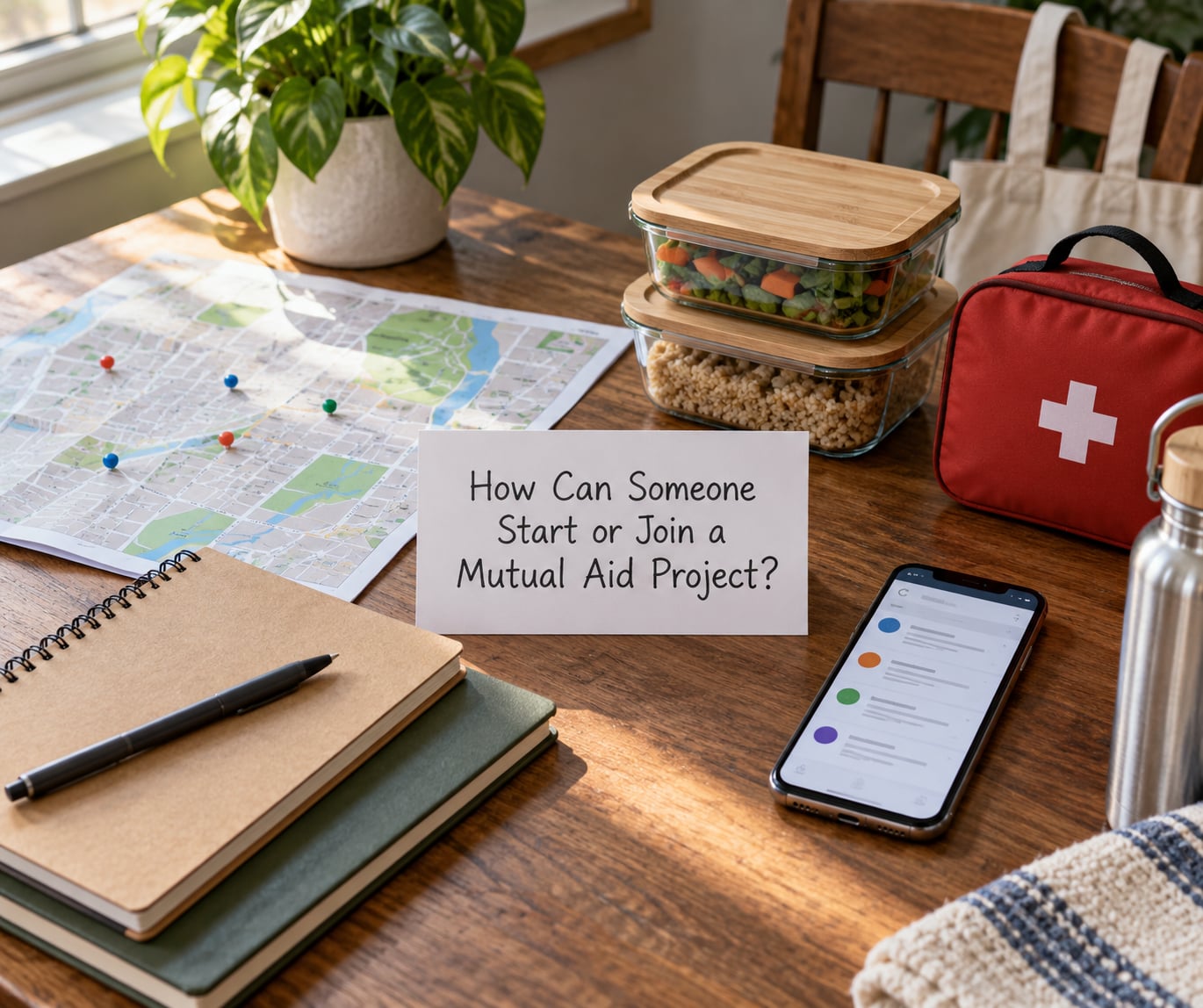
Joining is easier and lower risk than starting. Search your city or county name plus mutual aid, check neighborhood association groups and library bulletin boards, and ask existing groups what they are short on this month. Contribute one specific thing, a recurring slot rather than a vague offer of help.
Starting a group is more work, and the order matters. Most successful ones do it in steps:
- Listen before organizing. Talk to the people the group would serve. Write down what they say is hard, in their words.
- Pick one narrow thing. Deliveries twice a week, a ride program, a tool library. A group doing three things at launch rarely survives.
- Find five reliable people. Not an email list. People who will show up. Rotate every job, including the unglamorous ones.
- Set basic agreements in writing. Safety, money handling, confidentiality, and how decisions get made.
- Watch the safety side. If money or vulnerable people are involved, use two people for every financial task, verify identity through a trusted local partner, and never handle documents someone has not handed you directly.
- Decide on privacy rules early. No addresses or immigration details in group chats. Share a phone number or a meeting place instead.
- Set a review date. Three months in, ask whether the people served are in charge. If not, change it.
On money and legal structure, keep it simple early: a small unincorporated association, no hiring, no payroll, minimal cash. Get real advice before taking on anything bigger, since the rules differ by state.
What Are the Limits and Risks of Mutual Aid?
Mutual aid is genuinely useful and it is not a substitute for public services. Knowing the failure modes keeps a group honest.
Power does not disappear
Groups start flat and drift. A few confident people end up deciding everything, and the language of solidarity covers decisions nobody voted on.
Informal exclusion
Removing applications and ID checks removes the gatekeeping and also removes the data that surfaces who is being missed. People who are isolated, undocumented, working odd hours or distrustful of institutions are the hardest to reach, and a chat group full of people already online will not fix that.
Burnout
Organizers name emotional exhaustion as the top challenge, and it is mostly an operational problem. Relentless need, no mental health support for the volunteers, unclear end points and the same three people carrying every shift all drive it.
Resource and space gaps
Food needs a kitchen, cold storage and someone who knows food safety rules. Many groups lack the space to pack and store anything, and the skills needed (bookkeeping, cooperative decision-making) rarely come for free.
Co-optation and pressure
Governments and nonprofits sometimes absorb mutual aid programs, which can bring real resources and also strip the political edge out of them. A group that suddenly needs a grant application and a compliance officer to feed people is worth paying attention to.
Limits
Informal networks cannot do what trained professionals do. Medication, surgery, legal representation, domestic violence shelters and emergency response need licensed people and accountable institutions. Knowing when to hand something over is a skill, not a failure of the model.
How Does Mutual Aid Support Equity and Social Justice?
Mutual aid reaches people that formal systems reliably miss, and it does it for structural reasons. People denied housing, food, healthcare, education or safety because of their income, race, gender, disability or immigration status usually fall through the eligibility rules of programs built by and for other people.
A group with no intake process and no paperwork can move faster than a benefits office. A childcare swap can make a job or a class possible. An eviction defense group buys time that a legal aid queue cannot. Peer support built around shared experience carries a kind of credibility that professionals often lack, especially in mental health and harm reduction work.
It also redistributes something usually invisible: knowledge about systems. When neighbors pool what they know about applying for aid, navigating a landlord-tenant process or finding a clinic, that knowledge stops being an individual advantage and becomes a community asset.
None of this replaces structural reform. Mutual aid fills gaps, sometimes enormous ones, and a society that depends on unpaid neighbors to cover those gaps has arranged itself badly. The strongest groups I know about do both, feeding people now while pressing for the policy that reduces the need.
Frequently Asked Questions
Is mutual aid free to receive?
Usually yes, because most mutual aid groups operate on contributed time and donated goods, with no fees for the people they support. Some charge small, transparent amounts to cover real costs such as transport, supplies or a shared kitchen, and a few operate on a sliding scale. Ask the group directly how it pays for operations, and remember that contributing is never a condition of receiving.
Who can take part in a mutual aid group?
Membership is usually open to anyone in the area or anyone affected by the issue the group addresses, which may include people living elsewhere who share the need. Some roles have real requirements: driving a route usually needs a valid license and insurance, handling money needs two people and basic bookkeeping skills, and supporting survivors often requires training. Ask what a specific role involves before you commit.
How do people share resources without someone taking advantage?
Most groups rely on trust rather than quotas. There is no application, no means test and usually no rule against taking a lot, and the reasoning is that survival is not a moral failure. Basic safeguards help more than limits do: two people counting cash, a shared ledger, clear criteria agreed in advance, and regular contact with the people being served so problems surface early instead of accumulating.
How do I avoid scams when joining a mutual aid project?
Meet people in person before sending money or sharing personal details, and check whether the effort is connected to a group you can verify through a neighborhood association, library or local nonprofit. Be cautious with anyone asking for wire transfers, gift cards or a social security number, and never agree to carry money or packages for a stranger you have not met. Legitimate groups explain who they are and what they do.
When should a mutual aid group turn to nonprofits or public services?
Sooner than most groups expect. Mutual aid works well for food, transport, tools, company and short-term cash, and poorly for anything requiring licensed expertise or legal accountability, including medical care, legal representation, child protection and emergency response. Groups that hit those limits should partner with existing organizations rather than build their own version, and should never tell a member their needs fall outside what a public program covers.
Conclusion
Put simply, this is what is mutual aid and how does it work: identify a need, gather people and resources, and hand the help directly to whoever asked. Do it locally, start small, and keep the decisions in the hands of the people who need it most.
Start by listening. Find a group in your area that already exists and ask what is missing this month, then take one specific role, a standing shift rather than a vague promise. That is how most people get involved, and it is enough.