
Concern builds when several changes show up, persist for more than about two weeks, and start to interfere with sleep, school, or relationships. A single bad Saturday is not a diagnosis, and no checklist can tell you what is going on inside your teenager’s head. What it can do is help you spot patterns you would otherwise explain away, then give you something concrete to say out loud.
This guide is educational. It cannot diagnose depression, and only a qualified healthcare professional can do that. If your teen may not be safe right now, contact emergency services or a crisis line immediately rather than reading further.
Table of Contents
- What You Need
- Step-by-Step: How to Recognize Warning Signs of Teen Depression
- Step 1: Know How to Recognize Warning Signs of Teen Depression
- Step 2: Look for Changes Across More Than One Area
- Step 3: Check for Warning Signs That Need Prompt Attention
- Step 4: Ask Calm Questions and Listen Without Pressuring
- Step 5: Document Patterns and Involve Appropriate Support
- Common Mistakes
- Frequently Asked Questions
- Can a teenager be depressed without looking sad?
- How long should I wait before talking to a healthcare professional?
- What should I say if my teen says they are depressed?
- Should I tell my teen’s school if I am worried about depression?
- What if my teen refuses to talk about what is wrong?
- Conclusion
What You Need
Recognizing warning signs of teen depression is really an observation job, not a test. No adult, however observant, can confirm a mood disorder from the outside, and this guide does not try to. What you can do is get organized enough to notice, remember and report what you have seen, so a clinician has something better than guesswork to work with.
Before you start, line up four practical things:
- Uninterrupted time. A conversation squeezed between homework pickup and dinner teaches a teenager that you are busy. Block out a calm stretch instead.
- A private, low-pressure setting. A car ride, a walk, or the kitchen after everyone else has gone to bed works better than a face-to-face interrogation across the table.
- A route to a healthcare professional. Know who your teen’s pediatrician or GP is, whether your school has a counselor, and what your insurance or local service requires before you need it at 9pm.
- A picture of the teen’s world. You see one setting. Teachers, coaches, and school staff see the same young person across six hours and several hundred social interactions a week. They often notice changes first.
One more thing to have ready: the name and number of a crisis line for your country. In the United States and Canada, call or text 988. In the UK and Ireland, Samaritans answer free on 116 123, 24 hours a day. Elsewhere, your national health service or a local youth mental health hotline will do the same job.
Step-by-Step: How to Recognize Warning Signs of Teen Depression
Step 1: Know How to Recognize Warning Signs of Teen Depression
Teen depression is a real, treatable health condition in which a persistent low mood, loss of interest, or irritability lasts long enough and hits hard enough to disrupt daily life. In adolescents it rarely looks like a grown adult sitting quietly in a dark room, which is exactly why so many parents miss it.
The threshold that matters most is change over time across more than one area of life. Three grumpy evenings in a row after a bad friendship is adolescence. Three grumpy weeks plus skipped meals plus stopped sport plus dropped grades is a pattern worth taking to a professional.
As you read on, keep one rule in mind: describe what you saw, not what you assume it means. “She stopped coming down for dinner and turned her phone face-down” is an observation. “She’s depressed” is a conclusion you are not qualified to draw.
Step 2: Look for Changes Across More Than One Area
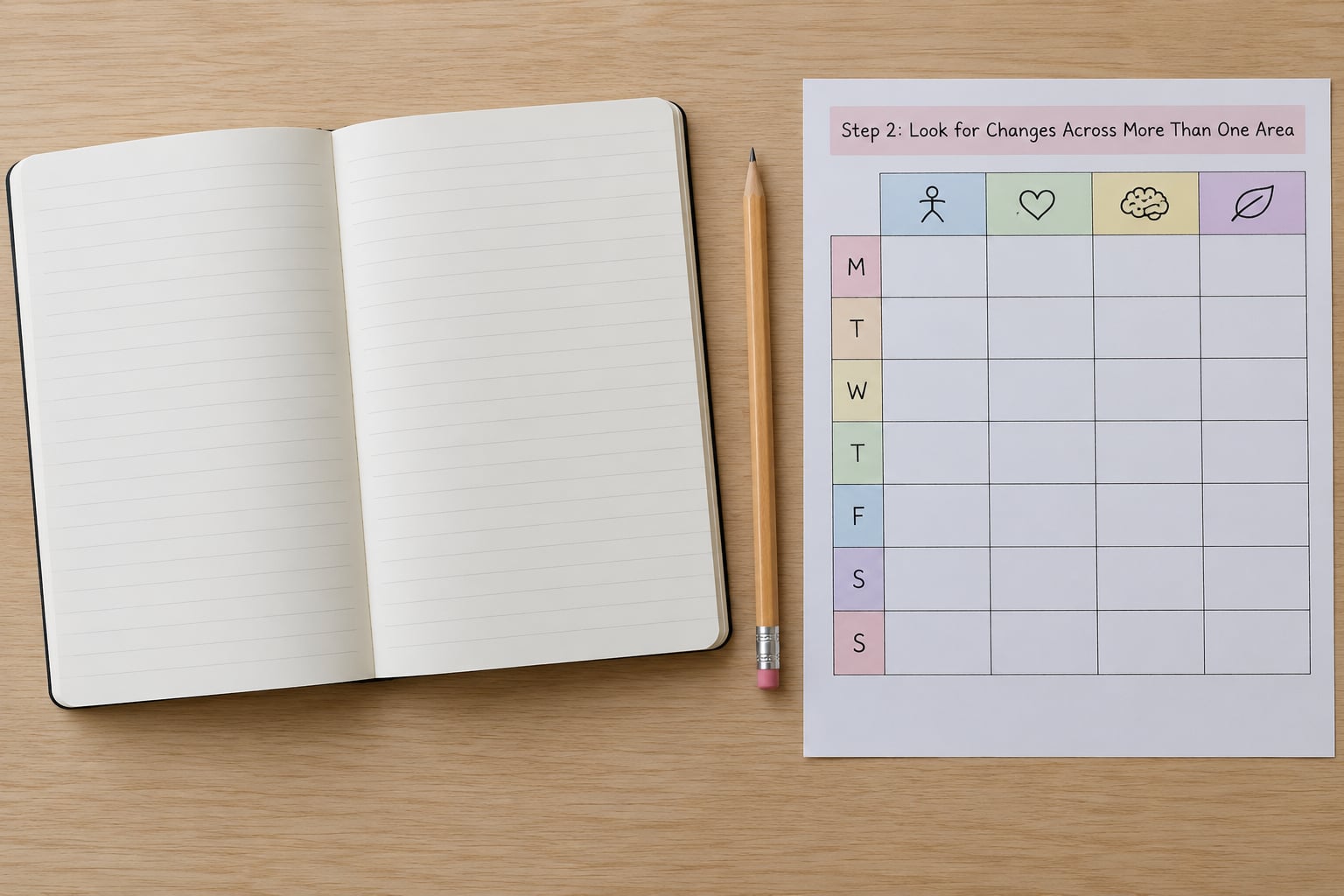
Depression rarely shows up in one category. Scan the whole range and pay attention to how many boxes fill up at once.
Emotional changes. Persistent sadness, crying spells with no obvious reason, hopelessness about things that used to matter, guilt or worthlessness, numbness, or losing interest in hobbies that were previously the reliable good part of the week. Teen boys and teens on the gender spectrum more often show irritability, anger over small things, or emotional numbness instead of sadness.
Behavioral and school changes. Grades sliding from a solid B average to a C, missing classes or refusing to go, dropping a sport or a club, quitting music lessons, coming home later without explanation, secretiveness, a collapse in hygiene, money or spending habits that suddenly change, or a room that stays closed all day. Substance use that starts or sharply increases matters too, because a lot of teenagers self-medicate before they ever tell anyone.
Physical changes. Sleeping far more than usual or waking at 3am and lying there, insomnia, appetite swings and visible weight change, headaches and stomachaches without a clear cause, constant fatigue, aches in muscles or joints with no medical explanation, restlessness or slowed movement.
Cognitive changes. Trouble concentrating, difficulty making even small decisions, slow thinking, poor memory, and negative thinking that is stuck on the worst-case version of events. A teenager who used to revise and now sits at a desk for two hours with the same page open has changed in a way that matters.
Social changes. Pulling away from friends, a reluctance to be seen, cancelling plans repeatedly, harsh treatment of people who used to be close, or a sudden and sustained shift in who they spend time with.
Two things make a sign count more than the sign itself: how long it has been there, and how much it costs. A teenager who is tired for a fortnight but still turns up for the things they love is doing better than one who looks fine on the surface and has quietly dropped everything.
Step 3: Check for Warning Signs That Need Prompt Attention
Some signs are not “call next week.” Contact a healthcare professional the same day, or emergency services if you think your teen cannot stay safe, when you notice:
- Talk about death, wanting to disappear, being a burden to the family, or that things would be better if they were not here. Saying it once is as serious as saying it repeatedly.
- Giving away possessions they care about, or suddenly saying goodbye or wrapping things up.
- Risky or self-destructive behaviour: cutting, unsafe dosing of medication, drinking heavily, reckless driving, new or escalating substance use.
- A sudden, unnatural calm after days of visible distress. Relief in a crisis often means a decision has been made.
- Threats or talk about harming other people, severe and escalating agitation, or a loss of grip on reality including hearing voices, seeing things others do not, or holding firm beliefs others call impossible.
- Not eating, drinking, or sleeping enough to function, or any sign they cannot keep themselves safe where they are.
If you are not certain which category a sign falls into, treat it as urgent. Overreacting costs an appointment; underreacting costs something a conversation cannot fix.
Step 4: Ask Calm Questions and Listen Without Pressuring
Parents repeatedly report that naming what they noticed worked better than asking “How are you doing?” That generic question invites “Fine” and ends the conversation. Specifics do not.
Pick the moment first: not during an argument, not in front of siblings, not at 11pm on a school night. Then open with what you saw, without labels. Avoid the word depressed in the opening line. It invites argument, not disclosure.
Then ask open questions and let the silence sit. Someone usually starts talking in the gap after a real question.
Questions that work:
- “I’ve noticed you’ve been coming straight to your room and eating in there. What’s that been like?”
- “You used to love practice and you haven’t been in three weeks. What changed?”
- “You’ve been getting up at night a lot. How long has that been going on?”
- “How have you been feeling about yourself lately?”
- “Have you had thoughts of hurting yourself or not wanting to be here?” Ask this plainly and calmly if you have any reason to. Vague phrasing makes it harder to answer honestly.
While they answer, do not interrupt and do not rush to fix it. Reflect back what you heard, say that the feeling makes sense given what they described, and thank them for telling you.
One promise to avoid: complete secrecy. Say what you can actually do. “I’m not going to tell anyone unless I think you’re in danger, and if I ever do, I’ll tell you first” is honest and keeps the door open. Promising total confidentiality and then telling their school counselor after three panicked phone calls is how teenagers learn to stop trusting adults.
Many teens open up to a coach, a teacher, or a school counselor before a parent. That is not rejection of you. Ask those adults directly what they have noticed, and ask your teen whether they would like help opening that door.
Step 5: Document Patterns and Involve Appropriate Support
Memory is unreliable in a worrying week. Two weeks before the appointment, start a simple written record: date, what you saw or what they said, how intense it was, how long it lasted, and any effect on sleep, food, school or safety. Notes help a pediatrician or therapist see the shape of a few months instead of a single Tuesday.
Write what happened rather than what it means. “Up until 2am four nights last week, said school feels pointless” is useful. “In a dark place” is not.
Then think about who to contact, in this order of severity:
- Ongoing but not urgent: your teen’s pediatrician, GP, or primary care provider, plus the school counselor. Most providers are used to mental health screening and can start with a conversation or a questionnaire before any referral.
- Distressing, sleep or school clearly breaking down: a therapist or adolescent mental health service. Depending on where you live, this may be a referral through primary care, a school-based service, or a private provider, and it is worth asking directly about wait times and cost.
- Safety in question: crisis line or emergency department. In the US, call or text 988. In the UK and Ireland, Samaritans is on 116 123.
Behave as if you are asking permission even when you do not need it. A teenager told “I have booked you an appointment” will often go along and feel betrayed; a teenager told “I’d like to book you in, can I try?” has a chance to participate. Where you are a foster or kinship caregiver, check your local rules about consent and confidentiality before making calls.
Once support is in place, keep doing ordinary things. Sit and eat with them. Keep turning up to the sport even if they no longer want to play. Low-key consistency matters more than long speeches.
Common Mistakes
Most adults who miss early signs are not careless. They are responding to what they were handed: a moody teenager, a sigh, an unhelpful one-liner. These are the errors that come up most, and what to do instead.
Writing it off as a phase. Puberty is genuinely difficult and genuinely real. But “it’s just being 15” is not a reason to stop watching. Notice it, write it down, set a review date two weeks out.
Diagnosing from behavior. “He’s clearly depressed” and “she’s just being dramatic” are both conclusions from the outside. Say what you observed and let a clinician do the diagnosing.
Comparing. “Her brother went through the same thing and he was fine.” Development differs, and comparison adds shame to a young person who is already struggling to explain something internal.
Interrogating. Rapid-fire questions about friends, sleep, phone and grades feel like an interrogation, and a teenager under interrogation gives minimal answers. Ask less, wait longer, and let silence do the work.
Punishing the symptoms. Removing the bedroom door, taking away the phone, or withdrawing privileges in response to withdrawal or a mood swing shuts down exactly the small talk that was still happening. Those responses appear again and again in parent forums, and they make the next conversation harder to start.
Promising complete secrecy. It buys one disclosure and loses the adult relationship afterward.
Trying to solve it in one conversation. You cannot fix this with one talk. Your job right now is safety and connection; treatment is someone else’s expert job. Repeating the honest and boring versions: notice the pattern, say it plainly, listen without interrupting, write it down, and bring in a professional when it does not lift within about two weeks.
Frequently Asked Questions
Can a teenager be depressed without looking sad?
Yes. In adolescents, irritability, anger, or emotional numbness can replace visible sadness entirely. A teen who is short with everyone, explosive over small things, or oddly flat is worth taking seriously, especially alongside changes in sleep, appetite, withdrawal, or schoolwork. Moodiness that fades in a few days is normal adolescence. Low mood, irritability, or emptiness that lingers for more than about two weeks and disrupts daily life is the pattern a healthcare professional will want to evaluate.
How long should I wait before talking to a healthcare professional?
Do not wait past two weeks of persistent symptoms. If changes are mild and your teen is still functioning, use that window to observe, record what you see, and arrange a routine appointment with a pediatrician or GP rather than waiting for it to worsen. Seek help sooner if sleep, eating, school, or friendships are clearly breaking down, or if there is any sign of self-harm or suicidal thinking. In that case call or text 988 in the US and Canada, or Samaritans on 116 123 in the UK and Ireland.
What should I say if my teen says they are depressed?
Say thank you first. They took a risk telling you, and that is the part you want to reinforce. Then acknowledge without debating or diagnosing: that is a heavy thing to carry and it makes sense they are telling you. Ask what they need from you right now, and ask whether they would be willing to see someone professional. Avoid lecturing, minimizing with other people’s stories, or listing everything you have done for them.
Should I tell my teen’s school if I am worried about depression?
Sometimes, and it depends on what you have seen. If the problem is showing up at school, contacting the counselor or a teacher you trust can get useful eyes on the situation. Explain what you noticed rather than sharing a diagnosis, and involve your teen where possible so school support does not feel like punishment. Be aware that school staff often cannot keep a confidence, so tell your teen before you call. Ask their school what their confidentiality policies are before you share details.
What if my teen refuses to talk about what is wrong?
Keep the door open instead of forcing it. Say that you have noticed specific changes, that you are not asking them to explain right now, and that you will keep checking in. Name the worry directly once, including safety questions if you have reason to. Asking a school counselor, coach, or pediatrician directly is not going behind their back, it is getting more eyes on the situation. Many teenagers speak to a professional long before they speak to a parent, and that is progress, not failure.
Conclusion
If you take one action from this, make it this: pick a calm moment, name the two or three specific changes you have noticed, ask one open question, and then stay quiet. That is the whole opening move, and it costs you ten minutes.
After that, write down what you saw and when. If it does not lift within about two weeks, or if any sign suggests your teen is not safe, contact a healthcare professional, a school counselor, or a crisis line. Asking for help early is a protective step, not a diagnosis, and not a reflection of anything you did wrong. 2026