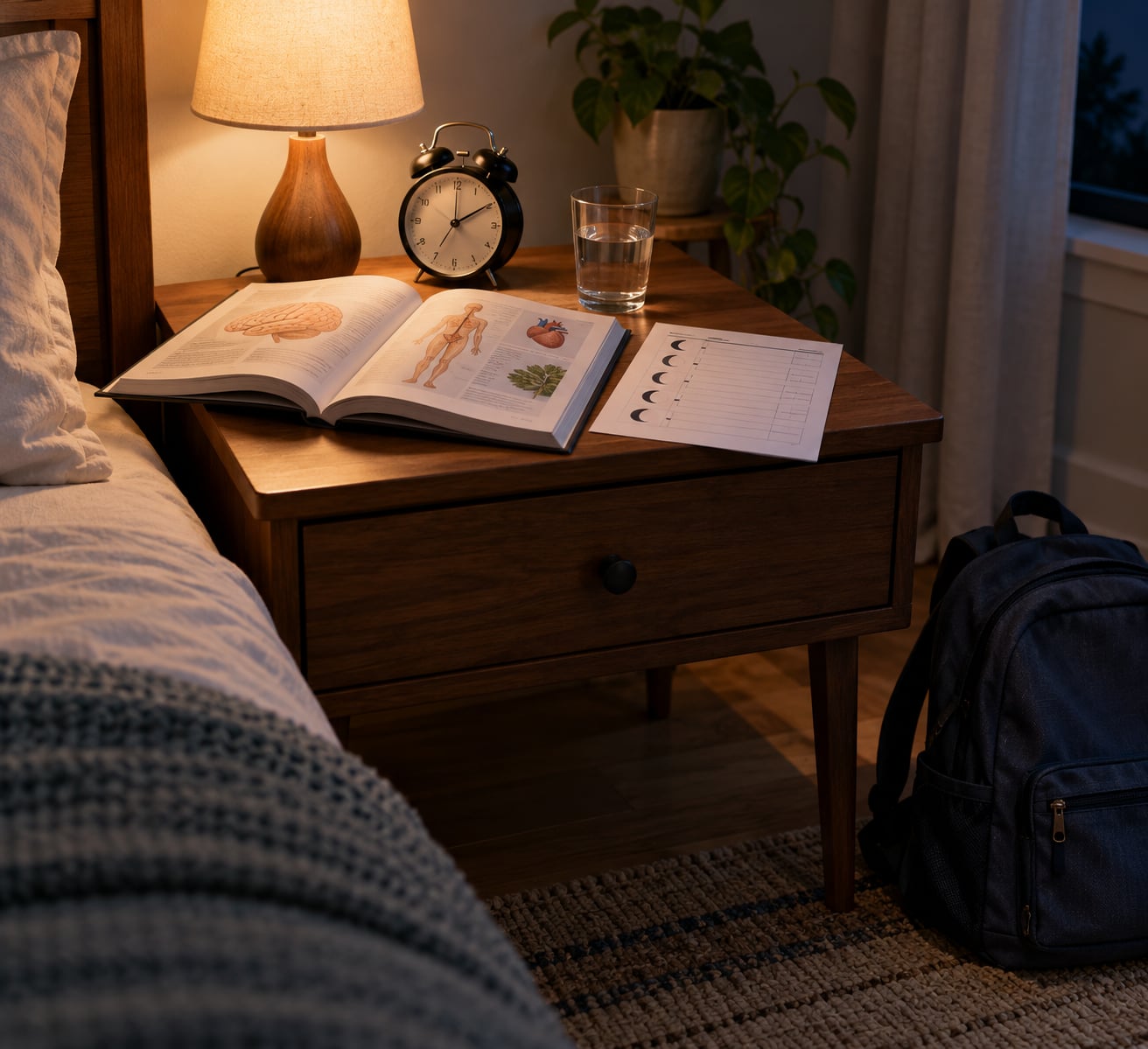
Teens need about 8 to 10 hours of sleep a night, while most adults need 7 to 9. That gap exists because puberty shifts the body clock later, deep sleep carries the growth hormone that fuels a rapidly growing body, and the teenage brain is still in its second wave of cognitive maturation.
If your teenager falls asleep at 1 a.m., struggles to wake at 6:30, and then sleeps until noon on Saturday, you are looking at biology, not attitude. I know that is not a comforting read for a parent who has been told a 10 p.m. bedtime would fix everything.
This is general health information, not medical advice. For sleep problems in a specific teen, talk with a pediatrician or a sleep medicine specialist.
Table of Contents
- How Much Sleep Do Teens Need Compared With Adults?
- Why Do Teenagers Need More Sleep Than Adults?
- Four reasons teens need more sleep than adults
- Homeostatic sleep pressure: why an exhausted teen still cannot fall asleep early
- What Happens to the Teenage Brain During Sleep?
- How sleep supports learning and memory
- What Causes Teens to Get Too Little Sleep?
- What causes teenagers to stay up late?
- How Can Teenagers Build a Better Sleep Routine?
- What Signs Suggest a Teen Is Not Getting Enough Sleep?
- When should a parent talk with a healthcare professional?
- How Can Parents and Schools Support Teen Sleep?
- Can school start times affect teen sleep?
- Frequently Asked Questions
- Why is my 14-year-old sleeping more than usual?
- What is considered oversleeping for a 15 year old?
- Should teenagers take melatonin supplements?
- Why do teenagers stay up so late at night?
- Why is my teenager always tired?
- Conclusion
How Much Sleep Do Teens Need Compared With Adults?
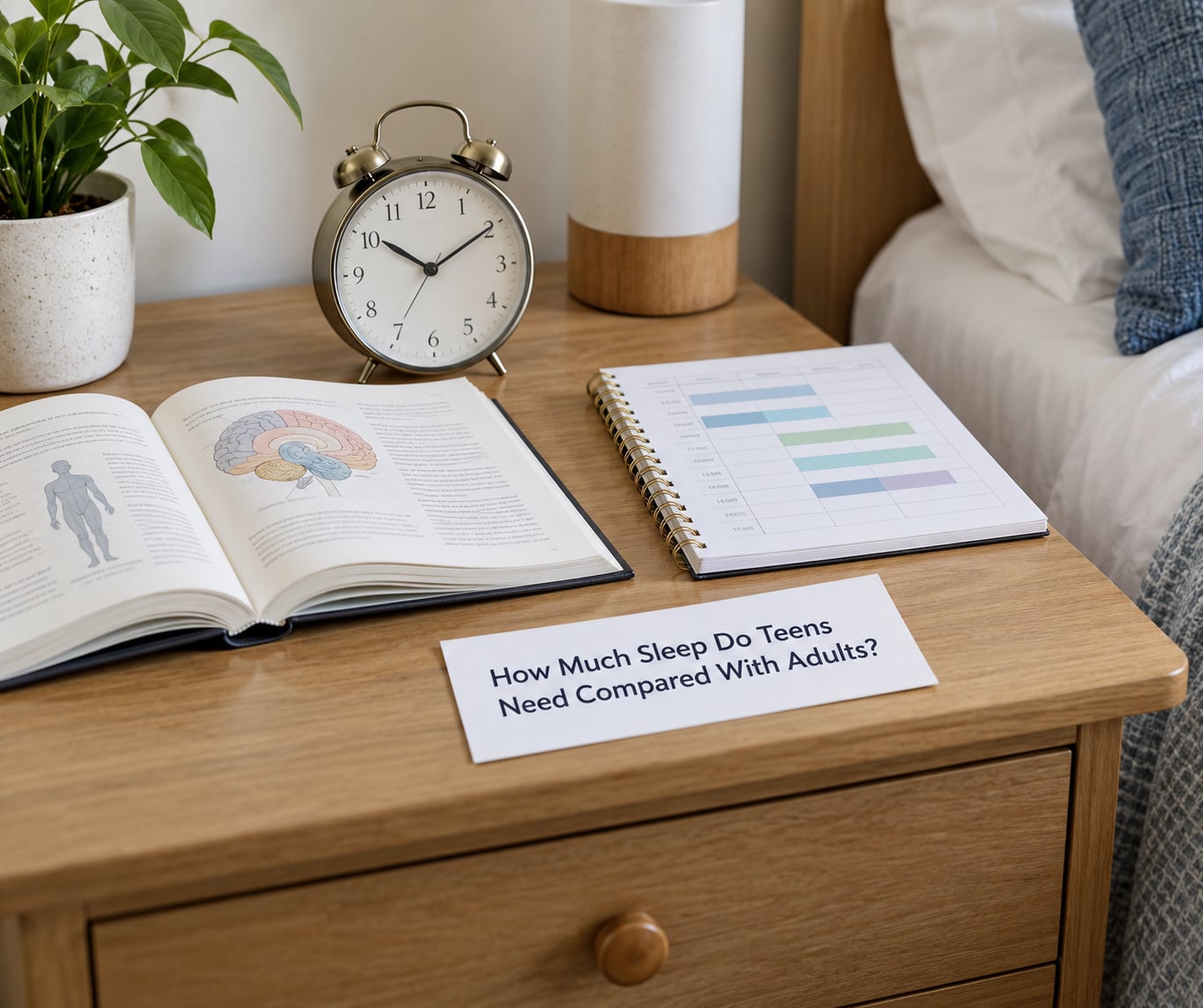
Teenagers should get 8 to 10 hours of sleep per night. Adults need 7 to 9 hours, which puts the typical teen’s requirement roughly one to two hours above a parent’s.
| Age group | Recommended sleep per night | Commonly cited source |
|---|---|---|
| Children, 6 to 12 | 9 to 12 hours | American Academy of Sleep Medicine |
| Teens, 13 to 18 | 8 to 10 hours | National Sleep Foundation |
| Young adults, 18 to 25 | 7 to 9 hours | National Sleep Foundation |
| Adults, 26 to 64 | 7 to 9 hours | National Sleep Foundation |
| Adults, 65 and over | 7 to 8 hours | National Sleep Foundation |
Pediatricians at Johns Hopkins Medicine put the number closer to 9 to 9.5 hours for teenagers, and that is the figure I would use when arguing with a school board. The ranges are not quotas to hit exactly. They describe what most healthy teens seem to need, and individual variation is real.
There is one important clarification. Teens generally do not need more total sleep than adults purely in biological terms, which surprises people. What changes is timing. The adolescent night starts later and, for most teenagers, runs longer than the adult night.
Why Do Teenagers Need More Sleep Than Adults?
Four reasons teens need more sleep than adults
Brain development: Adolescence brings a second wave of cognitive maturation. The brain reorganizes, prunes and strengthens connections during sleep, and the frontal lobe regions responsible for judgment and impulse control are among the last to finish maturing.
Physical growth: Adolescence is the fastest growth period since infancy. Growth hormone is released in pulses during deep, slow-wave sleep, so cutting that sleep time removes part of the signal that drives bone, muscle and tissue repair.
Emotional and behavioral control: Sleep loss in teenagers shows up first as reactivity. Tired teens tend to read neutral comments as criticism and struggle to pause before responding, which is exhausting for everyone in the room.
A shifted body clock: Puberty delays melatonin release by roughly two to three hours. Research on typical teen patterns suggests sleepiness often arrives around 10:45 to 11 p.m., with full alertness not returning until about 8 a.m.
| Factor | Teenagers | Most adults |
|---|---|---|
| Recommended sleep | 8 to 10 hours | 7 to 9 hours |
| Melatonin onset | Often 10:45 to 11 p.m. | Often 9 to 10 p.m. |
| Typical sleep window | Late night to late morning | Late evening to early morning |
| Main pressure point | Early school start times | Work and family schedules |
Homeostatic sleep pressure: why an exhausted teen still cannot fall asleep early
This is the part almost every article about teen sleep skips. Two separate systems decide when you sleep. Circadian rhythm is the clock that pulls you toward wakefulness during the day and toward sleep at night. Homeostatic sleep pressure is the accumulating debt of wakefulness, built up as adenosine rises across the day.
A teenager who has been awake since 6:30 a.m. has enormous homeostatic pressure by 9 p.m. That pressure alone does not create sleep. Melatonin has to signal that the biological night has started, and in most teens that signal does not arrive until close to 11 p.m.
The result is the pattern parents describe on forums and in clinic visits: a teen who is absolutely exhausted and still wide awake at 10:30. The 2009 review by Hagenauer and colleagues on adolescent changes in homeostatic and circadian regulation of sleep is the standard reference for this two-system problem.
That is also why telling a teen to just go to bed earlier often fails. Moving the bedtime earlier without moving the body clock produces an hour of staring at the ceiling, and the lost sleep time does not come back.
What Happens to the Teenage Brain During Sleep?
Sleep consolidates what the day put in. During deep sleep, the brain replays and stabilizes recently formed memories. During REM sleep, it processes emotional weight and links new material to existing knowledge.
How sleep supports learning and memory
Three things happen that a student notices the next morning:
- Memory storage. Facts learned in class are moved from short-term holding into longer-term storage, and consolidation happens mostly after the learning session, not during it.
- Attention and working memory. A teen running on six hours holds fewer items in mind at once and drifts more easily during a long lesson or a lecture.
- Emotional processing. The amygdala, which reacts faster than reasoning, calms during sleep. That reset is why a bad day feels manageable after a full night and unmanageable after four.
None of this replaces good teaching or adequate support. A well-rested teen still needs a class that is worth staying awake for. Sleep makes the available instruction usable; it does not create more of it.
That said, the research on teen sleep deprivation and brain function is consistent enough to stop treating sleep as optional homework. Chronic short sleep is associated with lower attention, weaker academic performance and more difficulty with executive function, which is the group of skills that turns effort into results.
What Causes Teens to Get Too Little Sleep?
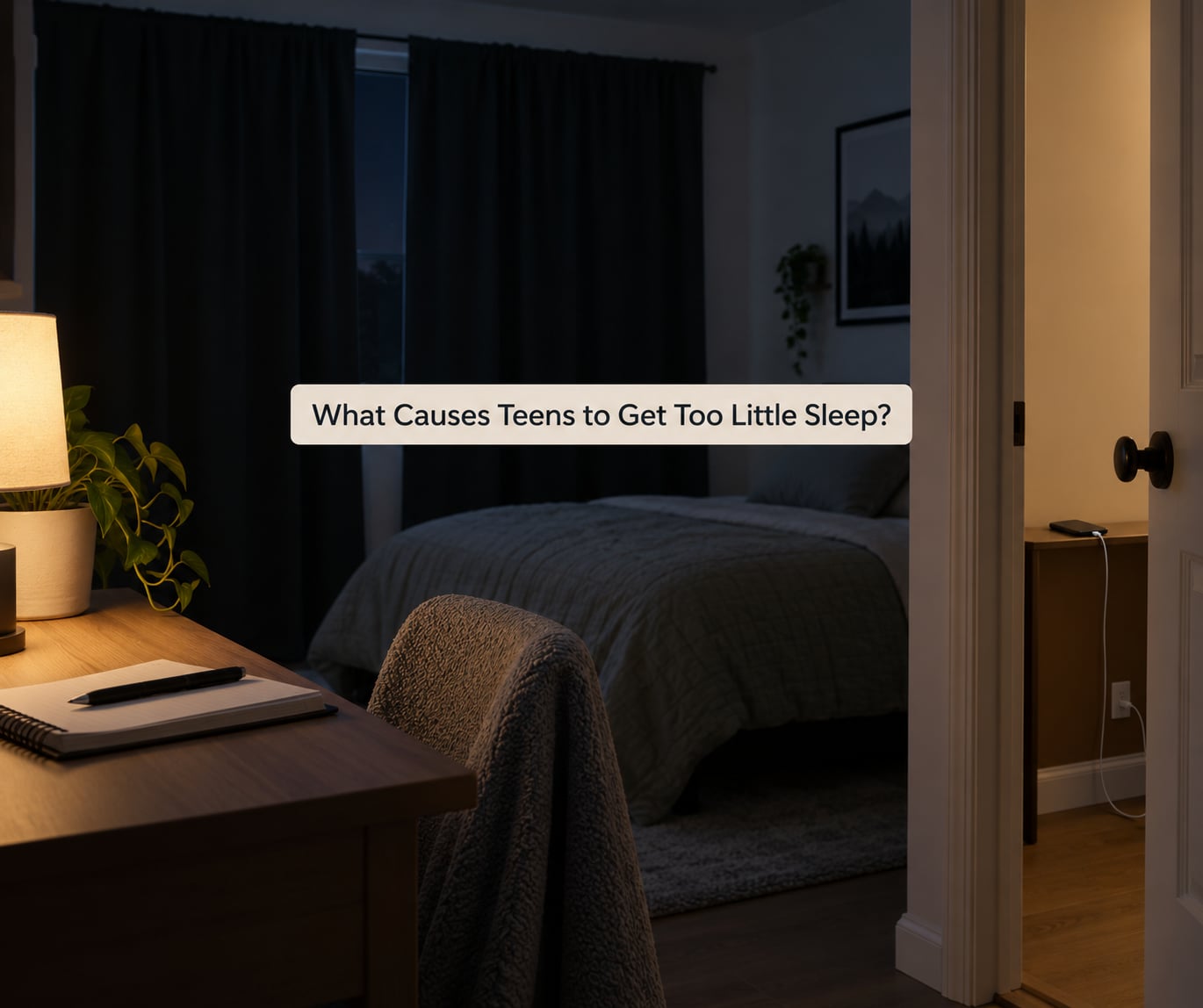
The biology sets a floor. The schedule decides whether the teen ever clears it. Most short sleep in teenagers is a scheduling problem wearing a biology-shaped costume, which is good news, because schedules can change.
What causes teenagers to stay up late?
- Early school starts. A 7:05 a.m. bell in Nashville high schools, or an 8 a.m. start anywhere, lands squarely in the window when a teen’s melatonin has barely started flowing.
- Homework and part-time jobs. Work that used to fit after dinner now spills past 10 p.m.
- Screens in bed. Light and stimulating content both delay sleep onset, and scrolling turns a short delay into an hour.
- Social life. Late-night texting and gaming are social commitments, not just entertainment.
- Caffeine and energy drinks. An afternoon cola or pre-workout can still be half-active at midnight.
- Weekend recovery. Sleeping until noon on Saturday shifts the body clock forward, and Monday morning then feels like a 2 a.m. wake-up. That mismatch has a name: social jet lag.
Here is the short checklist. For each item, mark it honestly for the past seven days:
- Is the wake-up time fixed before the bedtime is decided?
- Is a phone or tablet in the bedroom at all?
- Is there caffeine after 2 p.m.?
- Does the weekend wake-up time run more than an hour later than a weekday?
- Is there any 30-minute window with no obligations at all?
Most teenagers who answer yes to three or more of those have a schedule problem with a clear cause.
How Can Teenagers Build a Better Sleep Routine?
Routine guidance, not a treatment plan for insomnia or any other medical condition. If sleep problems persist despite changes, that is a doctor conversation, not a habit problem.
- Anchor the wake-up time. Fix the morning first, not the night. A stable wake time pulls the circadian clock forward more reliably than an early bedtime alone.
- Get light early in the day. Outdoor light within an hour of waking, ideally with breakfast, helps set the clock for the rest of the day.
- Build a wind-down. The same 30 to 45 minutes every night: shower, read, music, out of the bedroom if possible.
- Set a screen curfew that ends the scrolling, not the device ban. Parking a phone in the kitchen at 10 p.m. works better than confiscation fights. Many teens will tell you the trust matters more than the rule.
- Keep the bed for sleep. Reading is fine; dozing, doomscrolling and homework are not.
- Cap the weekend shift. Stay within about an hour of your weekday wake time. A two-hour jump is enough to cost you Monday.
- Treat naps as a short tool. Twenty minutes before mid-afternoon helps a dangerously tired driver or a sick kid recover. A two-hour nap at 5 p.m. ends up pushing sleep to midnight.
- Watch caffeine timing. Energy drinks are not a sleep aid with a side effect; they are the opposite.
Move the whole schedule gradually. A teenager whose body clock runs three hours late will not jump to a 10 p.m. bedtime in one evening, and the attempt usually ends in frustration on both sides.
What Signs Suggest a Teen Is Not Getting Enough Sleep?
Short sleep rarely announces itself. It shows up as behavior that gets labeled as attitude, defiance or a screen addiction.
- Falling asleep in cars, at desks, or within minutes of sitting down
- Needing several alarms and still dragging in the morning
- Irritability over small things, or a shorter fuse than usual
- Slipping grades or homework that used to be manageable
- Withdrawal from friends and family they normally enjoy
- Slower reactions, which matters enormously behind the wheel
- Constant caffeine or energy drinks
- Sleeping far more on weekends than weekdays
Sleep inertia, the groggy fog in the first minutes after waking, is a normal part of waking up, but many adults mistake it for laziness in their kids. It is heavier when sleep is short and the wake-up is abrupt.
When should a parent talk with a healthcare professional?
Make an appointment if short sleep is affecting school, mood or safety, if snoring or pauses in breathing appear during sleep, if legs feel restless or painful at bedtime, or if insomnia runs week after week despite consistent sleep habits. Seek urgent help for dangerous daytime sleepiness, especially with driving, or for breathing that stops during the night.
How Can Parents and Schools Support Teen Sleep?
Households and schools control different levers. At home, the practical gains usually come from negotiating obligations rather than adding willpower.
- Treat a reasonable bedtime as a scheduled commitment, like dinner or a practice.
- Review homework load and part-time work shifts together. Something has to move when both are packed into the same evening.
- Stop treating sleep as a reward or a punishment.
- Tie driving privileges to a minimum standard of sleep. Sleepy driving causes crashes.
- Support a short nap before a late event rather than a 3 a.m. night.
- Speak with the teen as someone whose body is changing, not someone failing to try.
At the school level, the big lever is the bell. The American Academy of Pediatrics recommends that high schools start around 8:30 a.m. California set 8:30 a.m. as the legal floor for its high schools, and Florida has moved in the same direction. Parents who report later starts describe a noticeably calmer kid, and school districts notice attendance and safety numbers too.
Can school start times affect teen sleep?
Yes, directly. A start time that lands before a teen’s biological morning effectively truncates sleep without the teen choosing to do it. Even a modest delay produces visible changes in alertness and mood, which is why later starts show up so consistently in parent and teacher reports.
The shift is also visible in the data. A June 2026 Columbia University neurology news release reported that U.S. teenagers are getting the least sleep they have had in decades. Long-running studies have also documented a steady erosion of teen sleep since the early 1990s, which makes this a schedule problem in a culture-wide sense, not a personal failing.
Frequently Asked Questions
Why is my 14-year-old sleeping more than usual?
A 14-year-old sleeping later and longer is often a normal part of puberty, because the body clock shifts two to three hours later and a growing body needs more deep sleep. Check for the usual companions: snoring, restless legs, difficulty waking, or falling asleep in class. If sleep is normal in length but the teen cannot wake for school, a later schedule usually helps. If there is loud snoring, breathing pauses or persistent daytime sleepiness, book a visit with a pediatrician.
What is considered oversleeping for a 15 year old?
Oversleeping is not a single number, but regularly sleeping well past 11 hours on school nights is worth a conversation. Occasional long sleeps after a short week, a growth spurt or an illness are unremarkable. Persistent sleeping past noon on weekends usually points to recovery from chronic short sleep rather than too much sleep. Poor sleep quality can also produce long hours in bed alongside feeling exhausted, so snoring or breathing pauses deserve a professional look.
Should teenagers take melatonin supplements?
Melatonin is widely used and widely discussed, and many families ask about it for teens who cannot fall asleep early. Because it is a supplement rather than a medicine, quality and dose vary between products, and long-term use in teenagers is not well studied. Talk with a pediatrician before giving it, especially for a teen with a health condition or other medications. A doctor can also check whether the real problem is a delayed sleep pattern that responds better to schedule changes.
Why do teenagers stay up so late at night?
Two systems explain most of it. Homeostatic sleep pressure builds all day, so a teen is genuinely tired by evening, but circadian rhythm releases melatonin roughly two to three hours later than in adults or children. On top of that, late homework, part-time work, screens and social commitments fill the hours that are left. Early school starts then cut the night short. The result is a teen who is exhausted at 9 p.m. and still wide awake at 11 p.m.
Why is my teenager always tired?
Always-tired in a teenager usually means a mismatch between the sleep the body needs and the sleep the schedule allows. Frequent causes include a late body clock paired with an early start time, too little sleep at first, weekends that shift the clock forward, caffeine, and screens until late. Persistent tiredness despite a long night in bed can point to snoring, sleep apnea or a restless legs problem. Book an appointment rather than assuming it is laziness or low motivation.
Conclusion
Teens need more sleep than adults because a delayed body clock, a second wave of brain development and the growth hormone released during deep sleep all peak during adolescence. The requirement is 8 to 10 hours against 7 to 9 for most adults, and the timing matters as much as the total.
The first thing to do is simple: write down the last seven days of wake-up times and bedtimes and look at the gap. Fix the morning, protect a wind-down, and move one obligation instead of all of them. If sleepiness, snoring or breathing pauses show up, that is a phone call to a doctor, not a discipline problem.