
Active listening means listening to understand what someone means, not to line up your reply. It is a set of habits rather than a talent you either have or lack, and it improves fastest when you practice it in the conversations you already have every day.
Most advice on this stops at the workplace door. That’s a shame, because the kitchen table, the group chat, and the phone call with a parent are where listening matters most and where the habits are hardest to keep. Below is how to practice active listening in everyday conversations, in six steps you can use tonight.
One warning first: the advice can feel artificial the first few times you try it. Someone in a class once called active listening “quite silly” until they realized how much they were preparing rebuttals instead of listening. The awkwardness fades. The habit sticks.
Table of Contents
- What You Need
- Step-by-Step: How to Practice Active Listening in Everyday Conversations
- 1. Prepare to Give the Conversation Your Full Attention
- 2. Listen for the Main Point and the Feelings Behind It
- 3. Use Reflective Responses Instead of Interrupting
- 4. Ask Questions That Invite More Clarity
- 5. Summarize Before You Respond
- 6. Follow Up and Remember What Matters
- Common Mistakes
- Frequently Asked Questions
- What is active listening, and how is it different from just staying quiet?
- How do I practice active listening when I am not good at understanding emotions?
- What can I say when I do not know how to respond to someone’s feelings?
- Does active listening mean I have to agree with the person I am listening to?
- How can I stay focused when someone is speaking slowly, repeating themselves, or giving a long explanation?
- What should I do if I realize I interrupted someone?
What You Need
You need three things, and none of them are equipment.
- Attention you can actually give. Not perfect attention, just enough that you could repeat the last two sentences the person said.
- A willingness to pause judgment. You can think “that’s not how I’d do it” internally, and still keep listening out loud.
- Somewhere to put details when the conversation involves names, dates, or follow-ups. A notes app on your phone is plenty. In person, a pen works.
If you can give those three, you have everything required. The rest is repetition.
Step-by-Step: How to Practice Active Listening in Everyday Conversations
1. Prepare to Give the Conversation Your Full Attention
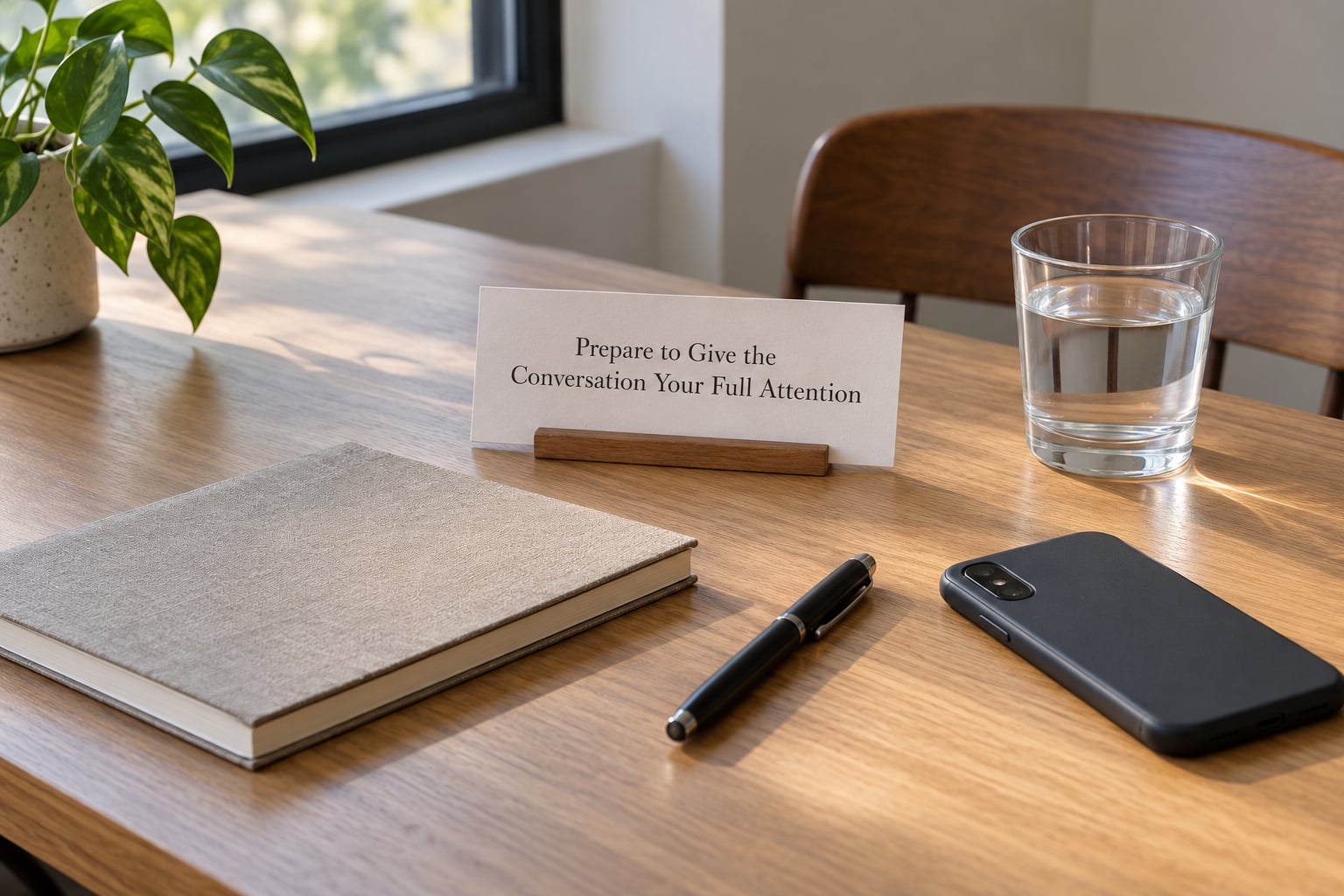
Most bad listening starts before anyone speaks. You take the call while washing dishes, and you spend the first four minutes deciding whether the laundry is going to be a problem. Ten seconds of setup prevents that: phone face down, notifications off, water filled.
Decide before you start whether you are listening or politely postponing. If you genuinely cannot give ten minutes now, say so and set a time. Half-attention is worse than an honest delay because the other person keeps talking into a void.
2. Listen for the Main Point and the Feelings Behind It
People repeat themselves for two reasons. Either you missed the point, or the point is emotional and words alone will not carry it. Listen for both tracks at once.
Try to write the main point in your head in six words or fewer. Then notice the affect underneath: hesitation, a voice that drops, a joke that arrives too quickly. Those are usually the actual message. If someone says “I’m fine, honestly” in a tone that isn’t fine, the tone is the sentence you should be listening to.
Keep your interpretation separate from what you heard. “She didn’t say the word quit” is an observation. “She’s about to quit” is a guess. Guessing is fine as long as you check it instead of acting on it.
3. Use Reflective Responses Instead of Interrupting
An interrupting listener is usually reacting to a half-formed idea. Reflective listening gives the speaker a turn to finish the thought and correct you, which is where the actual information lives.
Two phrases cover most of it. “What I’m hearing is that the deadline moved and nobody told you” checks the content. “It sounds like this matters because you planned around it” checks the feeling. Both are wrong often enough to be worth using, and being corrected by the speaker is a feature, not a failure.
If you disagree with them, hold it until the summary. Agreeing with someone’s conclusion is not required to take their experience seriously, and telling them so quietly is not the same as pretending you agree.
4. Ask Questions That Invite More Clarity
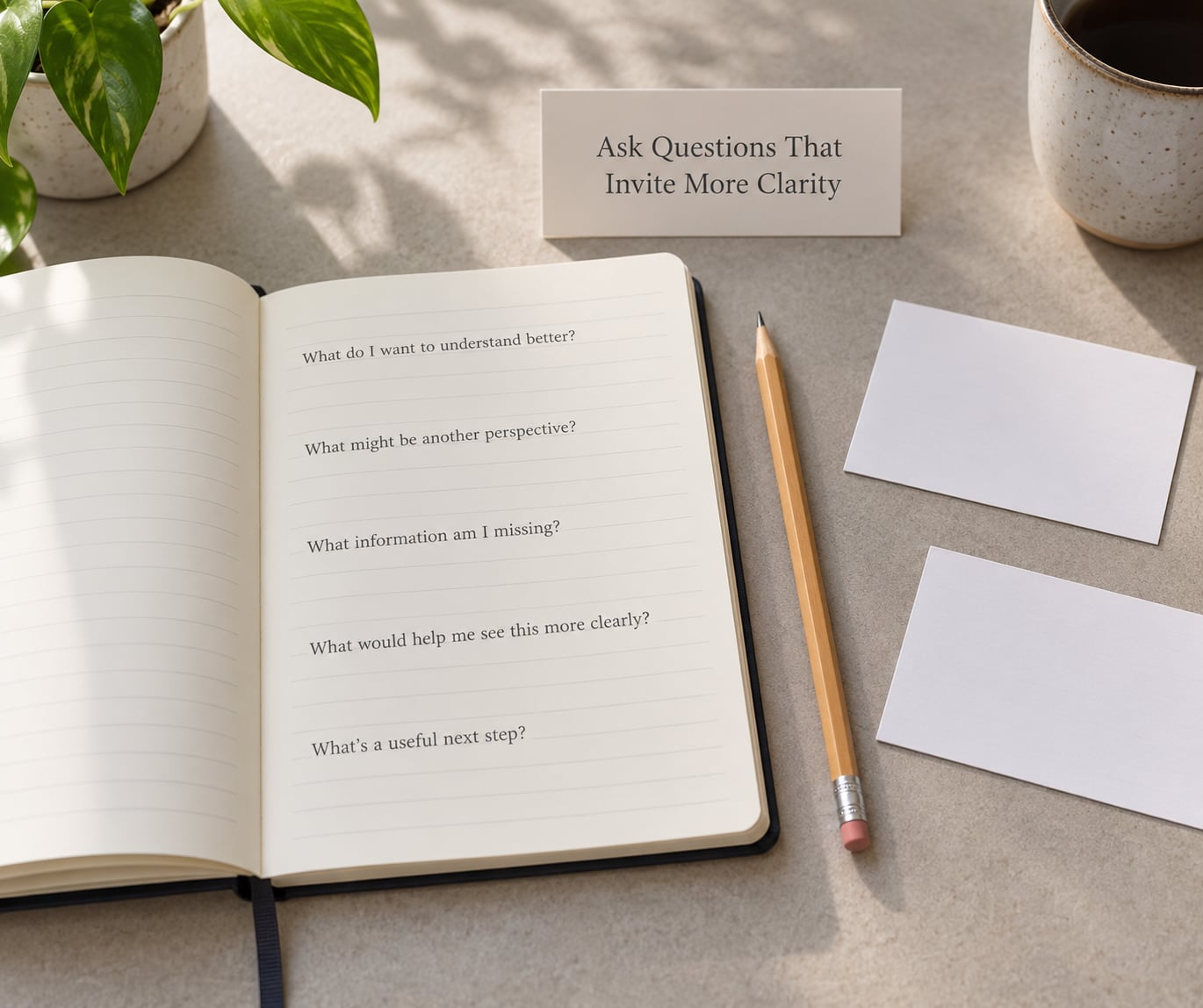
Questions do more work than advice ever does, and the shape of the question decides how much comes back. A closed question asks for confirmation. An open one asks for a story, and stories are where the useful detail hides.
| Instead of | Try |
|---|---|
| “Did you like the party?” | “How was the party last night?” |
| “You should talk to your manager.” | “How do you think your manager read the message?” |
| “Are you still angry about that?” | “What keeps coming back when you think about it?” |
| “That’s not what happened.” | “Tell me the part I missed.” |
Start with reflection, then ask. People who jump straight to questions sound like an interview; people who reflect first sound like they’re actually there.
5. Summarize Before You Respond
Once the speaker finishes, hand their version back before you give yours. Two or three sentences is enough: the main point, the feeling, and anything unresolved.
“So the schedule is fine, the budget isn’t, and what bothers you most is that you found out from the group chat. Did I get that right?” is a complete response to almost any complaint. If you got it wrong, the correction costs you one sentence instead of an argument.
Then respond to what was actually said, not to the version you built in your head at second thirty. That gap, between the first interpretation and the real one, is where most avoidable fights start.
6. Follow Up and Remember What Matters
Listening ends when the person leaves, which is why it doesn’t always feel like listening at all. The trust comes from what happens next: a text later that says “you were right about the deadline, I checked,” a note from a work conversation ending up as a calendar reminder, or asking again next week how the thing went.
Pick one or two details per conversation to keep. That’s it. The people who feel genuinely heard are rarely the ones with the best technique, they’re the ones who referenced something three days later that nobody else remembered.
Common Mistakes
These are the five failures that show up most often in ordinary conversations, with the fix for each.
- Rehearsing a rebuttal. You decide what you’re going to say at second five, then spend the rest of the sentence waiting for your turn. Fix: decide that the summary comes before your point, every time, even when you are certain.
- Giving advice too early. Advice offered at minute one is heard as a verdict. Fix: ask what they’ve already tried before you suggest anything, and hold solutions until they ask.
- Asking only closed questions. “Do you want to talk about it?” gets a no more often than a yes. Fix: swap confirmation questions for open ones, especially with someone who seems quiet.
- Treating silence as agreement. If nobody objects, the room usually stopped listening. Fix: name it. “I haven’t heard anyone on the second option, and I might be missing why.”
- Confusing agreement with understanding. Validation is not consent, and you can take someone’s account seriously while still thinking they are wrong. Fix: say both halves out loud. “That makes sense to me, and I still think we should wait.”
Two more situations come up constantly. When someone steamrolls you, don’t wait for a gap: “I want to finish your point, and I’d like to get to mine too” works better than the frustration you’ll feel if you wait.
When you’re tired, upset, or your attention keeps sliding, say so and pick a different time. Listening badly on purpose is not a personality. For people with ADHD or anxiety, the standard advice to “focus harder” is useless; writing the main point in six words is a workaround that survives bad days.
A short note on silence and eye contact. Both are usually described as essential, and both vary enormously across families, cultures, and settings. Direct eye contact can read as respect in one room and as confrontation in another, and a pause before answering can signal thoughtfulness to one speaker and impatience to the next. Mirror the speaker’s rhythm rather than applying a universal rule.
Mediated conversations have their own rules. On the phone you lose tone and posture, so use verbal confirmation more, not less. In a group chat, listen before typing, and resist answering the message you read at second one once the thread has moved. Text asks you to fill silence that face-to-face leaves alone, which is where arguments get started.
Frequently Asked Questions
What is active listening, and how is it different from just staying quiet?
Staying quiet is silence; active listening is effort you can describe afterwards. It means attending to what someone means, including the feeling underneath, then reflecting it back accurately enough that they can correct you. If you can summarize the other person’s point and name its emotional tone without guessing, you were listening. If you only held your tongue until you could speak, you were waiting.
How do I practice active listening when I am not good at understanding emotions?
Skip the emotion part for now and get the content right. Summarize the facts in six words, ask one open question, and let the speaker supply the feeling themselves. Most people volunteer the emotional layer unprompted once they feel accurately heard. Over a few weeks, comparing their wording to your guess teaches the emotional ear faster than trying to read it cold.
What can I say when I do not know how to respond to someone’s feelings?
You do not need the perfect line. Reflecting what you did notice is enough: u0022That sounds exhausting,u0022 or u0022You sound disappointed, more than angry.u0022 Then ask, u0022What do you need from me right now, listening or help?u0022 That question hands the decision back to the speaker and gets you out of guessing. A simple u0022I don’t know what to say, but I’m listeningu0022 is honest and acceptable.
Does active listening mean I have to agree with the person I am listening to?
No. Agreement is a separate decision, and separating the two is the whole point. You can say, u0022That makes sense from where you’re standing, and I think there’s a problem with that plan,u0022 without dismissing anything they feel. Most people can hold a disagreement calmly when they know you actually took their account seriously first.
How can I stay focused when someone is speaking slowly, repeating themselves, or giving a long explanation?
Repetition usually means the point has not landed yet, not that the speaker is confused. Write the main point in six words in your head or on paper, then keep an eye out for the moment they say it differently. Ask about the part you are still unclear on. Two minutes of patience buys you the actual reason behind a long story.
What should I do if I realize I interrupted someone?
Stop, do not apologize twice, and repair it directly. u0022I cut you off, I’m sorry, tell me where I jumped in.u0022 Then finish listening, and use the summary to check whether the point survived your interruption. Most people forgive an obvious mistake within seconds; what lingers is being interrupted and never revisited.
Pick the next ordinary conversation you are already going to have, and use one move in it. Just one. Summarize someone’s point before you reply, or ask a single open question instead of offering a solution. Six steps learned all at once collapses by the third conversation; a single habit repeated for a month changes how people talk to you.