To study for a test without cramming, spread short review sessions across several days, retrieve the material from memory instead of rereading it, and test yourself with real questions before the exam. The plan below takes about 15 minutes to set up and roughly 30 to 40 minutes a day to run.
The reason it works is simple. Memory gets stronger each time you pull something out of your head, and it gets stronger again when you pull it out after a gap rather than immediately. Cramming skips both parts.
Table of Contents
- The Six Techniques That Replace Cramming
- What You Need Before You Start
- Step-by-Step: How to Study for a Test Without Cramming
- Step 1: Turn the Test Into a Checklist
- Step 2: Build a Spaced Study Schedule Instead of Cramming
- Step 3: Learn Topics in Small, Active Blocks
- Step 4: Practice Recall Instead of Rereading
- Step 5: Test Yourself With Real Questions
- Step 6: Finish With a Final Review Plan
- Common Mistakes That Turn Study Into Cramming
- Frequently Asked Questions
- How can I study for a test without cramming if I did not start early?
- How many hours per day should I study for an upcoming test?
- Are flashcards an effective way to study without cramming?
- What should I do if I cannot remember anything while studying?
- Should I study the night before a test or get more sleep?
- How do I decide which topics need the most study time?
- Conclusion
The Six Techniques That Replace Cramming
If you take nothing else from this guide, take these six. They are the whole method.
- Space your sessions. Twenty minutes on Monday, again on Wednesday, again on Saturday, beats four hours on Sunday.
- Retrieve, do not reread. Close the notes and write what you remember before you check.
- Self-test early. Practice questions from day one, not the night before.
- Mix your topics. Alternating subjects feels harder and works better than long single-subject blocks.
- Log your errors. Every wrong answer becomes a specific task for the next session.
- Protect your sleep. Memory consolidates overnight, so an all-nighter costs you the next day too.
What You Need Before You Start
You need four things and none of them are expensive: the test outline, a set of practice questions, whatever notes you already have, and a calendar. Add a quiet desk and a phone you can turn face down.
The test outline is the important one. Find the syllabus, the learning objectives, the assignment brief, or the list of topics on the practice exam. Everything you study should trace back to something that will actually be asked.
For a biology exam, that means the unit list plus two past papers, not the textbook. For a history exam, it means the essay titles from the course page plus the dates and turning points named in the rubric. Write both on one page. That page becomes your checklist in the next section.
Practice questions matter as much as the outline, because they tell you the format. Twenty short answers and one long essay are two completely different memory jobs.
Step-by-Step: How to Study for a Test Without Cramming
Step 1: Turn the Test Into a Checklist
Copy every topic from the outline onto a single sheet. Beside each one, mark it green if you could explain it cold right now, yellow if you half know it, and red if it is unfamiliar.
Then weight each topic by exam marks and by how often it appeared across past papers. A nine-mark essay outranks a one-line definition, even if the definition is easier to learn.
Sort the sheet into three piles: green for maintenance, yellow for your main study time, red for triage. Red items are usually the reason people think they need to cram, so decide early whether they are worth the hours.
Step 2: Build a Spaced Study Schedule Instead of Cramming
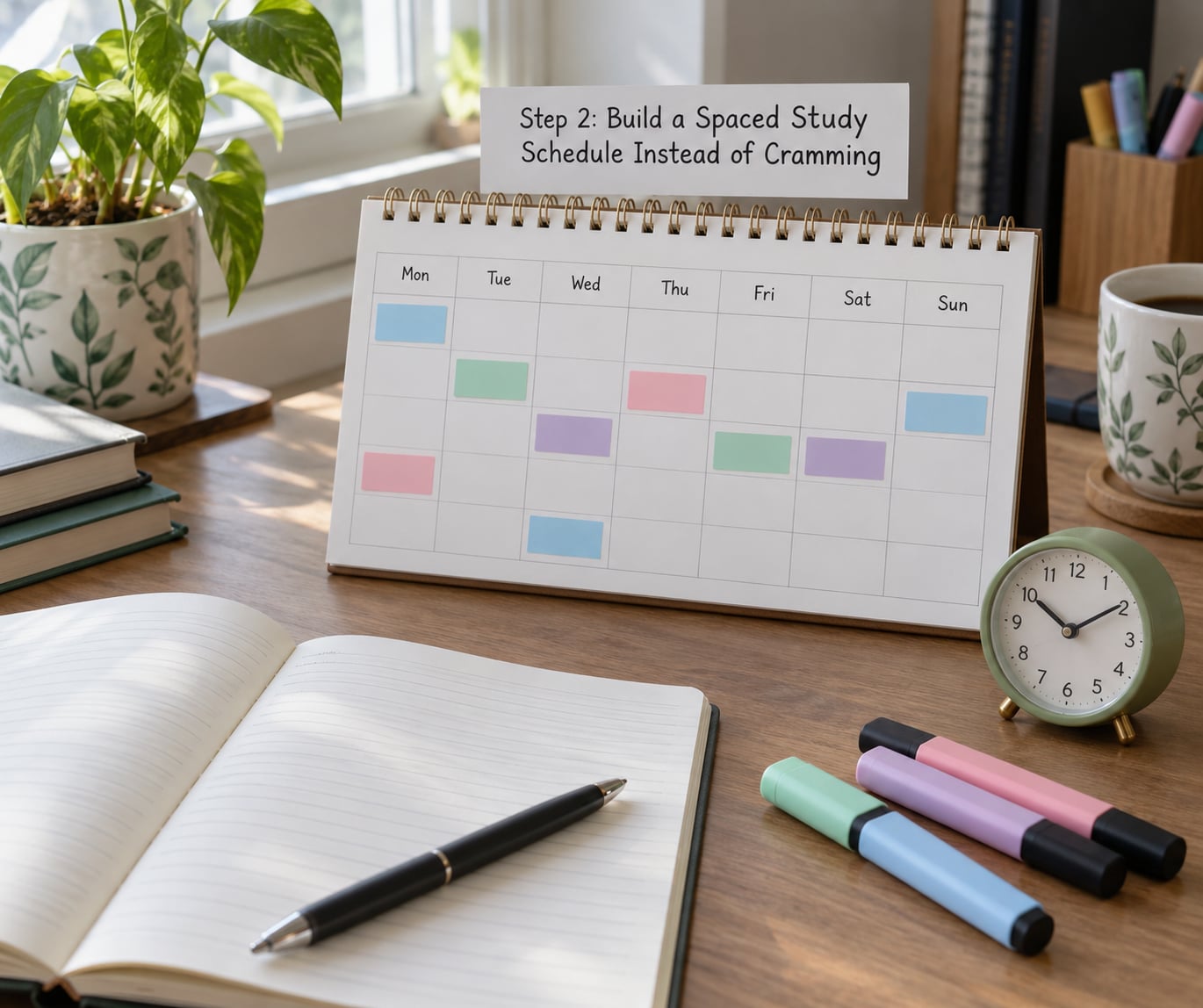
Put your first session on your calendar now, before you feel motivated. Motivation is unreliable; a booked slot is not. Keep sessions to 20 to 40 minutes with a real break between them, because attention drops well before the hour is out.
A simple pattern is Day 1, Day 3 and Day 7. Learn on Day 1, retrieve on Day 3 to check what survived, then retrieve again on Day 7. If you have longer, the 1-3-5-7 variant adds a fourth pass and spreads the whole thing over about a month.
| When | What you do | Time |
|---|---|---|
| Five days out | First pass on red and yellow topics. Learn, then retrieve. | 30-40 min |
| Four days out | First practice set, timed. Start the error log. | 25 min |
| Three days out | Second pass on whatever you got wrong. Mix in a green topic. | 30 min |
| Two days out | Full timed practice paper under exam conditions. | 60 min |
| One day out | Light review of the error log and your summary sheets only. | 30 min, then stop |
| Night before | Skim your one-page sheet. Pack your things. Sleep. | 15 min |
If you miss a day, do not try to make it up in one go. Skip to the next scheduled slot. Doubling up is how a plan turns back into cramming.
Step 3: Learn Topics in Small, Active Blocks
Work one objective at a time, not one chapter at a time. A 25-minute block looks like this: five minutes to frame the topic and note what you expect, twelve minutes to learn from notes and examples, then eight minutes with the notes closed to write out everything you can recall.
That last eight minutes is the part most people skip, and it is the part doing the work. The gaps in what you wrote are your study list for tomorrow.
Handwriting helps here. It is slower than typing, which sounds like a drawback, but the speed forces you to choose what matters. For anyone who retakes notes word for word, switching to pen is often the change that moves material into long-term memory instead of leaving it where it can still be seen.
Step 4: Practice Recall Instead of Rereading
Rereading feels productive because the material is right there. Recognition is easy; retrieval is not, and the test will ask you to retrieve.
Four methods work, roughly in order of strength:
- Blank-page recall. Write everything about a topic on a blank sheet, check the notes, then mark what you missed in red.
- Flashcards. One idea per card, front phrased as a question. Anki and Quizlet handle the scheduling if you want it automated.
- Teach it back. Explain a concept out loud to an empty room, a friend, or your phone. Where you stall is where the gap is.
- Self-explanation. After each section, ask why it matters and how it connects to the last one.
If you cannot study every day, set a floor of 15 minutes of recall rather than skipping. When consistency feels impossible, shrink the session until starting feels trivial, then let it grow.
Step 5: Test Yourself With Real Questions
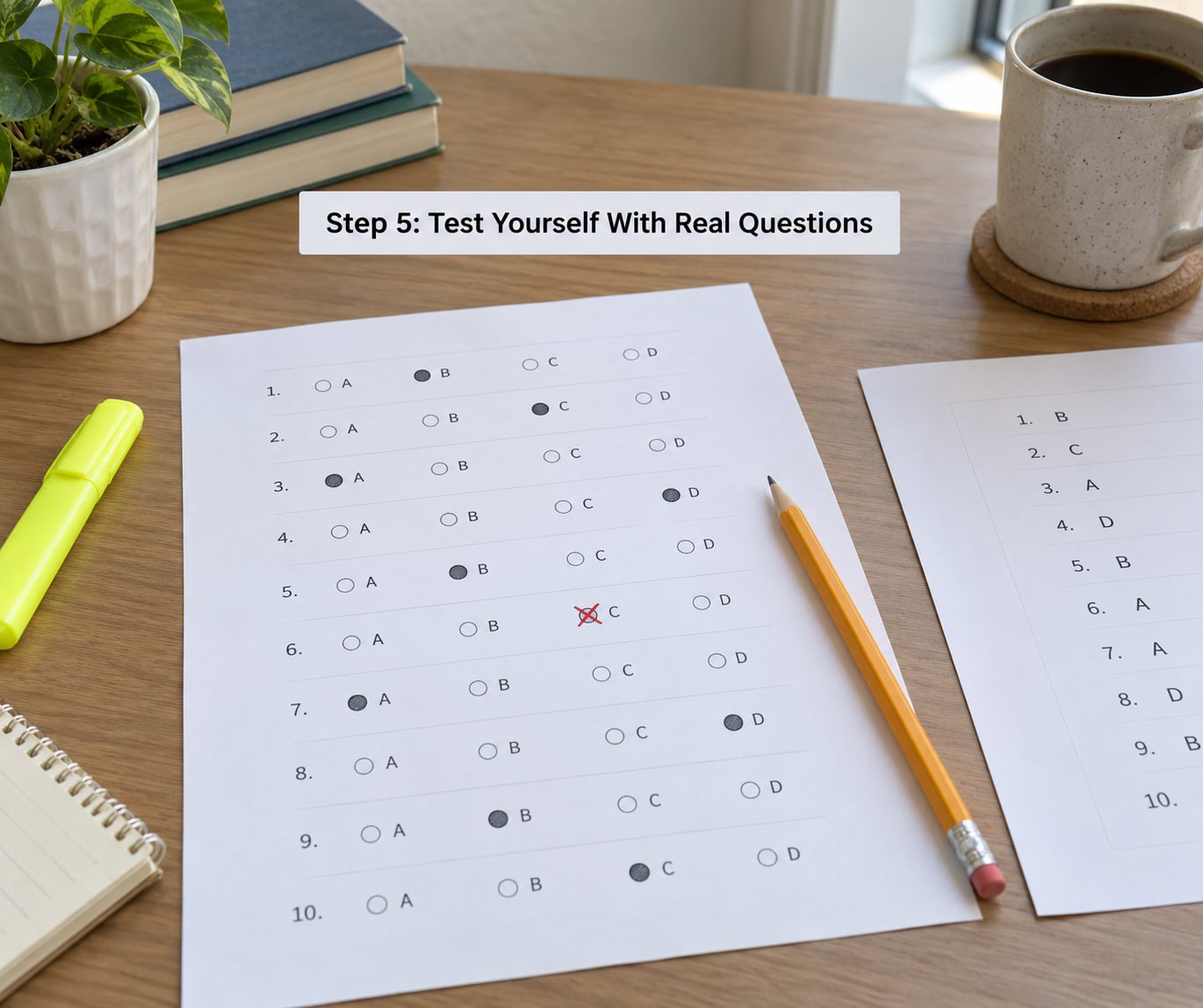
Take practice questions from the first session, not the last. Do them closed-book and timed, so the conditions resemble the real thing rather than a comfortable study session with notes open.
Then review the answers properly, including the ones you got right. Mark every miss in one place. That error log becomes the agenda for your next session, which is why it is worth ten minutes of writing rather than a quick skim.
Past papers are worth more than homemade quizzes because they show you the real weighting and phrasing. The regret students report is almost never about spending an hour on a past paper. It is about not doing it sooner.
Step 6: Finish With a Final Review Plan
The last 24 to 48 hours are for review, not new learning. Go through your error log, your summary sheets and any formula sheet. Do not open a chapter you have never touched, because unfamiliar material in the final window reliably produces panic and very little retention.
Set a stop time the night before and write it down. For a 9am exam, I would stop by 8pm, since anything learned after that competes with sleep for the same hours.
If the test is tomorrow and the syllabus is nowhere near finished, damage control beats cramming. Work through the highest-weight topics, use flashcards for facts and formulas, run one practice set, then sleep. A rested brain that knows 80% usually beats an exhausted brain that once knew 100% and lost most of it overnight.
Common Mistakes That Turn Study Into Cramming
Rereading and highlighting. Both create familiarity, not recall. Replace the third pass through a chapter with a blank-page recall on the same material.
Studying with no schedule. Open-ended sessions drift toward whatever is easiest, which is rarely what the test asks for. Use the calendar and treat the slots like appointments with yourself.
Saving practice questions for the end. If your first practice set happens the night before, it is a diagnostic, not preparation. Move one set to day one to find out where you actually stand.
Spending everything on one weak topic. If a red topic eats four sessions and still will not sit still, cap it at two sessions and move on. The marks follow coverage, not obsession.
Keeping your phone within reach. Studying with a phone beside you is really studying in two places at once, badly. Put it in another room. Not on silent, another room.
Cutting sleep to gain study hours. You lose the consolidation those hours were meant to buy, plus your focus the following morning. Stopping on time is part of the plan.
Trying to interleave everything at once. Mixing topics works, but jumping between five subjects in one block makes the block useless. Mix two or three, and keep the rest for later sessions.
A quick adaptation by subject type:
| Material type | Use mostly |
|---|---|
| Formulas and vocabulary | Flashcards and timed recall |
| Essays and theory | Past questions plus timed full answers |
| Problem sets and calculations | Redo problems without your notes in front of you |
| Diagrams and processes | Blank-page drawing from memory |
Frequently Asked Questions
How can I study for a test without cramming if I did not start early?
Triage the syllabus instead of trying to finish it. Weight every topic by exam marks and past-paper frequency, then spend your remaining sessions on the highest-weight material you are least confident about. Use practice questions to find gaps quickly instead of reading sequentially, and protect sleep the night before. A partially well-prepared rested student outperforms a fully cramming exhausted one.
How many hours per day should I study for an upcoming test?
For most subjects, one to two focused hours a day across five or more days beats a single long session. Quality matters more than length: 30 minutes of timed practice with an error log outperforms three hours of rereading. If you only have 15 minutes, do 15 minutes of active recall rather than a rushed pass over notes.
Are flashcards an effective way to study without cramming?
Yes, when each card asks one specific question and you answer before flipping. Cards are weak for essays, diagrams and multi-step problems, so pair them with past papers for those. Spaced repetition apps such as Anki or Quizlet handle the scheduling for you by showing a card again shortly before you would forget it.
What should I do if I cannot remember anything while studying?
That feeling is normal early on, and it means the material is unencoded rather than lost. Return to it for one short learning session, then close the notes and try again. Write down what you do recall even if it is fragmentary. If recall accuracy is still near zero after two or three sessions on one topic, move on and let spacing catch up.
Should I study the night before a test or get more sleep?
Do a short review and get proper sleep. Read your error log and summary sheet for fifteen to thirty minutes, then stop at a fixed time you set earlier. Consolidation happens overnight, and an exhausted morning costs more than the last hour of reviewing gains you.
How do I decide which topics need the most study time?
Cross two lists: how many marks each topic is worth, and how confident you are on it. High weight plus low confidence gets the most time. High weight plus high confidence needs only maintenance, and low weight topics can often be handled with flashcards. Past papers are the fastest way to get the weighting right.
Conclusion
The whole method reduces to three things: write the test outline as a checklist, book three or four short spaced sessions on your calendar before tonight, and run one timed practice set instead of opening your notes again.
Start with the self-test. It takes twenty minutes, it tells you what you are actually facing, and it is the moment most people realise they do not need four hours in a panic. Everything after that is just fixing what the practice set exposed.