Learning how to get a letter of recommendation comes down to five steps: pick someone who actually knows your work, ask them early, hand them everything they need to write without chasing you, follow up once near the deadline, and thank them afterward. Most letters fail not because the writer is unwilling but because the request arrives late or arrives empty.
The whole process takes about six to eight weeks if you start now. It is uncomfortable, especially the first ask, and it gets much easier once you have done it once.
Table of Contents
- What You Need
- Step-by-Step
- How to Choose the Right Person to Ask
- How to Ask Someone for a Recommendation
- What to Include in Your Request
- How to Follow Up Without Being Pushy
- How to Submit the Recommendation
- Common Mistakes
- Frequently Asked Questions
- How far in advance should I ask for a letter of recommendation?
- Can I ask a professor I never took a class with?
- What should I include in an email asking for a recommendation?
- How do I follow up if I do not hear back?
- Should I write the recommendation letter for the person?
- What should I do if my first-choice recommender says no?
- Conclusion
What You Need

Before you contact anyone, assemble the packet that makes the writing easy. A recommender who has to reconstruct who you are will either decline or write something forgettable.
- The deadline. The date the letter must be submitted, plus the date the school considers it on time. Those are often different, and the gap is where people get burned.
- The program details. School, program, degree level, and the submission method the institution uses.
- Any letter prompts or guidelines. Many committees tell you what they want to hear, and repeating those prompts in your request makes the letter land better.
- Your resume or CV, updated for the specific application rather than the generic version.
- A one-page brag sheet: a plain list of accomplishments, projects, roles, awards, and dates that you are proud of.
- Your personal statement or essay, or at least a paragraph on your goals.
- Two or three candidate recommenders, with backup names in case the first choice says no.
- Contact details and the portal link, so the letter goes to the right place without you repeating yourself later.
A calendar matters more than people expect. Count backwards from the deadline by six to eight weeks and set your ask date there, not the deadline itself.
Step-by-Step
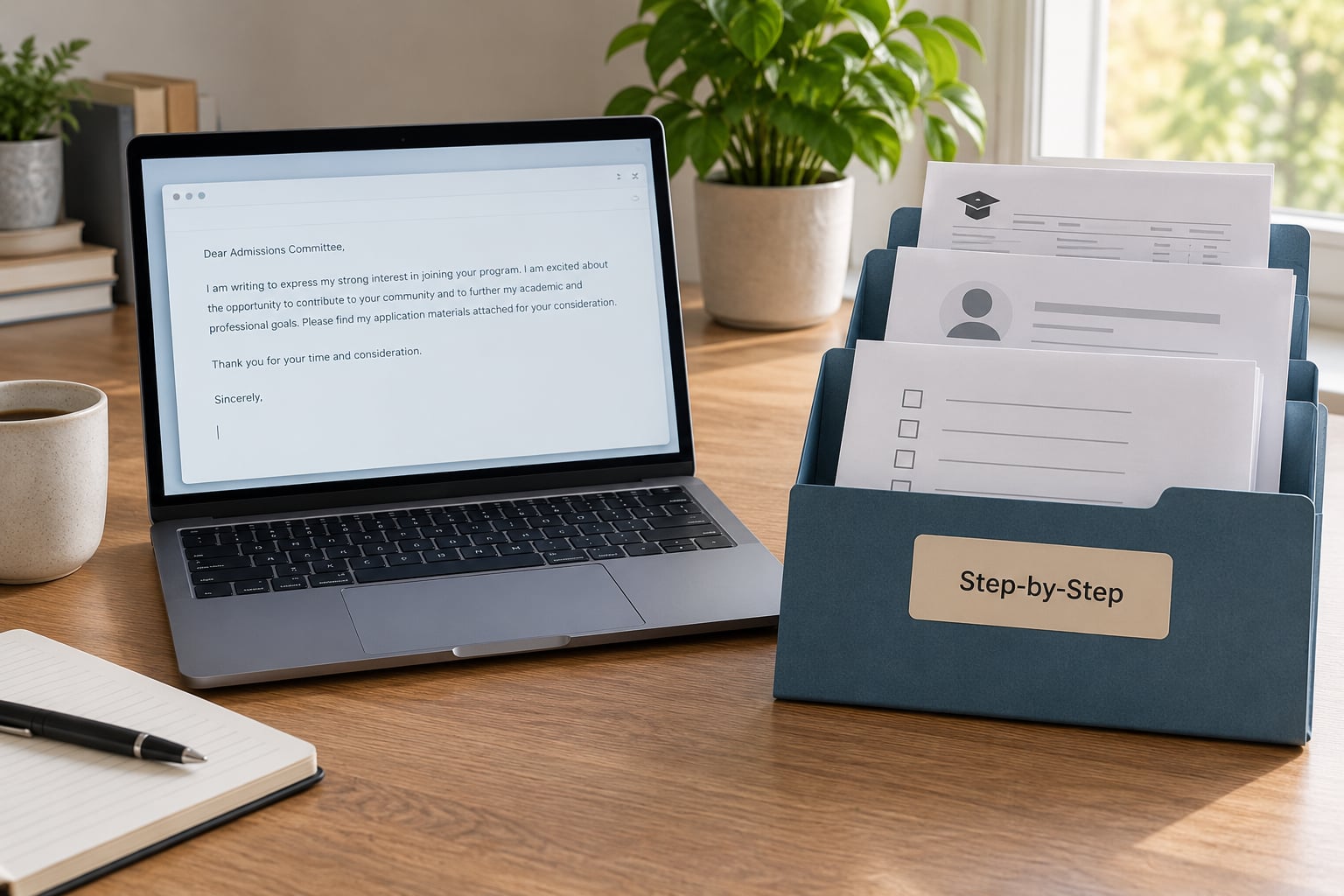
Here is the order that works, and roughly how long each step takes.
How to Choose the Right Person to Ask
Choose by access to your work, not by title. A supervisor who watched you handle a difficult client for a year can describe how you work under pressure. A famous person who met you once at a conference cannot.
The strongest recommenders fall into a few groups. Academics who taught you, graded your writing, or supervised your research. Supervisors or managers who can speak to your judgment and follow-through. Coaches, mentors, and community leaders who have watched you over time. Peers or classmates who saw you closely, which some programs accept and some do not.
Do not ask someone simply because they are famous, because you got an A, or because their title looks good on an application. Committees can spot a thin letter, and the wrong recommender is worse than one fewer letter. The AI overviews that rank for this question make the same point: popularity is not evidence.
Who fits which application:
| Application type | Strongest recommenders | Usually accepted |
|---|---|---|
| Undergraduate college | Teachers, counselors, coaches, activity leaders | Mostly non-academic references |
| Graduate school | Research supervisors, professors, thesis advisors | Usually at least one academic reference |
| Business or law school | Managers, supervisors, former employers | Academic or professional mix |
| Job application | Direct managers, colleagues, clients you served | Professional references |
| Scholarship or fellowship | Mentors, program directors, community leaders | Usually open to non-academic |
| Certification or licensing | Supervisors and senior colleagues | Professional references |
If you genuinely do not know anyone, the answer is to build the relationship before you need the letter. Volunteer for something the person runs, ask for feedback on your work, show up twice. After a few months you are no longer a stranger with a request, and asking becomes reasonable.
Career changers and adults returning to school usually have stronger letters than they expect. A manager of eight years, a volunteer coordinator, a former teacher, or a long-term client can describe reliability in concrete terms, which is exactly what an academic letter about coursework cannot do for you. If this is your first pass at how to get a letter of recommendation and your resume is thin on academic credentials, lean into that evidence instead of apologizing for the gap.
How to Ask Someone for a Recommendation
Ask in person when you can, then follow up in writing. Reddit’s r/GradSchool consensus is roughly the same: in person first, a phone call as fallback, email next, and never a text. A text signals that the request is less important than the rest of your inbox.
Professors on r/Professors have said plainly that they accept requests when they get advance notice and full context, and decline otherwise. That is the whole negotiation, stated out loud.
Spoken version, about twenty seconds:
Professor Alvarez, do you have two minutes? I am applying to the urban planning master’s program at [school], and I wondered whether you would be willing to write a recommendation for me. My strongest work with you was the capstone on [topic]. The deadline is [date], and if the timing does not work I completely understand.
Written version, copy this and fill in the blanks:
Subject: Recommendation request for [program] — deadline [date]
Dear [name],
I hope this finds you well. I am applying to [program] at [school] and I would be grateful if you would consider writing a recommendation letter for me.
We worked together [brief context: course, role, project, dates]. Of that work, I am most proud of [one specific thing], and [one skill or trait the person actually saw].
The deadline for the letter is [date]. The committee asks that recommenders address [paste the prompts]. I have attached my resume, a one-page brag sheet, and my statement of purpose, and I am happy to send a draft or answer any questions.
If this is not something you have time for, please just let me know. I will find another way.
Thank you for considering it,
[name]
That last paragraph matters. It gives the person a clean exit, which makes a yes more likely rather than less.
What to Include in Your Request
Your job is to reduce the writer’s workload. Send everything in one message, not in stages.
- Your resume or CV, tailored to that program.
- The brag sheet: roles, projects, dates, measurable results, awards, and anything you want named in the letter.
- The deadline and the program’s letter prompts, copied in rather than linked.
- The submission instructions, including the portal link or address.
- A short paragraph on why this program matters to you, which gives the writer something concrete to connect you to.
- Two or three suggested points, phrased as examples, not instructions.
Keep the whole packet under four pages. Recommenders write these between other work, and a tight request reads as respect for their time.
Some writers ask if they can see a draft. Sharing a draft for accuracy is normal and fine. Writing the letter for them is a different thing, and more on that below.
How to Follow Up Without Being Pushy
Send exactly one reminder, about two weeks before the deadline, and make it easy to answer. Getting how to get a letter of recommendation right is mostly about rhythm: one ask, one nudge, one thank-you.
Hi [name], just checking in on the [program] recommendation. The deadline is [date], and the portal asks recommenders to submit through [link]. If anything is missing from the packet I sent over, tell me and I will get it to you today. No rush if you are traveling or mid-semester.
If the deadline is close and you have heard nothing, follow up once more with a specific offer to extend the deadline in writing. That one sentence often unlocks a stalled letter, because the recommender is worried about missing it rather than unwilling to write.
Check the application portal yourself. Most systems show a letter as received, requested, or missing, and that status often appears days before the recommender tells you anything. Catching a missing letter two weeks out beats discovering it after submission.
If the answer is no, do not take it personally or argue. Thank them, ask whether they can point you to someone else, and move to your second name the same week.
How to Submit the Recommendation
Most schools now use an online portal where you enter the recommender’s details and the school emails the person a link. That is the normal route for undergraduate applications through services like the Common App or Coalition Application, and many graduate programs run something similar.
Some programs still want a sealed envelope or a letter handed in by the applicant. Older applications, conservatory programs, and some professional programs do this. Check the instructions twice, because submitting the wrong way can mean an unread letter.
Three checks before you close the application:
- The portal shows each letter as received, not as pending.
- Every recommender’s name and title are spelled the way they appear on their own documents.
- Your own contact details are current in case the committee has a question.
Common Mistakes
Almost every weak letter traces back to one of a handful of avoidable errors. Knowing how to get a letter of recommendation is mostly knowing which of these to avoid.
Asking two weeks before the deadline. Short-notice requests get declined, and the writer is right to decline. Fix: ask at least four to six weeks out, six to eight weeks for graduate school, internships, and anything with a competitive deadline.
Sending a generic request that reads like a mass email. One sentence about what you actually did together is the difference between a letter and a form letter. Fix: name the class, the project, or the role, and one moment you handled well.
Asking without providing context. A request with no deadline, no program, and no attached resume sits at the bottom of a crowded inbox. Fix: attach everything in the first message.
Choosing a famous stranger over a familiar witness. A letter from someone who met you once is thin, and it can read worse than no letter at all. Fix: pick the person who saw the most of your actual work.
Choosing a recommender who is unreachable or leaving the country. Check that the person checks email and will be around during the writing window. Fix: keep a second and third candidate ready.
Writing the letter yourself, or paying someone to. Admissions offices treat a self-written reference as a serious integrity problem, and it can end an application on its own. Fix: offer a draft for factual accuracy only, clearly labeled as a starting point.
Chasing hard. Three unanswered messages and a deadline that has already passed help nobody. Fix: one reminder, then escalate politely and accept that you may need a different letter.
Forgetting the thank-you. A short note after submission costs five minutes and keeps the relationship open for graduate school, references, and jobs later.
Frequently Asked Questions
How far in advance should I ask for a letter of recommendation?
Ask at least four to six weeks before the deadline, and six to eight weeks for graduate school, fellowships, and competitive scholarships. Two weeks is the bare minimum and usually gets declined. The longer lead time you give, the more likely the writer is to say yes, because they have room in their term to fit it in. If your deadline is closer than that, ask anyway and be honest about the date.
Can I ask a professor I never took a class with?
You can, but the odds are low. A professor who never observed your work has nothing to describe, and most will point you to someone who has. The exceptions are faculty you have done research with, advisers who mentored you outside a classroom, or people you have worked with repeatedly on a project. Treat an introduction from a mutual contact as the only realistic route.
What should I include in an email asking for a recommendation?
Include your resume or CV, a one-page brag sheet, the program name, the submission deadline, and any prompts the committee gave recommenders. Add one or two sentences about what you worked on together and one specific moment that shows your work habits. State plainly that a no is fine. Everything should fit in four pages.
How do I follow up if I do not hear back?
Send one reminder about two weeks before the deadline, keep it short, and offer to send a draft or extend the deadline in writing. Check the application portal to see whether the letter has already been received. If nothing has arrived a week before the deadline, contact the admissions office and ask how much grace they allow. Then activate your backup recommender.
Should I write the recommendation letter for the person?
Offering a draft for factual accuracy is normal and usually welcomed. Writing the letter yourself and passing it off as theirs, or paying a service to do it, is considered a form of academic dishonesty and can void an application. If a recommender asks you to draft it, provide bullet points about your work and let them write the prose in their own voice.
What should I do if my first-choice recommender says no?
Thank them, ask whether they can recommend someone else, and move to your second name that week. Tell the program nothing unless they ask; most schools simply require that the number of letters arrive. If a program insists on an academic reference and you cannot get one, contact the admissions office before the deadline and ask about alternatives such as a letter of support with supplemental materials.
Conclusion
Start this week rather than next. Identify two or three people who have actually seen your work, check the recency of each relationship, and confirm in a single conversation that they are willing before you send anything formal.
Then build the packet: resume, brag sheet, program details, deadline, submission instructions. Ask in person where you can, follow up once, and thank them at the end. That is the whole process, and it works. If you have never run through how to get a letter of recommendation before, do one complete cycle on an application that matters less than the one you actually care about, and the second time will feel ordinary.