To interview someone for a story, prepare a short list of open-ended questions, decide in advance what you still need to learn, then open with an honest explanation of who you are, where the story will appear and how their words will be used. Listen more than you talk, follow up on what surprises you, and check quotes with them before you publish. This is about interviewing a person as a source, not a job candidate.
That last distinction matters, because search results for this question are crowded with HR advice about hiring interviews. Nothing below has anything to do with assessing a candidate. It is about sitting down with a neighbour, a student, a participant or a community member and getting the details, scenes and reflections that make a story true rather than merely plausible.
The interview is where the story is actually made. Notes and research give you a frame, but only the conversation gives you the line you did not know to ask for. The same person can produce three different stories depending on whether you asked “What happened?” or “Take me back to the morning you decided to go.” Technique is the difference between usable material and a page of nothing.
Table of Contents
- What You Need
- How to Interview Someone for a Story: Step-by-Step
- 1. Define the story and what you need to learn
- 2. Research without writing the answer in advance
- 3. Build an open-ended question sequence
- 4. Set consent, boundaries, and recording expectations
- 5. Begin with context and build rapport
- 6. Listen actively and follow the story’s meaning
- 7. Verify important details without breaking trust
- 8. Close carefully and explain what happens next
- Common Mistakes
- Frequently Asked Questions
- How long should an interview be?
- How do I prepare when I know very little about the person?
- How do I handle silence during an interview?
- How do I ask about sensitive experiences without causing harm?
- Should I record an interview or take notes?
- Should I check quotes with the person before publishing?
- Conclusion: Start With Purpose and Trust
What You Need
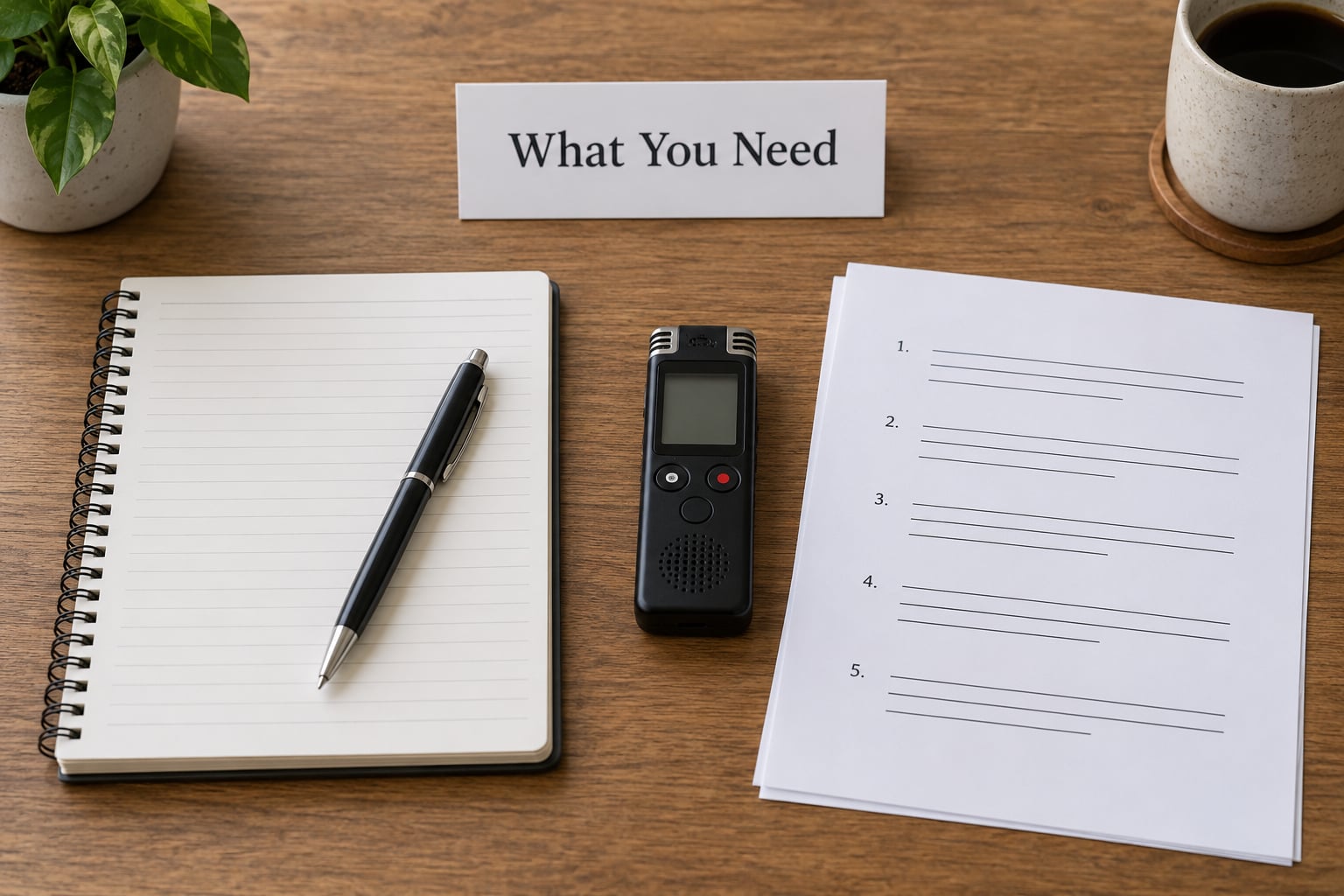
A story angle in one sentence. Not a thesis, just the reason this person matters to what you are writing. If you cannot finish that sentence, the interview will drift.
A way to check facts. Names, dates, spellings, job titles, figures. Either you have a reliable route to confirm them later, or you ask about them carefully in the room. Step seven covers how.
A quiet place with a door that closes. Kitchen tables beat coffee shops for a first conversation, because background noise makes people speak shorter and softer. If the meeting is remote, treat headphones and a known-good connection as the equivalent of a closed door.
A recording device, if the person has agreed to be recorded. Ask before you press record, not after. A phone on the table in plain view records better than a tiny recorder in a pocket, and it looks less like surveillance.
Somewhere to keep your notes. Paper beats a laptop for eye contact, and a laptop becomes a wall. Either way, build in ten minutes after the interview to expand shorthand into full sentences while it’s still fresh.
A list of open-ended questions, roughly eight to twelve, ordered but not scripted. You will use perhaps half of them.
Two things that are easy to forget. Ask whether the person needs an interpreter, a step-free room, or a different time of day, and treat any request for a break as normal rather than as a problem. If the story touches grief, violence or illness, slow the whole process down: fewer questions, longer pauses, and an explicit promise they can stop at any point.
How to Interview Someone for a Story: Step-by-Step
1. Define the story and what you need to learn
Turn a broad idea into one focused interview objective. “Mental health in this neighbourhood” is a subject. “How a community program changed access to counseling” is an interview goal, and it tells you what to ask for.
Write down four things before you make contact: the central question, the context a reader needs, the evidence available to you, and what can wait for another story. That last item is the one that saves you. An interview that tries to answer everything ends up shallow on all of it.
You know the setup worked when you can name the one thing only this person can tell you. If you can’t, they may be interesting, but they aren’t necessary yet.
2. Research without writing the answer in advance
Read enough to be dangerous but not so much that you walk in with conclusions. Look for public records, existing coverage, the organization’s own reports, and anything the person has already published or posted. The goal is to find gaps, not to build a script that makes the gaps disappear.
Separate what you know from what you assume. Write the assumptions down, because assumptions are the ones that leak into your voice as leading questions: “When the program collapsed, how did that feel?” presumes the collapse and the feeling.
Research also protects against asking what they have already answered a hundred times. On forums, working journalists and students repeatedly recommend skipping the celebrity and approaching ordinary people instead, because a community member with real experience has not been interviewed for this story before.
The signal that your research worked: you arrive curious about a specific gap, and the first five minutes of the conversation send you in a direction your notes did not.
3. Build an open-ended question sequence
Move from broad to specific: context, then narrative, then detail, then meaning. “Tell me about the program” opens the door. “What happened the first time you called?” narrows it. “What did you think the clinic would say?” gets you inside the moment. “Why do you think that?” gets you the part only they can give.
Rewrite anything that can be answered with yes or no. These four swaps do most of the work:
- “Was the first visit scary?” becomes “What was going through your head on the way there?” — a described scene instead of a one-word answer.
- “Do you think the program works?” becomes “What changed for you after a few months?” — evidence you can quote rather than an opinion to interpret.
- “When did you decide to get involved?” becomes “Tell me about the day you decided to get involved.” — a dated memory with people and weather in it.
- “How did your family react?” becomes “Who was the first person you told, and what did they say?” — a relationship and a line of dialogue.
Keep the order loose. Read your list before you start so it is not a surprise, then put it down. If you are delivering questions from a page, your voice changes, and people hear it.
4. Set consent, boundaries, and recording expectations
Consent is not a form. It is a conversation you have out loud, in plain language, before the recorder goes on: what you are working on, who it is for, roughly how long it will take, and that you would like to record so you do not misquote anyone.
Then say the part people actually care about: they can skip any question, stop at any time, ask you to turn the recorder off, or ask for something to be off the record or unattributed. If you cannot honor anonymity in your publication, say so now rather than after you have the tape.
Offer practical accommodations without making the person ask twice. Some people prefer a phone call to a room. Some need a relative present, or need the questions in advance, or need you to slow down. Some simply need to hear that this is an ordinary Tuesday and nobody is in trouble.
If you have already pitched them a story you are not going to write, or sent repeated follow-up emails, correct it here. People assume a conclusion exists before the conversation starts; unexplained pursuit is the fastest way to lose a source and your credibility.
5. Begin with context and build rapport

Open by saying who you are, what you are writing, and how you found them, then hand the conversation over. Something like: “Thanks for making time. I’m writing a piece about how the food pantry program got started here, and I want to understand it from the people who ran it. I’ll ask about ten questions, maybe forty minutes, and I can send you anything I quote before it runs. Where would you like to start?”
Your own nervousness transfers straight across the table, and so does calm. Give yourself a minute to settle before the recording starts. Small talk is not wasted time, but keep it short and let the subject steer it; a story usually announces itself within five minutes if you stop filling space.
Nerves look like short answers. So does expertise, exhaustion and bad weather. Notice which one you are dealing with before you change tactics: someone who gives you one line might simply need a scene to talk from, not a better question.
6. Listen actively and follow the story’s meaning
Stop planning while they talk. Listen for emotion, change over time, causes, decisions and contradictions. A repeated phrase is usually the real subject of the interview, and a detail you did not expect is usually the lede.
Your follow-up bank can be small. “Take me back to that moment.” “What happened next?” “How did that feel at the time?” “Why do you think it went that way?” “You said X — what did you mean by that?” “Has that changed since?” Each one buys you another layer, and none of them sounds like an interrogation if you say them gently.
Use silence as a tool. When someone stops, count slowly to three before filling the gap. Most of the time they are arranging their thoughts, and the sentence after the pause is usually the honest one. Do not grab the quiet to rescue yourself.
Aim for roughly a 20/80 split, with them doing most of the talking. If you have been talking for two minutes, ask a question. If you want to summarize, do it briefly and check it: “So the grant ran out in March and the pantry moved to the church basement — is that right?” People correct you, and the corrections are free accuracy.
If they go off on a tangent, do not cut them off mid-sentence. Note where they drifted, let it run, and steer with a question rather than a steering wheel: “You mentioned your old supervisor. How did you two end up working together?”
7. Verify important details without breaking trust
Names, dates, spellings, titles, numbers, and the exact wording of anything you might quote all need checking. Two moves do most of it: say it back during the conversation and check the transcript afterwards.
“Your program started the spring after the lease was signed — is that right?” is a question. “You started that spring, right?” is a trap with a question mark on it. When records are incomplete, say so: “I can’t confirm the date from the public filings, so I’ll describe it as early that year. Does that match your memory?” That protects your accuracy and keeps the person from feeling accused.
Ask for complete sentences when you are recording, especially for anything you might cut down later. A clip that begins “so yeah, and then she…” is unusable; a complete sentence is editable, an unfinished one often is not.
The line to hold: you are checking facts, not testing the person. If your questions start sounding like a cross-examination, say what you are doing and why, and let them respond.
8. Close carefully and explain what happens next
Ask before you let the moment pass: “Is there anything about this I should have asked and didn’t?” Real interviews often produce their best material here, because the pressure is off. Then ask who else I should talk to, and what I am getting wrong.
Sum up what you promised: where the story will run, when, that you will send quotes for a check, and what happens if they want something changed. Say it out loud and write it down before you leave. If you promised a review copy, send it.
End with something short and human: “Thank you for the time, and for the part about your mother’s kitchen. That is the detail the story needs.” Then leave. Lingering after the recorder stops reads as suspicion, and pushing for one more quote is how good interviews get worse.
Common Mistakes
Asking yes-or-no questions and blaming the answer for being useless. The question closed the door. Fix it by turning the last five questions you asked into openings: add “why,” or “tell me about that.”
Talking over the subject. You will do it once. Watch for it, apologize briefly if you steamroll a sentence, and let them finish the thought.
Moving too fast. A person who has never been interviewed needs context and pace, especially at the start. Silence at the beginning feels like a mistake to you and like safety to them. Slow down and the material usually catches up.
Stating assumptions as fact. “After you were laid off” is an assumption wearing a suit. Test it and let them correct you.
Skipping consent because the conversation is going well. Especially when it is going well. Record nothing and promise nothing without saying so first.
Overloading them. Twenty questions in ninety minutes produces fatigue, not depth. Most stories need six good answers, and a person who is tired starts giving you the sentence they think you want.
Stopping without warning. There is no graceful drift into goodbye. Ask, “Have you got another twenty minutes, or shall we call it here?” and accept the answer.
For sensitive or high-stakes stories, three adjustments pay off. Ask whether they want to be identified at the start, not at the end. Plan fewer questions and more breaks. And decide in advance what you will do if they ask to stop — the answer is that you stop, and that you tell them you will.
Frequently Asked Questions
How long should an interview be?
About an hour is the useful default, with the first ten minutes for context and consent and the last ten for anything you missed. Forty-five minutes works well for a first conversation with someone new to media. Length is less important than leaving before fatigue turns their answers into summaries of summaries. If you have fifteen minutes only, ask three questions rather than cramming twelve.
How do I prepare when I know very little about the person?
Prepare the subject, not the person. Read enough public material to know the general context, then build questions around what you do not know rather than around what you have already confirmed. Open with two or three broad questions and let their answers decide the rest. A useful sequence leaves you with room to abandon the plan entirely if the conversation goes somewhere better.
How do I handle silence during an interview?
Treat it as part of the conversation, not a failure. When a person stops talking, wait and count slowly to three before speaking. Most of the time they are putting thoughts in order, and what comes after the pause tends to be more honest than what came before. If the silence stretches past ten seconds, a gentle prompt works better than another question: take your time, or tell me more about that.
How do I ask about sensitive experiences without causing harm?
Explain what you are asking and why, let them decline, and make stopping easy rather than awkward. Ask what they want to be called in the story before you get to hard material. Avoid graphic detail unless it is genuinely necessary, and offer to continue another day. If the conversation becomes distressing, stop and check in. The story will be better for the pause, and so will they.
Should I record an interview or take notes?
Record if the person agrees, and ask for complete sentences so clips stay usable when you edit them. Notes force you to listen for structure, which is valuable, and they capture only what you chose to write. Recording catches everything, including the detail you did not know you needed. Many people record and take light notes at the same time, then expand the notes into full sentences right afterward.
Should I check quotes with the person before publishing?
Send the passages you plan to quote, with the surrounding context, and ask for factual accuracy rather than approval. People rarely object to a correct quote and frequently catch a mistake in a name, date or detail you had wrong. Give them a reasonable window to respond, and if you disagree with a correction, publish carefully and explain nothing publicly about the exchange.
Conclusion: Start With Purpose and Trust
Start today by writing down your story’s central question in one sentence, then drafting six open-ended prompts beside it. Choose a quiet room, agree in advance what you will record and how their words will be used, and go looking for the ordinary person who has lived the thing you are writing about.