A short speech for a community event runs two to five minutes, or roughly 250 to 650 words, and its job is narrow: make people feel welcome, explain why the gathering matters, and leave them with one idea or one next step. Most speakers try to do too much in that window. The fix is a fixed order of work you can finish in an evening.
I’ve watched a lot of first-time speakers get talked down by a phrase they had never heard before. The speakers who land are not the most polished ones; they are the ones who arrived with a single point and had rehearsed the first thirty seconds out loud until they no longer had to think about them.
This guide walks through how to prepare a short speech for a community event from the first question you ask the organizer to the last trim before you go on stage. There is a fill-in template, a timing table, and a complete example you can adapt tonight.
Table of Contents
- What You Need
- The brief from the organizer
- One sentence about your purpose
- A real detail to anchor it
- Your own time and word count
- The kit
- How long should a short speech be?
- Step-by-Step: How To Prepare A Short Speech For A Community Event
- Step 1: Understand the Event and Your Audience
- Step 2: Choose One Clear Purpose for Your Short Speech for a Community Event
- Step 3: Build a Simple Speech Structure
- Step 4: Write for Listening
- Step 5: Rehearse and Refine
- Common Mistakes
- Frequently Asked Questions
- How long is a short speech at a community event?
- What is a good opening line for a community event speech?
- What is a good short welcome speech example?
- How do I write a speech when I am nervous?
- How should I start a student council or youth speech?
- What if my time slot is cut short at the last minute?
What You Need
Before you write a word, five things have to be settled. Any one of them left open will show up later as a stalled opening or a speech that never finds its point.
The brief from the organizer
Ask what the event is for, who else is speaking, and whether you are opening the event, introducing someone, or speaking in the middle of a programme. Also ask for the hard time limit in minutes, and whether it includes your introduction or your thank-you.
One sentence about your purpose
Write it before anything else: after this speech, the room should understand, feel, consider, or do one specific thing. “Feel welcome and start talking to their neighbours” works. “Talk about community” does not.
A real detail to anchor it
One story, one number, one moment. Gather it from a person you can name or a document you can point to. Unsupported detail is the fastest way to lose a room that came prepared to listen politely.
Your own time and word count
Measured community-event delivery runs about 125 to 140 words a minute. Under pressure, people speed up, so budget slightly below your target.
The kit
A phone for notes, a pen, a printed copy in large type with clear paragraph breaks, a bottle of water, and time the evening before to rehearse three times aloud. Printed notes matter. Phones fail, screens dim, and the room light is worse than you think.
How long should a short speech be?
There is no shared convention, which is exactly why people panic. Match the slot to the job and subtract about ten percent from your word count for pauses.
| Length | Word count | Best used for |
|---|---|---|
| 1 minute | 120 to 140 words | Introducing a guest speaker, thanking volunteers, handing over to the next item |
| 2 minutes | 240 to 270 words | Welcoming a room, opening a town hall or community forum |
| 3 to 5 minutes | 380 to 650 words | A personal reflection, a programme launch, an award or fundraiser address |
| 7 to 10 minutes | 900 to 1,300 words | A full address with several examples and a longer story |
Two minutes is the safest default for a community event. It is long enough to say something true and short enough that nobody is checking their watch.
Step-by-Step: How To Prepare A Short Speech For A Community Event
Five steps, in this order. Skipping ahead to writing is why drafts arrive at 900 words for a two-minute slot.
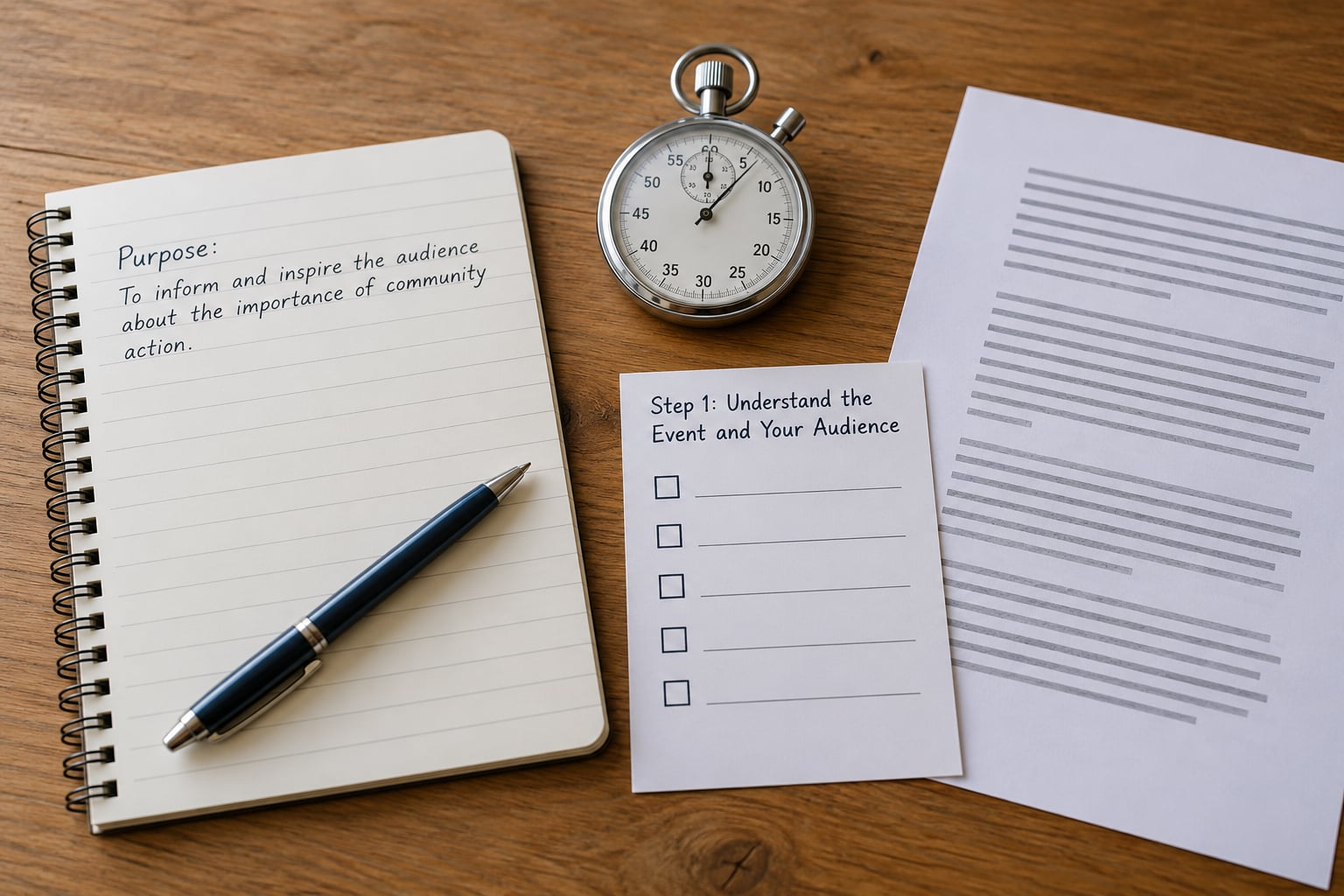
Step 1: Understand the Event and Your Audience
Ask the organizer three questions and write the answers down: what is this gathering for, what changed recently that made it happen, and what does the audience already believe about the topic. That last one does the most work, because a room that already agrees with you needs encouragement, not persuasion.
Then look at who is actually in the room. Grandparents, teenagers, parents with a child on their hip, people who arrived late and are still finding seats, people who did not come but whose interests are being decided. That mix changes your pace and your vocabulary more than any technique does.
Note the practical details too: whether a sign language interpreter is working, whether a handout will be translated, whether the microphone will be handheld or fixed. If interpretation is happening, you face the interpreter before you face the audience and you keep your sentences short.
If you’re speaking on behalf of a whole group, say who you are speaking for and who is not in the room. Community members notice when a voice is presented as the voice of everyone, and they notice the correction too.
Check the level of your language against a real person. Would a neighbour who has been waiting three years for a bus stop shelter think you were talking to them?
Step 2: Choose One Clear Purpose for Your Short Speech for a Community Event
Finish this sentence: “When you sit down, I want you to ______.” Fill it in with a verb you can picture. Know, volunteer, introduce yourself to the person beside you, sign up, speak up at the meeting on Thursday. If you cannot fill in the blank without hedging, the purpose is still vague.
Then pick the one supporting point that earns that outcome. A purpose needs an argument behind it, but only one. Two minutes gives you room for one reason, one example, and one repeat.
The forum conversations around this question keep circling the same worry: how do you speak for a group without speaking over anyone. The answer is narrower than it sounds. Name your own connection, say what you saw, and let the conclusion be an invitation rather than a verdict.
Step 3: Build a Simple Speech Structure
Five blocks. Greeting, what this event is, one main point with a story, what you want from people, and thanks. That is the whole architecture, and it maps onto the framework people in the r/LifeProTips impromptu-speech thread still cite years later: greeting, state the event, establish common ground, say why you’re speaking, call for action.
Each block gets one or two sentences of notes and nothing more. Full sentences become scripts, scripts become reading, and reading kills a room faster than a weak idea.
Here is the whole thing as a fill-in template:
- Greeting. Good evening, and thank you for being here. [Name, and the one line about why you have the microphone.]
- The event. Tonight is about [what is happening]. [One sentence on why it matters right now.]
- Common ground. Most of us got here because [shared experience]. [Second shared detail, if it is genuine.]
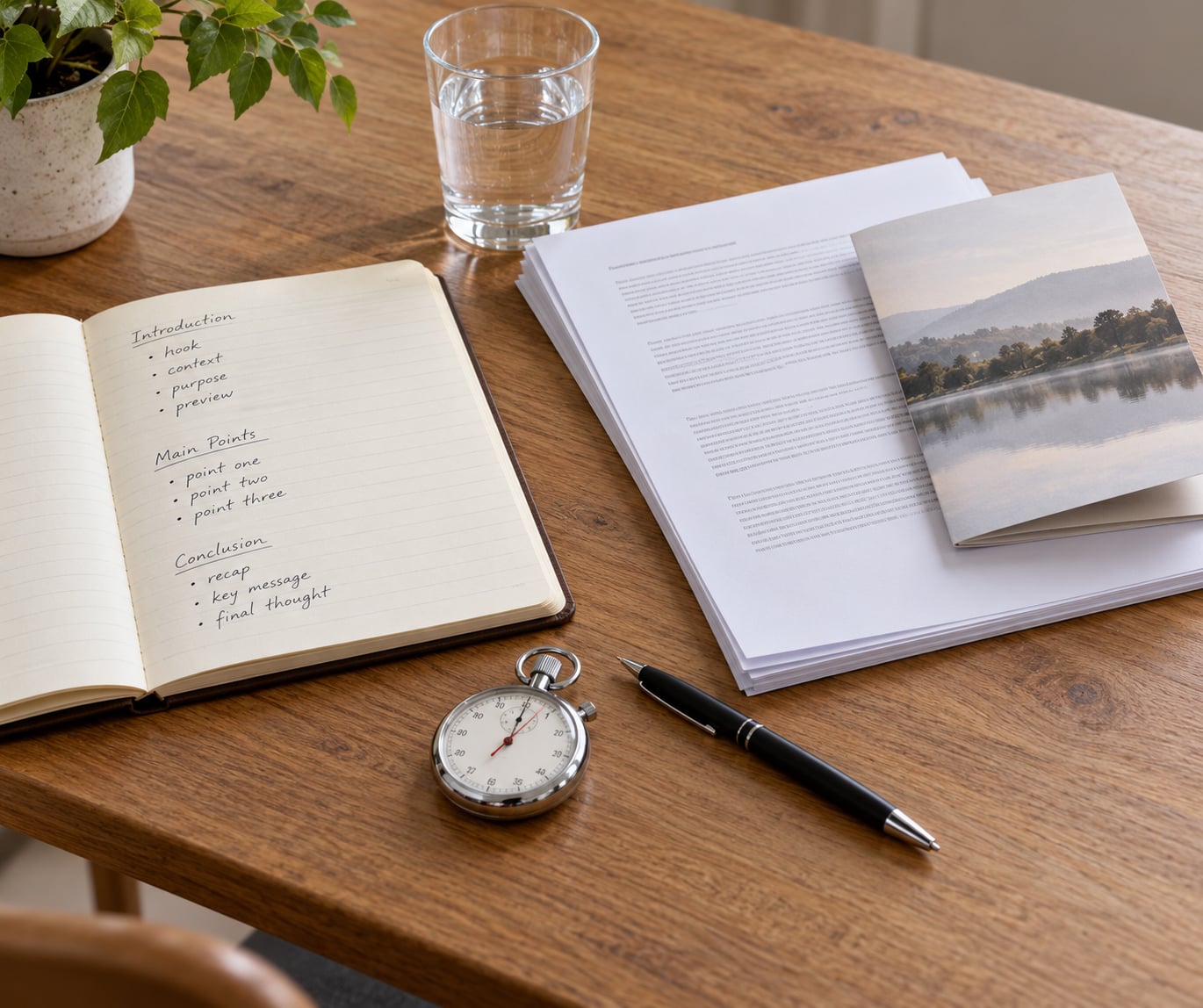
- Your one point. The thing I want to say is [main point]. [The story or detail, 60 to 80 words.]
- Call to action. So here’s what I’m asking for: [the specific thing]. [How and by when, if it applies.]
- Close. Thank you for showing up. [Hand over, or end on the repeated main point.]
To see it finished, here is a complete two-minute welcome speech for a neighbourhood tree-planting morning, annotated so you can see which block is doing which job.
“Good evening, everyone. My name is Ruth Adeyemi, and I run the planting rota for the Oakfield volunteer list. We’re here tonight to mark twelve trees going into the strip of ground behind the health centre, and to talk about what happens next.
[Greeting, name, credibility, event stated in two sentences.]
Most of us found out about this strip of ground the same way, by walking past it and wondering what it was for. For years it got used for bin bags and deliveries. Mrs. Okafor on the corner told me she had a photograph of that ground as a hedge row from 1981.
[Common ground, then the story that carries the main point. One detail, named person, verifiable.]
That hedge row came back from the same kind of planting we did this morning, planted by people who didn’t expect anyone to write anything down. So here’s my one ask of you: put your name on the planting rota for the spring session. It takes ten minutes, it’s on the sign-up sheet by the door, and a tree you planted yourself gets watered.
[Call to action: specific, low-effort, with the how and the where.]
Thank you for coming out on a cold evening. Bring your neighbour to the next one.
[Close, repeated ask, handover.]
That runs about 240 words, so roughly a minute and fifty seconds with the pauses left in. Swap the details for your own and it holds together the same way.
Step 4: Write for Listening
Your ear, not your eye, is the test. Read the draft out loud and every written sentence announces itself as one that needed breaking in half.
Cut any sentence with two or more commas in it. Cut any word you would not say to a neighbour. Replace a term like “utilisation” or “underserved demographic” with the plain word, because a term of art makes listeners stop listening to find out what it means.
Keep paragraphs to one or two sentences with a blank line between them. That is your safety net: if you lose your place, the next line tells you where you are.
Vary the length deliberately. Three short sentences, then one long one. Long enough that your voice drops at the end, which people find calming and easy to follow.
Land the last line of each block somewhere real. “Twelve trees” is a fact. “Twelve trees that would not be there if nobody here had bothered” is a line.
Step 5: Rehearse and Refine
Rehearsal is not reading. Stand up, hold the paper, and speak the words out loud, at the pace you would actually use in the room. Reading silently tells you almost nothing about timing or breath.
Time every run. Three timed rehearsals is the practical minimum, and one of them should be standing at a table with a glass of water so the setup is not new to your body. If the first run comes in over your limit, cut whole sentences, never words inside sentences. Whole sentences are what change the clock; fiddling with individual words does not.
Mark your notes where you intend to pause. Pauses read as confidence, and they are the only part of delivery you control completely.
Prepare for the version of the day that goes wrong. Rehearse the cut lines you would use if you only get 90 seconds, and rehearse the handover for introducing someone else, because the order of a community programme often changes at the last minute and you should be able to start with either your name or theirs.
Nerves show up most often when you speak to people you already know, which is the defining condition of a community event. The physiological fix is dull and effective: exhale longer than you inhale for about a minute before you go on, and keep your feet flat and still while the first sentence comes out. The first sentence is the hard one; after that you are talking to people you have already greeted.
Common Mistakes
Running over. The most-complained-about failure in community events. Write to 90 percent of your word count, and cut a whole block rather than trailing off with “and, yeah, anyway”. Signalling to the organiser that you have cut something is better than being cut off.
Rambling openings. “So, yeah, I’m here, it’s been a while, anyway, hi everyone.” Twenty seconds of that and the room has decided about you. Greet, name yourself, say why you have the microphone. Fifteen seconds, done.
A generic greeting. “Good evening everyone” is fine. “Good evening everyone, ladies and gentlemen, distinguished guests, friends and family” is not, because it lists categories of person rather than looking at the actual room. Name who is there instead.
Too many ideas. Three things is already a list, four is a newsletter. One main point, repeated, beats four points nobody can recall in the car park.
Reading verbatim. The tell is your eyes dropping to the page at the end of every sentence. Notes with keywords only, so you can look up. If you stumble, glance down. Nobody has ever noticed a speaker checking a card.
Jargon and unsupported claims. A statistic you cannot source is a liability in a room where somebody works in that field. Either find the source or drop the number.
No call to action. Not every speech needs one, but a gathering where nothing is asked of the attendees is a gathering where nothing changes afterwards. Invite one small action.
Ignoring the community context. Speaking about a group you do not belong to, or presenting one person’s experience as everyone’s, lands badly in a room that knows the difference. Speak from your own connection and say what you saw.
Waiting for a cue that is not coming. Ask in advance who brings you to the stage, who hands you the microphone, and what the hand-over sound is. On the day, arrive early, stand near the person running the programme, and hold your own copy in the order you want it read.
A few small habits carry most of the weight. Drink water before you start, not during, in case your voice sounds thin. Look at three faces, one at a time, for one full sentence each. Keep your hands above the waist and still. And finish early if you can. The person after you will forgive you for it.
Frequently Asked Questions
How long is a short speech at a community event?
Two to five minutes is the normal range, which is roughly 250 to 650 words at measured delivery. One minute is enough to introduce a guest or thank volunteers. Two minutes is the safest default for welcoming a room. Above five minutes you are giving a full address, and you should ask the organizer whether the slot really allows it.
What is a good opening line for a community event speech?
Name something specific in the room before you introduce yourself: the occasion, the weather, or one detail from the organizing. “We’ve got forty chairs out and the rain held off, which feels like a good start” does more work than any formal greeting. Keep the first fifteen seconds to who you are and why you have the microphone.
What is a good short welcome speech example?
A short welcome speech usually has four parts: a greeting that names the occasion, one sentence on why the gathering matters now, a shared detail that puts everyone in the same story, and one specific ask. The example speech in this guide follows exactly that shape in about 240 words, so it can be read aloud in under two minutes.
How do I write a speech when I am nervous?
Write more, not less, then cut it back. Nerves mostly come from having nothing memorised, so rehearse the first thirty seconds until it is automatic, and keep the rest on keywords you can glance at. Breathe out longer than you breathe in for a minute beforehand, and remember that a steady pace reads as confidence even when you do not feel it.
How should I start a student council or youth speech?
Lead with the issue you actually want solved, not with your title or your credentials. Say what you noticed, what you did about it, and what you want the group to decide today. Keep your language at the level of the room and skip acronyms. Youth speeches land best when they are short, specific, and end with a question you genuinely want answered.
What if my time slot is cut short at the last minute?
Rehearse a 90-second version as well as the full one, cutting the story rather than the point. Openers on community programmes change order often, so prepare to start with someone else’s introduction as easily as your own. If you hear your limit while speaking, finish your current sentence, deliver the call to action, and thank the room.
Start tonight, not the night before. Write the one sentence about what you want the room to walk out with, fill the template around it, then read it out loud three times with a timer. If you can say the first thirty seconds without looking down, you are ready for the rest of it.