
You rebuild trust after breaking a promise by doing four things in order: tell the truth without excuses, name the damage the promise did, make amends that match the real loss, and then prove over weeks that the behaviour changed. An apology starts the repair, but it is not the repair.
Broken trust is expensive in a specific way. The person you hurt does not only doubt one promise, they start running a background calculation on every future one, which is why they ask questions they already know the answer to, why they check, why they seem stuck on a detail you consider small.
This guide works for romantic partners, spouses, parents, friends and co-workers. If you are the one who broke the promise, most of the work is yours. If you are the one who was hurt, your job is different and no less real: you decide the pace, and you get to ask for what safety looks like.
People who have worked through this in relationship forums tend to report the same thing. Trust does come back, but it comes back through months of ordinary, verifiable reliability, not through one good conversation.
Table of Contents
- What You Need Before You Rebuild Trust
- Step-by-Step: How to Rebuild Trust After Breaking a Promise
- 1. Tell the Truth Without Excusing Yourself
- 2. Acknowledge the Impact on the Other Person
- 3. Apologize Specifically and Own the Harm
- 4. Make Amends That Address the Actual Loss
- 5. Explain the Change You Are Making
- 6. Give the Other Person Control Over the Timeline
- 7. Follow Through Consistently and Ask for Feedback
- Common Mistakes and How to Fix Them
- Frequently Asked Questions
- I broke my boyfriend’s trust. How can I fix it?
- How long does it take to rebuild trust after a broken promise?
- Is a sincere apology enough to fix a broken promise?
- What if the person I hurt will not respond to my apology?
- How do you rebuild trust in a family or at work?
- Conclusion: Start With One Honest Repair Step
What You Need Before You Rebuild Trust
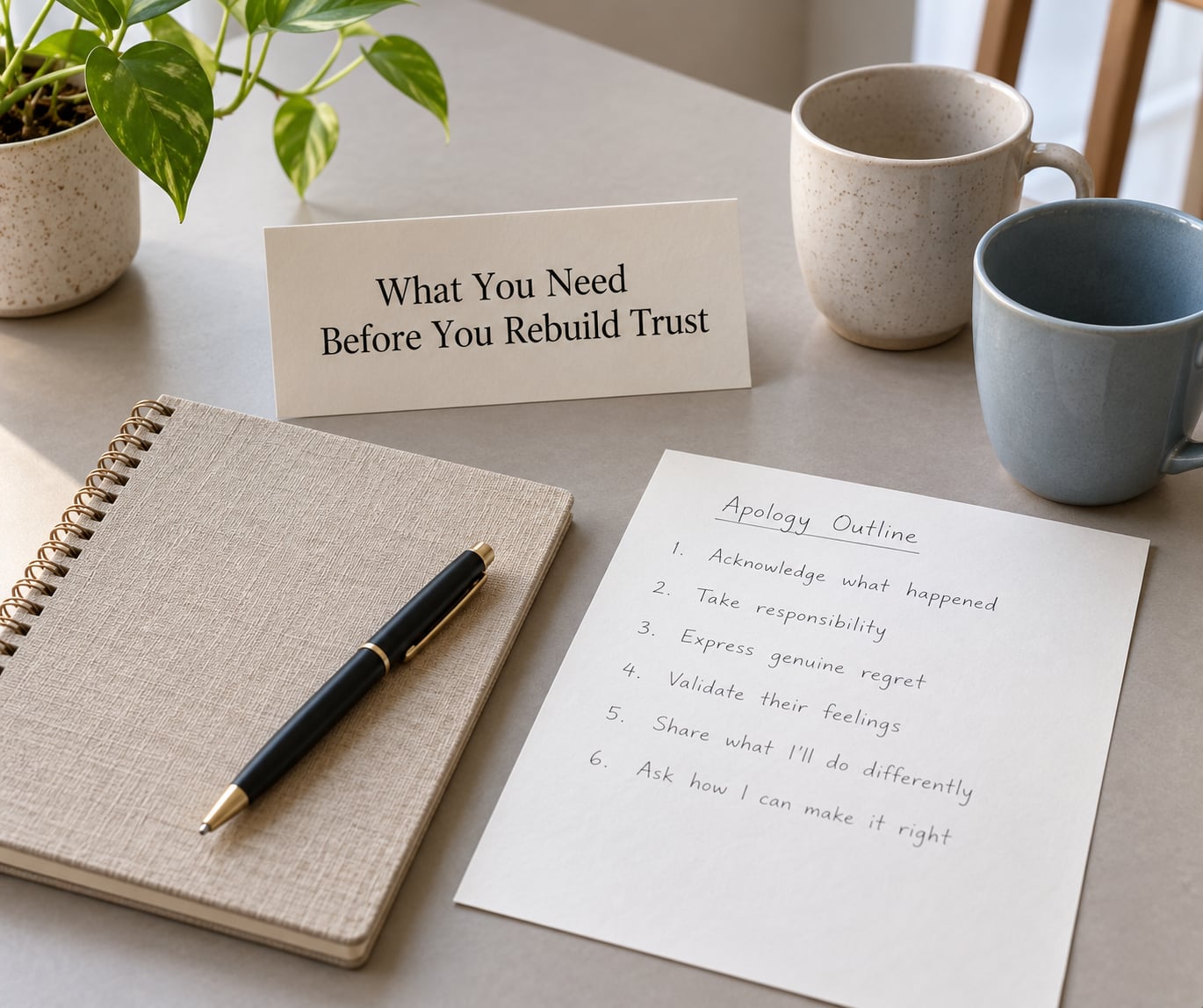
You cannot repair trust while you are still unclear about what you did. Most failed repairs fail here, in the first conversation, because the person who broke the promise is describing a slightly different event than the person who lived it.
Before you contact anyone, write down four things.
1. The exact promise. Not what you intended, not how it sounded. The words you used, the date, and the context. If you said you would be there by six, write six, not “we were going to get together.”
2. Why you broke it. The real reason, including the uninteresting ones. You forgot. Something at work ran late. You did not feel like going. You made the promise without checking your calendar.
3. The impact on them. Not the impact on you. What they had to do, cancel, rearrange, feel or decide because you were not where you said you would be.
4. A repair you can actually deliver. This is the part most people skip. Amends have to match the loss, so they need to be specific enough that the other person can see you did the thinking.
If you cannot complete those four, you are not ready to apologise yet. You are ready to apologise more honestly, which sounds similar but lands differently.
Step-by-Step: How to Rebuild Trust After Breaking a Promise
1. Tell the Truth Without Excusing Yourself
Say what happened, then stop talking. The instinct to add context arrives within about three seconds and it usually makes things worse, because context reads as defence.
Try this wording: “I promised you I would be at your place by six on Saturday. I was not. It was not because of anything that happened at work and I am not going to explain it away, because the reason is that I did not take it seriously enough to plan for.”
Keep facts separate from explanations. Facts: what you promised, what happened, when you knew. Explanations are allowed, but only after the other person has accepted the facts, and only if the explanation actually contains information they need. “I was going through a lot” usually does not.
2. Acknowledge the Impact on the Other Person
Most apologies go straight to their own feelings. “I am so sorry, I feel terrible about it.” That tells the hurt person nothing about whether you understand what happened to them.
Describe the effect from their side, using what you know rather than what you imagine. They had dinner alone and then waited an hour before deciding whether to call. They told their sister you would be there. They stopped asking you for anything for a month.
Say it simply: “You counted on me, and I was not there. That left you handling the evening alone, and I took that for granted.”
Emotional validation is not the same as agreeing you are a bad person. It is telling someone their reaction makes sense. If they cry, do not explain the tears. Let them finish.
3. Apologize Specifically and Own the Harm
A useful apology names the promise, the breach, the impact, and the change. Vague apologies fail because they can be applied to almost any situation, which means they carry almost no information.
The structure: “I said I would call you Sunday evening. I did not call. That meant you sat with that all night and I was not reachable when you needed me. That was my choice, not bad timing. I am sorry, and I will not make it again.”
Three phrases damage an apology. “I just want you to know…” usually leads somewhere defensive. “If you were hurt by that…” puts the reaction in question. “You already know I would never…” asks them to reassure you.
One more thing to watch: an apology that ends with “can you forgive me?” quietly transfers the work. You apologise, then hand them a decision they did not ask to make right now.
4. Make Amends That Address the Actual Loss
Amends are where repair becomes visible, so they need to match the damage rather than your guilt. Guilt is about you. The loss is about them.
If you cancelled plans, show up. Not with a speech, just with the thing you said you would do. If you were supposed to finish work and did not, finish it or hand over what remains with a real timeline. If the promise involved money, repay it, and if there is interest or a fee you caused, cover it.
If the loss cannot be fixed, name it. “I cannot give you back that weekend” is honest. Amends that pretend otherwise read as a second broken promise.
Be careful with grand gestures. A large gesture inside the first week often reads as buying your way out. It also raises the bar: the next failure costs more.
5. Explain the Change You Are Making
People trust systems more than resolutions. Tell them what is different now, in operational terms rather than emotional terms.
“I will not make plans I have not checked” is weak. “I now add anything with a fixed time to my calendar the day I agree to it, and I tell you by Thursday if the time is at risk” is strong. One describes an intention, the other describes a procedure you can verify.
Other changes that hold up: a reminder set the moment you commit, a phone calendar shared only for the times you promised, asking for help early when plans start looking uncertain, or checking in before the week gets full instead of after.
Also fix the conditions around the promise. If you break promises when you are overwhelmed or drinking or avoiding a hard conversation, that pattern is part of what caused the breach, and repair means changing it, not just the specific promise.
6. Give the Other Person Control Over the Timeline
This is the step that gets skipped most often, and it is the one the hurt person notices first. Trust is restored on their clock, not yours.
Ask directly: “What would help you feel safer right now, and what would make this harder?” Then take the answer seriously, including the parts you dislike. They may want to see your calendar. They may want you to check in before plans change. They may want six months of no cancelled dates before they sleep well.
Some people install location sharing. Some want access to a phone. Others find surveillance more damaging than the breach was, because it means living under observation. Ask, then follow the answer instead of deciding for them.
When they set a boundary that is smaller than you expected, that is not a punishment. It is them rebuilding at a rate they can survive. Expanding the boundary endlessly is a defence move, and people who do it usually end up back where they started.
7. Follow Through Consistently and Ask for Feedback
Trust deposits, in Brené Brown’s terms, are small and repeated. The small unremarkable things you said you would do, and did. Most of trust rebuilding is boring on purpose.
Do not treat every kept promise as evidence that things are fine. Ask instead, in a low-stakes moment: “Is anything feeling more solid than last month, or the same?” Let the answer be the same. Feedback without defensiveness is what makes the next hard conversation survivable.
Watch for the trigger. Someone can be doing well for six weeks and then, the week their mother is in hospital, ask the same question they asked in month one. That is a triggered response, not a failure of progress. Answer it plainly and move on rather than treating it as evidence that nothing changed.
Be honest when circumstances change too. Repair is not a performance of constant availability. It is telling them early and plainly when something is going to slip, which is itself a reliability behaviour.
Common Mistakes and How to Fix Them
Over-apologising. The fifth apology stops being accountability and becomes pressure on the other person to comfort you. Fix: make one complete apology, then let your behaviour carry the rest.
Hiding the information. Withholding the part that feels minor, on the grounds that they will forgive you faster without it. Fix: disclose it yourself before they find it, even at the cost of a much worse conversation.
Making a new promise to prove sincerity. Vowing never to lie again shifts attention to the vow rather than the repair. Fix: propose the concrete change from step five and let it run for months.
Blaming circumstances entirely. A difficult week explains a missed plan; it does not explain why the plan was never on a calendar. Fix: hold yourself responsible for the gap, and let context be context.
Demanding that trust return faster. Asking when things will be okay again puts them in the position of managing your impatience. Fix: check in occasionally, accept the honest answer, and keep doing the work.
Treating one big gesture as proof. The expensive trip does not replace the pattern that caused the breach. Fix: judge repair by months of small kept commitments, not by the size of a single effort.
One more worth naming: assuming the relationship should be rebuilt at all. If the breach was repeated, deliberate, and paired with ongoing deception, or if you are staying out of fear, professional help or a clean break serves you better than another repair attempt.
Frequently Asked Questions
I broke my boyfriend’s trust. How can I fix it?
Tell him plainly what you promised and what happened, without adding reasons. Then name what the breach cost him, apologise once and specifically, and make amends that match the real loss. After that, describe the specific change you are making in operational terms, and ask him what would help him feel safer. Trust returns through weeks of kept small commitments, not one conversation. If he is not ready to talk, give him space and keep your side of the repair consistent.
How long does it take to rebuild trust after a broken promise?
For a single broken promise handled well, people often report months. For a serious betrayal such as an affair or financial secrecy, one to two years is a range people commonly describe in forums. The pace depends less on time than on two things: whether the behaviour actually changed, and whether the hurt person feels safe enough to lower their guard. Some weeks will move fast and some will stall, particularly around triggers such as illness or family stress.
Is a sincere apology enough to fix a broken promise?
No. A sincere apology is necessary but not sufficient, because the hurt person has no way to tell sincerity from the next few months. What changes things is verifiable follow-through: amends that match the loss, a system that prevents a repeat, and small commitments kept without being asked. An apology with nothing behind it tends to make the situation worse, because it raises expectations and then drops them.
What if the person I hurt will not respond to my apology?
Give them space, then write once more, briefly and without pressure, saying what you have done differently rather than asking for a reply. Keep making amends where you can, such as returning something or covering a cost. Do not use their silence as evidence that you were wrong to try. If silence continues and you share a child, a household or a workplace, a short conversation with a neutral third party can clear the air without putting them on the spot.
How do you rebuild trust in a family or at work?
The same principles apply with a different vocabulary. Name the specific commitment you broke, acknowledge the practical cost to the other person, and then change the system that let it slip. At work that usually means a clearer process for deadlines and status updates. In a family it means predictable contact rather than grand gestures. Repair conversations go better scheduled than ambushed, and both settings improve when the other person can see the new process in use over time.
Conclusion: Start With One Honest Repair Step
The pattern behind every repair that works is the same: accountability, then observable change, on a timeline the other person controls. Words do the first part. Behaviour does the rest.
So start small and start now. Write down the exact promise you broke and what it cost the other person, then say both out loud without an explanation attached. That single conversation is the step most people never take, and everything after it depends on it.