Writing about a community without speaking for it means using the people’s own words, with their consent, and your name on the reporting. Not offering yourself as a spokesperson, and not treating one person as a stand-in for everyone. The standard here is accountability, not silence.
This is a practical question for journalists, nonprofit communicators, educators, fundraisers, brand teams and fiction writers who will put people unlike themselves on the page. It usually takes an afternoon of preparation before the drafting starts, and a second pass at the end that most people skip.
Forums where writers ask this question are full of anxious permission-seeking, and just as much frustration from community members who are tired of being asked to approve an outsider’s article. The line people keep drawing runs between writing with a community and writing about one. Speaking for means claiming authority you did not earn. Speaking about means describing, with attribution and care. Speaking with means letting people shape the account while you keep the responsibility for what you publish.
What follows is the working method I would hand a freelance writer in week one: what to gather before drafting, seven steps in order, and the mistakes that quietly wreck a piece no matter how careful the reporting was.
Table of Contents
- What You Need
- Step-by-Step
- Step 1: Define the community without inventing its boundaries
- Step 2: Research beyond stereotypes and official sources
- Step 3: Listen to more than one person
- Step 4: Ask for context, not just personal stories
- Step 5: Use language that does not claim authority
- Step 6: Let community members shape the work
- Step 7: Revise for accuracy, agency, and consequences
- Common Mistakes
- Frequently Asked Questions
- Can someone write about a community they are not part of?
- How do I find voices that represent a diverse community?
- Should I ask community members to review my article before publication?
- How do I write about a community without using one person as its voice?
- What should I do if community members disagree about how to describe their experience?
- How should writers handle language, cultural practices, and names accurately?
- The Standard Is Accountability, Not Silence
What You Need

You need four things before you write a word, and none of them are permission.
- Community-authored sources. Newsletters, podcasts, mutual-aid sites, zines, scholarship and reporting written by the people you are describing. If your source list is encyclopedias and other outsiders, you are building an echo chamber of inherited bias.
- A named reader. One specific person from that community who will read a real draft. Not a vague sense that it feels right. An actual reader with an actual name, contacted early.
- A consent habit. A short spoken agreement, recorded in your notes, covering what the piece is, where it will run, and what happens to their words. Consent given for one medium does not transfer to another.
- A correction path. A published address, a named person accountable, and a way for someone to reach you after publication. Decide this while nothing is at stake.
Also worth having: a short list of the phrases you default to, and a plan to check each one. That list becomes the fastest edit you will ever make.
Step-by-Step
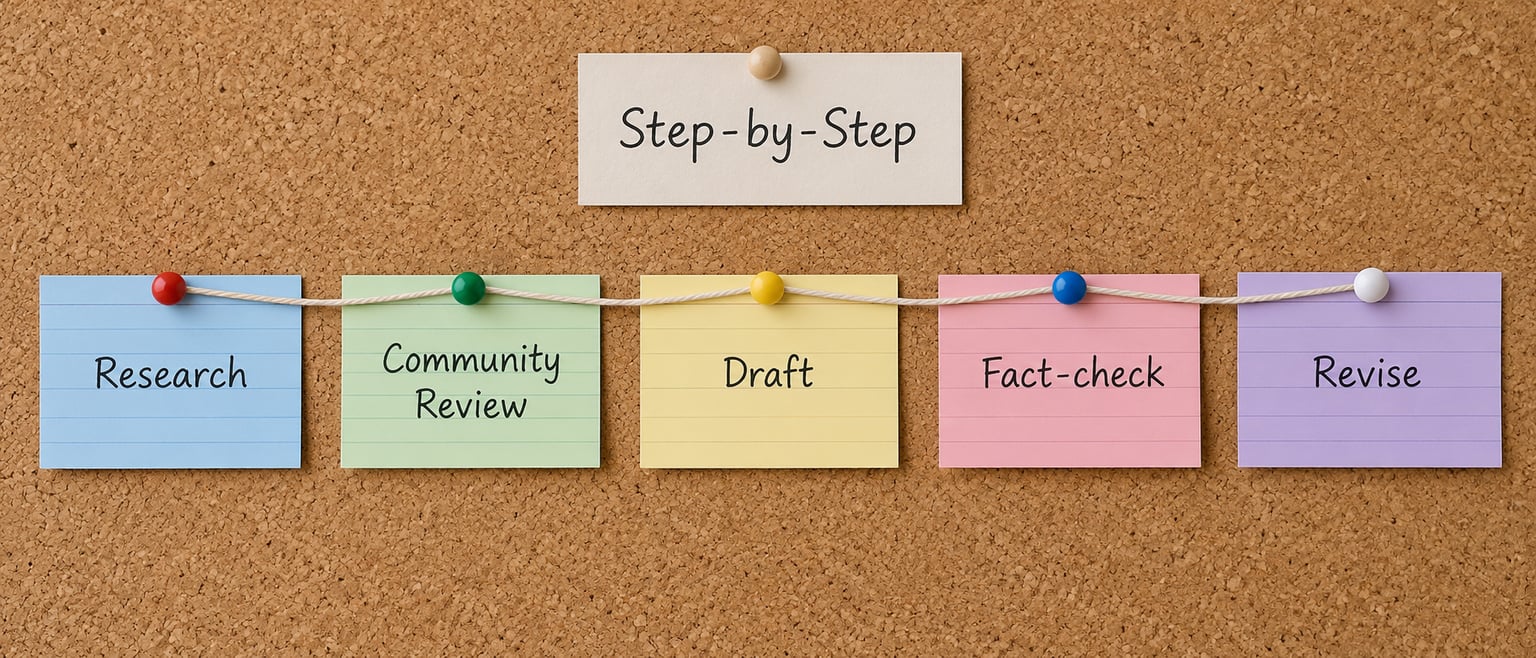
Step 1: Define the community without inventing its boundaries
Start by writing down who is actually in this group, in one paragraph, using the words they use for themselves. Every real community contains people who agree, people who don’t, people who have been inside it for a decade and people who arrived last month. That internal disagreement is the story’s substance, not an obstacle to it.
Geography, history and language all matter here. A city, a congregation, a profession, a fandom and a neighborhood are communities too, and the ethics are the same. Watch the broad label that erases specific identities, and be suspicious of any member of the group who describes themselves in a way your framing cannot hold.
Step 2: Research beyond stereotypes and official sources
Combine reputable outside research with sources the community itself produces. Primary documents, public records, local reporting, academic work and community publications beat a general reference article every time.
Watch for the inverse-stereotype trap. The opposite of a stereotype is also cardboard: the noble outsider who exists to teach the protagonist, the docile person who is grateful for everything. Reversing the stereotype does not make the character a person.
Cultural appropriation, defined plainly, is taking a cultural element and using it in a way the community did not sanction, usually with power and profit flowing outward. Representation is the opposite: the community’s own people telling their own story with credit, control and often compensation. The difference is not subject matter. It is who holds the pen and where the money goes.
Step 3: Listen to more than one person
Talk to people who agree with each other and people who do not. Most importantly, talk to people who reject the label you are using, or who say the community has no business being described as one thing.
Writers who talk to outsiders first often build an echo chamber, then present the result as research. If your sources are five authors citing the same 1990s study, you have one source wearing five coats.
Step 4: Ask for context, not just personal stories
Ask how someone understands their own experience, what shaped it, and what they think a reader outside the community usually gets wrong. Ask what they would refuse to be associated with.
Let people self-identify. Ask pronouns, and ask how they describe themselves in terms of identity, background and situation rather than assigning a category from the outside. And tell them who you are working for, what the piece will be, and where it will run.
Request consent; you do not apply for it, and nobody hands out standing permission to describe a group. Community members on writing forums are blunt about this one: asking a whole community to bless your project puts the burden on them.
Step 5: Use language that does not claim authority
Swap the phrasing you reach for by default. Observation belongs in your voice. Interpretation gets attributed to the person who made it. These five swaps fix most of it.
- “Black mothers struggle with childcare” becomes “Parents at the community center told us the evening bus does not run after 6 p.m.” That moves a claim out of your mouth and into a named mouth.
- “The community is divided on the policy” becomes “Two members we interviewed disagree sharply,” followed by each position in turn. It removes the single-voice problem and reports a real disagreement.
- “They are a proud people with a rich tradition” becomes a member describing their own tradition, in their words, with the name spelled right. That ends the outsider’s decorative summary.
- “She is a warrior and a trailblazer” becomes her own description of her work. Deficit framing and savior framing both start with praise you chose.
- “This group is largely unheard” becomes the name of the source who says so, plus a specific account of what is actually missing. A vague claim turns into something checkable.
Words like community, culture and tradition are not neutral when you use them on a group from outside. Words like resilience and resilience narratives can flatten a specific hardship into something inspirational.
Step 6: Let community members shape the work
Invite fact-checking or a sensitivity read, and give it a deadline so it is a real step rather than a courtesy. Set the terms in advance: factual accuracy and self-representation are open, editorial voice is yours.
Independence does not mean ignoring what a reader tells you. It means you can overrule a preference and cannot overrule a factual correction without a reason. And review is not a licence to publish someone’s medical history, immigration status or address because they read a draft.
Pay people who teach you. Forum writers are blunt that extracting expertise for free is a form of the same problem.
Step 7: Revise for accuracy, agency, and consequences
Run this pass the day before publication, with fresh eyes.
- Every claim about a group’s experience is attributed, or it is something you directly observed and can defend.
- No single person carries the weight of an entire community. Check whether your “residents” paragraph is really one person’s paragraph.
- The headline would survive being read aloud by the people described in it.
- Names, spellings, pronouns and cultural practices match the community’s own usage, checked against a source rather than assumed.
- Images and captions do not do work the text refuses to do.
- Credits are specific: who reported, who fact-checked, who reviewed. “Community member” is not a credit.
- A named person answers corrections, and the correction is visible when it happens.
Restraint is a signal too. A piece that is clear about what it does not claim reads as more trustworthy than one that explains everything.
Common Mistakes
Treating one person as the community’s voice. The fix: name that they said it, and seek a second and third person who will not agree. Disagreement you report honestly beats agreement you manufactured.
Deficit framing. Poverty, addiction, housing and disability are written as personal failing rather than as conditions with causes. The fix: ask what produced the situation, and let sources supply the structural explanation instead of your sympathy.
Relying on outsiders for credibility. A journalist who is not Black does not need to be the one explaining Black life to a reader. The fix: build the authority on sources and on your own transparent method.
Publishing without review. Not every piece needs a sensitivity reader, but nothing published about a specific community should skip the source check entirely. The fix: a 20-minute read with one named person and a deadline.
Getting it wrong and going quiet. Silence reads as a decision. The fix: publish the correction, keep it up, and say plainly what changed.
The mirror error. Refusing to write about people unlike you produces work with nobody in it. Writers on r/writing and r/books push back on this hard: the fear of harm becomes its own kind of erasure. The fix: write about people unlike you, with the same rigour, and hold the corrections open.
One more failure mode deserves its own paragraph because it is so common in nonprofit and brand writing: the savior narrative, where the people described exist to teach the protagonist something. Readers inside the community describe those pieces as deeply uncomfortable to read, because their lives are props in someone else’s moral growth. If your subjects disappear after the lesson is learned, restructure the piece around their goals instead.
Frequently Asked Questions
Can someone write about a community they are not part of?
Yes. Membership is not a license requirement, and many excellent pieces about a community were written by people outside it. What matters is method: source the community’s own writers, attribute every claim about their experience, let people self-identify, and credit your sources by name. The real risk is not writing from the outside. It is claiming authority you never earned, or extracting a story that keeps the risk and cost with the people you wrote it about.
How do I find voices that represent a diverse community?
Do not hunt for a single representative voice, because that person does not exist. Build a group instead: people who agree, people who disagree, people new to the community and people who have been in it for years, plus anyone who rejects the label. Find them through community newsletters, local reporting, mutual-aid groups, events and referrals from your first contact. Ten varied conversations beat one perfect spokesperson every time.
Should I ask community members to review my article before publication?
Yes, when the piece makes specific claims about a specific community, and give the reviewer a deadline so it functions as a step rather than a courtesy. Set terms first: factual accuracy and self-representation are open to change, editorial voice is yours. A review is not permission to publish someone’s private information, and it is not a veto. If you reject a factual correction, say publicly why.
How do I write about a community without using one person as its voice?
Attribute, pluralize and report the seams. Write that a named person told you something, rather than that the community believes it. Then go find someone who would put it differently and include that tension instead of smoothing it. Watch for the paragraph where three quoted speakers suddenly become one collective voice. If your draft says residents, members or people say, go back and count how many actual people are behind that sentence.
What should I do if community members disagree about how to describe their experience?
Report the disagreement rather than picking the version that suits your argument. Say plainly that sources within the community described the situation differently, and give each position its own space and its own name. Writers often treat the absence of consensus as disqualifying, which is a mistake: no community speaks with one voice, and pretending otherwise is its own kind of fabrication.
How should writers handle language, cultural practices, and names accurately?
Use the terminology the community uses for itself, checked against a source rather than assumed, and follow community-authored style guides where they exist, including the National Association of Black Journalists guidance and similar group-authored references. Spell names the way people spell them and ask when you are unsure. Get cultural practices described by practitioners. If a term is contested inside the community, say it is contested instead of picking the version that reads best.
The Standard Is Accountability, Not Silence
Start tomorrow by reading your draft aloud and replacing every unattributed claim about a group with a named source who said it. That single pass catches more of this problem than any amount of worry beforehand did.
The rest follows: community-authored sources, more than one voice, self-identification, request consent rather than permission, invite a real review, credit precisely, and correct in public when you get it wrong. Writing about a community without speaking for it is not a style of caution. It is a set of habits you can practice.