
Building a morning routine that reduces stress takes less than most published plans want you to believe. Pick a wake time you can actually keep, shrink the number of decisions you make before coffee, and add one repeatable calming signal — daylight, slow breathing, or a short walk. Six steps, ten minutes minimum, two weeks to build.
That last part matters. Most morning routine advice is written for someone with an empty house and a 5am alarm, which is a narrow slice of the people who are actually stressed. It is also the reason most readers give up by Thursday. A routine that only works under ideal conditions is not a stress tool; it is another thing to feel bad about.
This guide is built the other way around. Every step below is small enough to survive a bad night, a sick kid, or a shared home with one bathroom. I have kept a version of it myself and cut it twice when it stopped fitting my week. What survived is what is here.
Table of Contents
- What You Need
- How to Build a Morning Routine That Reduces Stress: Step-by-Step
- 1. Anchor the morning with a realistic wake time
- 2. Lower the first five minutes of decision-making
- 3. Give the body a gentle signal that the day is beginning
- 4. Eat and hydrate without turning breakfast into another task
- 5. Create a two-minute plan for the next part of the day
- 6. Add one reliable calming ritual
- Common Mistakes
- Frequently Asked Questions
- How long should a morning routine be?
- What is a 10-minute morning routine that can rewire my brain?
- Does a morning routine reduce cortisol?
- Do these routines help on chaotic mornings?
- How do I build a morning routine for anxiety or burnout?
- Conclusion
What You Need
You need four things, and none of them cost money.
- A wake time you can hold seven days out of seven. Not your best-case wake time. The one that survives a Monday. Most adults need seven to nine hours of sleep, so work backwards from when your day actually starts.
- One or two calming priorities. Pick what genuinely lowers your stress. For me that is water and a ten-minute walk, and everything else is decoration.
- A defined place to begin the day. A specific spot — the kitchen chair, the front step — matters more than it sounds. A location the brain recognises can start the day without a decision.
- A way to track what helps, loosely. A weekly note in your phone, not a streak counter. A missed day on a streak app feels like data loss; a weekly note feels like information.
That is the whole shopping list. Everything else in this guide is optional, and you can build it one piece at a time.
How to Build a Morning Routine That Reduces Stress: Step-by-Step
1. Anchor the morning with a realistic wake time

Set one wake time and hold it, including weekends, within about an hour. A steady wake time anchors your circadian rhythm and gives cortisol its normal post-waking curve something to run on instead of scrambling after it.
Most adult bodies need seven to nine hours. If you wake feeling like you lost a fight with a cabinet, the answer is more sleep, not a harder routine. Give yourself twenty more minutes in bed for two weeks before you judge anything else.
When an early schedule is not possible — night shift, small children, a partner on different hours — work from your real constraint. Anchor to the end of your sleep period instead: whatever time you must be up, count back the hours you need and set the wake time there. A night owl building a calm morning routine is not trying harder; they are picking a different anchor point.
The first fifteen minutes after waking are also sleep inertia, the fog that lifts as your body switches systems. Trying to make life decisions during that window is why early routines fail. Give the fog a job that needs no thinking: water, light, a glass on the counter.
2. Lower the first five minutes of decision-making
Stress in the morning is often decision fatigue wearing a costume. What to wear, what to eat, which email first, whether to answer the message from yesterday. Each one is tiny, and they stack badly.
Three moves cut most of that stack. Keep your phone out of the bedroom — across the room on a charger works better than a bedside table, because out of sight is what does it. Lay out tomorrow’s clothes before you sleep. Decide breakfast the night before, not at 6am with a groggy brain.
Then pick one starting cue and let it carry the weight: the bathroom, the kettle, the front door, the first sip of water. When I started doing this, the useful part was not the routine itself. It was not having to ask what happens next at 6:15.
Forum users describe this prep as the single biggest change to their mornings, which matches what the rest of the room is for. Nothing in the rest of the routine works if you are still scrolling at 6am with your jaw clenched.
3. Give the body a gentle signal that the day is beginning
Pick one physical signal and repeat it. Water. Five minutes of stretching. A walk around the block. Opening a curtain. Making the bed. Outdoor light in the first hour is the one with the strongest tie to your circadian rhythm and the morning cortisol curve, so if you can do one thing, step outside.
Stress reduction here comes from the signal, not the checklist. A five-minute ritual done most mornings beats an hour of wellness that happens twice a month.
If you have ten minutes total and no more, do this. Zero to two minutes: drink a glass of water and step outside or open a window. Two to five: breathe in for four, out for six, five rounds. Five to eight: a slow walk or five minutes of stretching. Eight to ten: write down the one thing that would make today easier. That is a complete calm morning, and it needs nothing you do not own.
Simple-living communities tend to converge on the same short list: get up, drink water, wash hands and face, move for ten to twenty minutes. Nothing exotic. It works because it survives a normal Tuesday.
4. Eat and hydrate without turning breakfast into another task
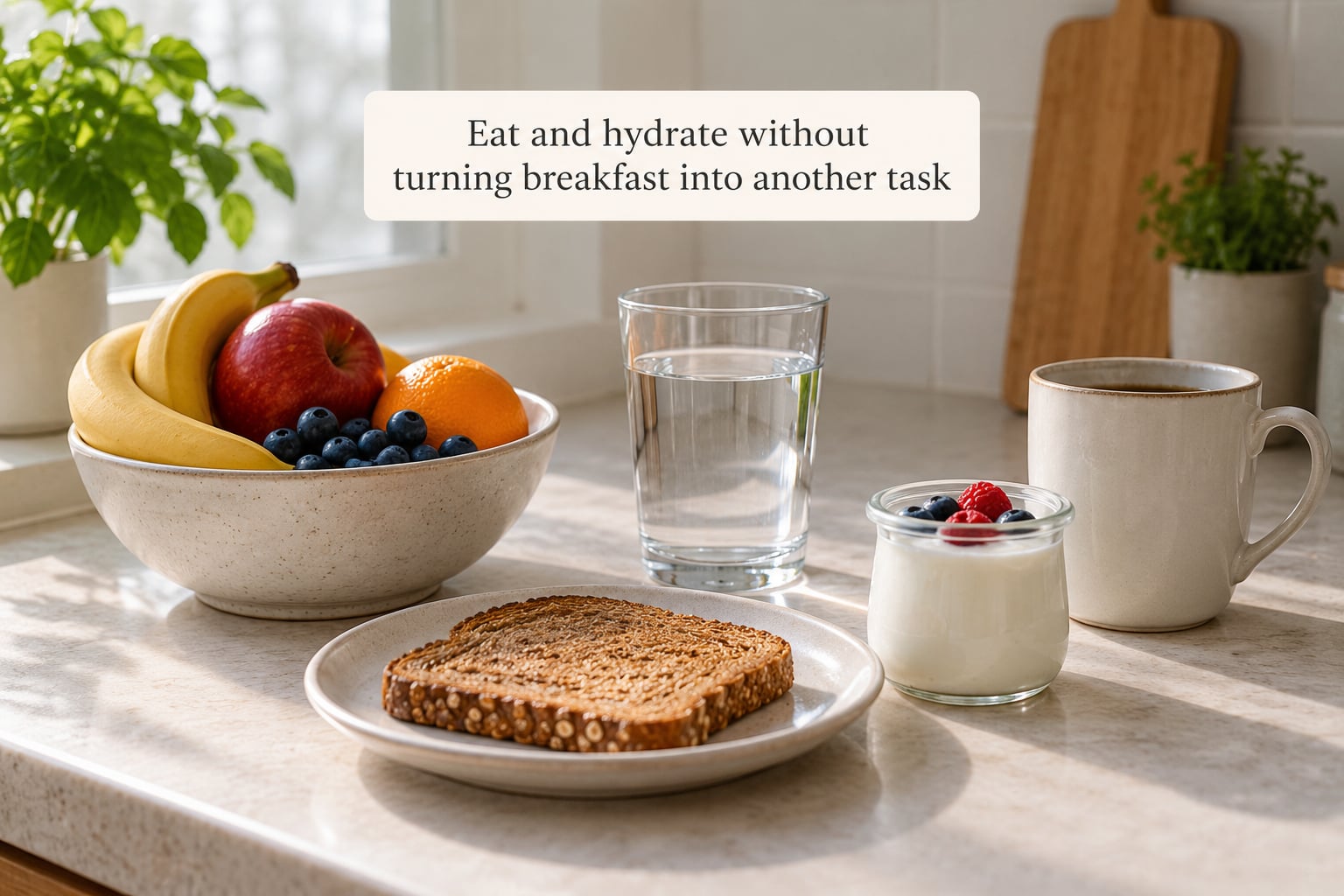
Eat something you already like within an hour of waking. That is the whole framework — no rules about macros, no forbidden foods, no meal plan. For a lot of people the stress-reducing part is not nutrition but removing a decision and a hungry-stomach headache from the first hour.
Some no-cook combinations that take under two minutes: yogurt with fruit and nuts, toast with peanut butter, overnight oats from last night’s leftovers, banana and a handful of whatever is in the cupboard. Drink a glass of water before or with it, and drink what you normally drink over the day.
Caffeine deserves a note because it is where many people trip. Cortisol is already climbing after waking, and caffeine on top of an empty stomach lands on top of that for some people, who then spend the morning jittery and wired. If that is you, have food or water first and delay the cup by 30 to 60 minutes. If coffee relaxes you, leave it alone. Individual variation here is large and mainstream guidance does not treat one timing as correct for everyone.
5. Create a two-minute plan for the next part of the day
Name three things on a single note. First, the one task that would make today a win. Second, the most likely source of stress — one named person, one meeting, one loose end. Third, the smallest useful next action for that stressor.
On a workday the third item might be sending the two-line reply that has been hanging over you. On a school run it might be packing the bag tonight so morning-you is not assembling it at 7:40. On a caregiving day it might be calling one person for fifteen minutes, because you cannot control the rest and you can control that.
On an unstructured day, plan two hours instead. A day with nothing scheduled is not automatically restful; it is a blank page, and blank pages produce their own dread. Two named hours with a treat attached at the end works.
Keep the note in one place. A new notebook for this is one more thing to lose.
6. Add one reliable calming ritual
Choose one ritual under five minutes that helps you regulate. Candidates: breathing with a long exhale, journaling three lines, prayer or reading, music with no news in it, or sitting with a warm drink before the rest of the house wakes.
The breathing ratio matters more than the meditation app you do not use. Breathe in for four and out for six, or in for three and out for six, and repeat for three to five rounds. The long exhale is the active ingredient — it tips you toward the parasympathetic side of the nervous system, the rest-and-digest mode that a fast morning keeps interrupting. If breathwork makes you light-headed, stop and breathe normally, or try three rounds instead.
Run the ritual for one week before deciding whether it earns a permanent slot. Most people attach a ritual to a habit already in place — the walk, the coffee, the first email — and it holds far better than a ritual floating on its own.
Common Mistakes
Building an ambitious routine. Twelve steps before 8am is not discipline, it is a job. Correction: run the minimum version for three weeks — wake time, no phone, water, one ritual — and add exactly one item only after the week was boring rather than hard.
Changing five habits at once. You will not know which one is working, and the first bad week will feel like total failure. Correction: one habit per two weeks, one at a time.
Treating the routine as a productivity system. This is the big one. The moment the morning becomes an output, a slow morning reads as a wasted morning, and dread comes straight back. The only measure that matters for this article is whether you feel less braced by 9am.
Checking the phone first. You have already decided what your day contains before you are awake enough to have opinions. Correction: charge the phone out of the bedroom tonight. That is the whole intervention.
Reading one broken morning as proof the plan is wrong. This all-or-nothing loop is the single most common reason routines collapse permanently. When the streak breaks, run a three-step restart: pick the smallest item on the list, do it tomorrow no matter what, and skip the review. People on self-improvement forums describe the shame after a broken streak as more damaging than the original stress.
Implementation tip: review once a week, on a fixed day, for five minutes. Keep the one habit that made the week noticeably easier and drop the one you did without noticing.
And be honest about the ceiling. If stress is affecting your sleep, your health, your relationships, or your ability to function most days, a morning routine is a small helpful thing, not treatment. Talking to a primary care clinician, a therapist, or a counselor is the appropriate next step. If you are in crisis in the US, call or text 988 for the Suicide and Crisis Lifeline. Nothing in this guide replaces that conversation.
Frequently Asked Questions
How long should a morning routine be?
Ten minutes is the useful minimum, and twenty is enough for almost everyone. A routine longer than about thirty minutes starts competing with sleep and work, and people drop it. Start at five: water, two minutes of slow breathing, a walk or a window, and one line in a notebook. Add one item every two weeks, and only if the week felt boring rather than hard.
What is a 10-minute morning routine that can rewire my brain?
Ten minutes, timed: zero to two minutes drink water and get outdoor light; two to five minutes breathe in for four and out for six, five rounds; five to eight minutes walk or stretch slowly; eight to ten minutes write the one task that would make today a win. Nothing in this list needs equipment or money. Repeat it for a week before adding anything.
Does a morning routine reduce cortisol?
Partly, and the mechanism is indirect. Cortisol normally rises right after you wake and falls through the morning. Morning daylight helps anchor the circadian rhythm that drives that curve, and slow exhales shift the nervous system toward rest-and-digest. No routine cures a cortisol problem, though. If fatigue, weight changes, or feeling constantly on edge persist, ask a clinician rather than tuning your alarm.
Do these routines help on chaotic mornings?
They help more on chaotic mornings, because a fixed small routine works when nothing else does. Keep a three-item version you can do standing up with a child in one arm: water, ten slow exhales, and one sentence about the day ahead. A routine that collapses under a hard morning is not a stress tool, it is one more failure to log.
How do I build a morning routine for anxiety or burnout?
Go smaller, not bigger. Under burnout the usual morning plans feel like one more demand, so start with wake time and delayed phone only, and give that two weeks. For racing thoughts on waking, the first move is physical — feet on the floor, water, light — before any breathing work, because a breathing exercise on an empty stomach can make panic worse. If anxiety is limiting your days, therapy is the lever that actually moves the needle.
Conclusion
A calm morning is built the same way every time: an anchor, fewer early decisions, one physical signal, food and water without a project attached, a two-minute plan, and one ritual you actually like.
Tomorrow, do three things only. Protect the wake time, keep the phone out of the bedroom until after your first glass of water, and add one calming ritual — five rounds of breathing with a longer exhale is plenty to start. Run those for two weeks before you touch anything else.
Consistency matters less than staying flexible. A morning you keep on the hard days is worth more than a perfect morning you only have on easy ones.