Legal segregation in American public spaces ended mainly through the Civil Rights Act of 1964, and specifically through Title II, which banned racial discrimination in places open to the public. But there is no single date. Courts had started the process in 1954, protest movements forced Congress to act, and the last holdout towns took years longer than the statute did.
Understanding how segregation ended in public spaces means separating two dates that most summaries blur together. The law changed in 1964. The last swimming pool, lunch counter or municipal building in a given town opened years after that.
This guide walks through the legal architecture, the grassroots pressure, the everyday changes, and the parts of the old system that moved rather than disappeared.
Table of Contents
- What Was Segregation in US Public Spaces?
- How de jure segregation turned daily life into a legal question
- What counts as a public accommodation
- When formal rules were informal habits
- How Segregation Ended in Public Spaces Through Law and Activism
- Plessy legalized it, and Brown began undoing it
- Grassroots pressure: boycotts, sit-ins and the Freedom Rides
- What the Civil Rights Act of 1964 and Title II actually covered
- How the federal government forced compliance
- How Segregation Ended in Public Spaces in Everyday Life
- Lunch counters, terminals and the order things actually changed
- Swimming pools: desegregation, violence and closure
- The gap between the year the law changed and the year the town changed
- Why Formal Desegregation Was Not the End of Racial Inequality
- Where segregation moved after 1964
- The spaces the Civil Rights Act never covered
- What Changed First, and What Still Needed Work
- Which public spaces desegregated first, and which came last
- How to find your own town’s desegregation date
- Frequently Asked Questions
- When did segregation end in public places?
- Did the Civil Rights Act of 1964 immediately end segregation in every public space?
- What is the difference between desegregation and integration?
- Why did some schools remain segregated after the Supreme Court ruled against it?
- How did ordinary people help end segregation in public spaces?
- Is public-space segregation still a problem in the United States?
- Conclusion: Start by Recognizing the Difference Between Access and Equality
What Was Segregation in US Public Spaces?
Segregation in public spaces was a set of written rules about which bodies could enter which buildings, and which part of the building they could use. It was not a matter of taste or private preference. A person who used the wrong water fountain, the wrong lunch counter or the wrong waiting room could be arrested.
Historians call the legal regime de jure segregation, meaning segregation required by law, and de facto segregation, meaning separation that happens without a rule on the books. For most of American history both existed at once, and the label many people use for the whole system is Jim Crow.
How de jure segregation turned daily life into a legal question
Separate entrances, waiting rooms, water fountains and counters were enforced by police, by courts, and by the threat of losing a job or a home. In the South, separate public facilities usually meant separate everything: schools, hospitals, buses, train stations, parks, cemeteries, restaurants and barbershops.
Some forms of separation never had a statute behind them. Private clubs, country clubs, gated neighborhoods and some church networks operated outside the law while enforcing the same rule. That gap matters, because it is where much of the exclusion quietly survived the legal changes of the 1960s.
What counts as a public accommodation
A public accommodation is a business or facility that serves the public, or that serves interstate travelers. Under Title II of the Civil Rights Act of 1964, the protected list includes hotels and motels, restaurants, lunch counters, coffee shops, movie theaters, theaters and entertainment venues, gas stations, and any store or business accepting customers.
The act reaches facilities that serve interstate commerce, which covered nearly every hotel, motel and restaurant that a traveler could walk into. Congress excluded genuinely private organizations, such as a private club or a church, which is why those spaces could remain closed legally long after the counter down the street had to serve everyone.
When formal rules were informal habits
Even where no rule existed, custom did the work. Refusing service, ignoring Black customers until they left, or quietly steering Black renters away from a neighborhood operated like law as long as no one could point to a statute. A person asking about the end of segregation in public spaces has to hold both realities at once.
The result was a public realm that looked different depending on who walked into it. In the same city, in the same afternoon, a person could ride a segregated bus, eat at a segregated counter, and swim in a closed pool.
How Segregation Ended in Public Spaces Through Law and Activism
Plessy legalized it, and Brown began undoing it
In 1896, the Supreme Court ruled in Plessy v. Ferguson that a Louisiana statute requiring separate railroad cars was constitutional, as long as the accommodations were equal. The ruling created the separate but equal doctrine, and it stood for more than half a century.
Equal turned out to be nearly impossible to prove. Separate facilities were almost never equal in quality, and no one had to explain why not. In Brown v. Board of Education in 1954, the Supreme Court ruled unanimously that separate educational facilities are inherently unequal, which undercut the logic the whole system rested on.
The follow-up decision the same year, Brown II, gave states no timetable. Implementation was to proceed with all deliberate speed, a phrase that became shorthand for decades of delay. Little Rock, Arkansas, where nine students tried to enter Central High School in 1957, showed what that delay could cost, and required federal troops to protect them.
Grassroots pressure: boycotts, sit-ins and the Freedom Rides
Congress did not move on its own. Organized resistance in Black communities created the political conditions for the Civil Rights Act, and much of it happened at lunch counters and bus stops.
The Montgomery Bus Boycott began on December 1, 1955, the day Rosa Parks refused to give up her seat on a segregated bus. It lasted 381 days and ended with the Supreme Court ruling in Browder v. Gayle that bus segregation in Alabama was unconstitutional.
On February 1, 1960, four students at North Carolina A&T in Greensboro sat at a Woolworth lunch counter and were refused service. They stayed, and they were joined. The sit-in model spread to Nashville, where students trained in workshops led by James Lawson, and to dozens of cities.
The Freedom Rides began on May 4, 1961, when riders left Atlanta on Greyhound and Trailways buses headed south to challenge segregation in terminals. Mobs met them in Anniston and Birmingham. After mobs attacked riders again in September, the Interstate Commerce Commission ordered the desegregation of all interstate bus terminals, which pushed federal authority further than any statute had.
The resistance to that pressure was violent and specific. Nashville’s Z. Alexander Looby home was bombed on April 11, 1960. In St. Augustine, Florida, in June 1964, a bomb went off at the Springfield Industrial Center at 3:30 in the morning while people were sleeping inside. Many of the demonstrators were teenagers.
What the Civil Rights Act of 1964 and Title II actually covered
The Civil Rights Act was signed on July 2, 1964. Title II is the section that ended segregation in public spaces, and its core was short: no business serving the public could refuse service, restrict service, or discriminate on the basis of race, color, religion, sex or national origin.
The practical reach was enormous. Restaurants, hotels, motels, theaters and gas stations could no longer keep separate counters, waiting rooms or rooms. In 1966, Congress removed an exemption that had shielded motels with fewer than five units, closing a small but notorious loophole.
Title III made it unlawful for businesses to discourage people from using a facility through intimidation or advertising, which reached discrimination outside the door. Title VII created the Equal Employment Opportunity Commission and extended employment protection beyond public spaces. Title VI cut off federal funds to states that segregated their own public institutions.
How the federal government forced compliance
A statute without enforcement is a suggestion. What made Title II work was the power it gave the attorney general to sue any business that discriminated, and the power to enforce school desegregation orders.
The Supreme Court tested the act in Heart of Atlanta Motel v. United States in December 1964, upholding the conviction of an Atlanta motel owner who refused rooms to Black patrons. Same-day service refused at the front desk counted as discrimination under the statute, which settled the most important open question about Title II in one ruling.
Some businesses gave up the fight without changing anything. Restaurant associations, chambers of commerce and a few national hotel chains advised members to serve everyone or close, on the theory that a lawsuit was worse than a new customer. Some local operators chose a different route and simply closed.
How Segregation Ended in Public Spaces in Everyday Life
Lunch counters, terminals and the order things actually changed
Nothing changed everywhere at once. The 1947 Double V march in Washington, D.C. pushed the slogan, but the order in which local facilities opened was driven by which ones felt pressure first.
Federal facilities changed fastest, because the federal government was the owner. Military bases and federal buildings desegregated first, followed by interstate bus terminals after the 1961 Commerce Commission order. Downtown lunch counters in cities with active student councils went next, frequently within months of a sit-in.
Smaller towns were last, and in some cases they were last because almost nothing happened to them. A town with no organized chapter, no students willing to sit in and no federal facility inside its limits had little pressure to absorb until court orders or lawsuits arrived.
The economic side of that period is worth naming. Boycotts cost Black-owned businesses real money, and the risk sat with the people with the least cushion. That cost is still discussed in community history groups, where people note that the businesses most harmed by a boycott were frequently the ones run by the families of the people doing the organizing.
Swimming pools: desegregation, violence and closure
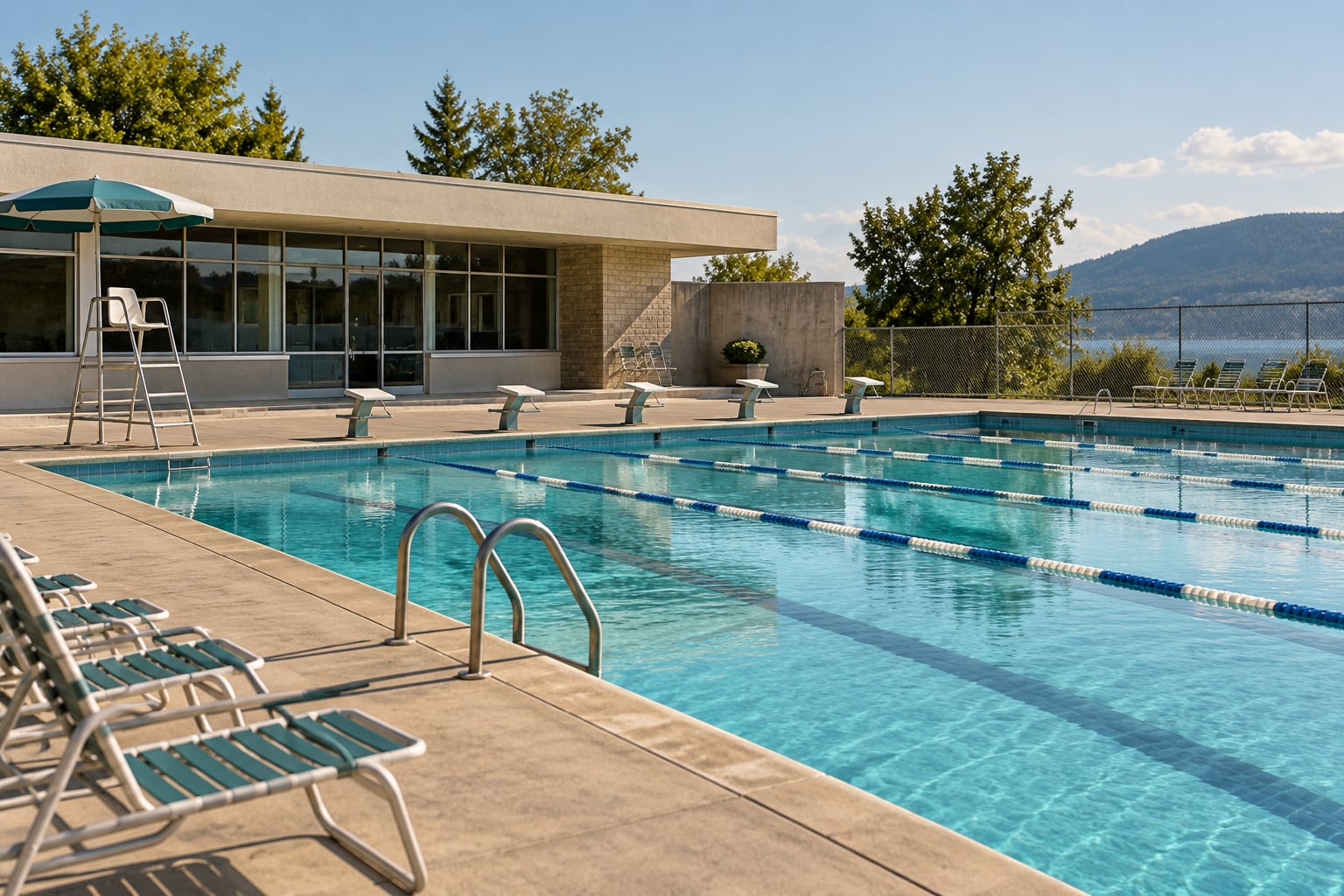
Public swimming pools were among the most contested public spaces, and the story is stranger than a clean date list. Many cities faced a choice: integrate the pool or close it.
Atlanta integrated its municipal pools in 1960, the first major Southern city to do so, and the city council accepted the cost of hiring guards and changing the rules to stop violence at the water. Across much of the South, the other choice won. Pools closed at record pace, and towns voted for closure because they had calculated the cost of compliance would be higher than the cost of losing the facility.
Desegregating a pool took more than removing a sign. Changing times, adding guards, admitting Black children under the same rules as white children, and defusing threats from parents who treated a pool as their own all counted as part of the work. Some of that work is remembered still: Fred Rogers waded into a pool on a children’s TV show alongside a Black boy, and that clip is shared to this day.
Where pools integrated, integration was uneven in practice. Reports through the 1960s describe Black families waiting weeks for swim lessons while white children were served immediately, a form of separate treatment inside an integrated facility.
The gap between the year the law changed and the year the town changed
People researching how segregation ended in public spaces usually find a national law, then a local date that does not match it. That gap is real and it is the single most common confusion on the topic.
Public accommodations in a large Southern city were generally serving everyone by 1964 and 1965. Public accommodations in smaller towns could take until the late 1960s, and school desegregation could run into the 1970s and beyond. There is no national authority that can date the last facility, because enforcement was local and uneven.
St. Augustine saw its public facility integrate in 1963. Some towns in South Carolina and Arizona held their last public facilities into the mid-1960s. Recognizing that the legal end and the practical end were different events is the difference between a useful history and a misleading one.
Why Formal Desegregation Was Not the End of Racial Inequality
The law said people could enter. It did not say they could afford to live near the building, get a loan for a house, be treated fairly inside it, or feel safe using it. That gap is where de facto segregation grew after de jure segregation was struck down.
Where segregation moved after 1964
Where a Black neighborhood was disinvested by redlining, subdivided by restrictive covenants or drained of capital, and then abandoned to white flight, desegregating a school district or a public pool changed the sign without changing the map.
Residential segregation now drives disparities in school funding, because property values differ and school budgets often follow them. It shapes which parks get maintained, which municipal services get funded, and where police concentrate. It affects health outcomes, because insurance access and environmental exposure both track where people live.
Housing discrimination also is not legally permitted, and researchers studying the subject still find differences in treatment that take no single form: steering, lost applications, and unit numbers that never match.
The spaces the Civil Rights Act never covered
Title II applies to businesses open to the public. It does not apply to private clubs, many private membership organizations, religious institutions or a family deciding whom to invite to dinner. Some social spaces operated as segregated for decades without breaking a federal statute.
This is where a common error creeps in. Segregation did not stop in 1968. It ended as a legal requirement in public accommodations and, more slowly, in schooling. It continued as a social choice in places where no one could be prosecuted.
What Changed First, and What Still Needed Work
Some spaces opened in weeks, others took years, and a few never opened at all in the form people wanted. The table below is a guide, not a legal record: dates are approximate and local.
| Public space | Approximate date | What forced the change |
|---|---|---|
| Military bases and federal buildings | 1948 and after | Executive action by the federal government as employer |
| Schools in some districts | 1954 onward, uneven | Brown v. Board of Education, then court orders |
| Interstate bus terminals | 1961 | Interstate Commerce Commission order after the Freedom Rides |
| Lunch counters in organized cities | 1960 to 1961 | Sit-ins, boycotts, then Title II in 1964 |
| Municipal swimming pools | 1960 onward | Atlanta integrated in 1960; many cities closed instead |
| Hotels, motels, restaurants, theaters | 1964 | Title II of the Civil Rights Act |
| Small towns and rural facilities | 1964 to late 1960s | Attorney general suits and settlement agreements |
| Large city school districts | 1970s and later | Federal court orders; some findings came decades later |
Which public spaces desegregated first, and which came last
The honest answer about the last place is that there is no settled answer. For public accommodations, the last holdouts were small Southern municipalities in the mid-to-late 1960s. For schools, the question gets murkier, because federal court findings of continued segregation came in major cities well after 1970, and the legal status of individual districts still changes.
What is not murky is the direction of travel. If a place stayed closed, it stayed closed because nobody had sued, nobody had sued because organizing had not reached there, and that absence of pressure was itself a legacy of the system.
How to find your own town’s desegregation date
Local history is where readers get real answers, and it is more available than most people expect. City council minutes from 1964 and 1965 usually record the vote on pool closure or integration, even when the minutes are vague.
Four places to check:
- City and county council minutes for 1960 through 1966. Search for pool, recreation, lunch counter and civil rights.
- Historic newspapers in digital archives, which cover the date a facility opened to everyone far better than later summaries do.
- Records of local NAACP chapters and churches, which often keep the timeline of complaints and lawsuits.
- State archives and law libraries, where attorney general case files name the businesses that were sued.
Expect to find a date in one source and a contradiction in the next. That tension is usually where the real story is, not a sign that you picked the wrong archive.
Accountability did not stop with the statute. Civil rights law still requires agencies to enforce equal access, fund services fairly, and measure whether people can actually reach the places that are supposed to be open to them. A facility can be legal and still be unreachable, which is the standard worth asking about.
Frequently Asked Questions
When did segregation end in public places?
Legal segregation in public places ended primarily in stages, not on one date. The Civil Rights Act of 1964, through Title II, banned racial discrimination in hotels, restaurants, theaters, gas stations and other public accommodations. Brown v. Board of Education in 1954 struck down school segregation, the Voting Rights Act of 1965 covered voting, and the Fair Housing Act of 1968 extended protection to housing. Many small-town facilities did not comply until the late 1960s.
Did the Civil Rights Act of 1964 immediately end segregation in every public space?
No. The act changed the law immediately, but compliance took years. The attorney general had to sue individual businesses one at a time, and some owners closed rather than serve Black customers. Many small Southern towns kept facilities segregated well past 1964, and public swimming pools in a large part of the South were closed permanently instead of integrated.
What is the difference between desegregation and integration?
Desegregation is the removal of legal separation: no separate entrances, counters or waiting rooms, enforced by law. Integration is the social and economic condition that follows, meaning people actually use shared spaces in roughly comparable numbers, with comparable treatment. A town can desegregate a lunch counter on paper while families still avoid it, or integrate the building while waiting times and rules stay separate in practice.
Why did some schools remain segregated after the Supreme Court ruled against it?
Brown II in 1955 ordered implementation with all deliberate speed and set no deadline, which allowed delay for two decades. After that, courts ordered desegregation, but local officials resisted through delaying tactics, closing or reshuffling schools, and intimidation. Residential segregation also shaped where students lived, so districts that wanted to comply were redistricting schools that families attended out of distrust of them.
How did ordinary people help end segregation in public spaces?
Mostly through organized, nonviolent pressure rather than speeches. People boycotted businesses, sat at lunch counters and stayed there after being refused, rode interstate buses to test terminal rules, and organized legal challenges. That sustained pressure raised the political cost of resisting, gave organizers documented evidence of discrimination, and is why the Civil Rights Act reached Congress in 1964 rather than twenty years earlier.
Is public-space segregation still a problem in the United States?
It is illegal, and it still happens. Federal desegregation orders covering specific school districts remain in effect, and courts continue to find that some districts are still segregated. Outside those orders, exclusion persists through housing patterns, uneven enforcement, and private spaces that Title II never covered, such as private clubs and many religious institutions. Legal permission to enter a space has never been the same as equal use of it.
Conclusion: Start by Recognizing the Difference Between Access and Equality
Segregation ended in US public spaces because four things happened together: courts struck down separate but equal, communities organized nonviolent pressure, Congress wrote Title II, and federal officials sued the businesses that refused. Remove any one of those and the ending would have taken much longer.
What ended was the legal requirement to separate. What continues is the harder question of whether people can actually reach and use public life on equal terms, which is a question that has to be asked of every place, every year.
The first step is local and cheap. Find the date your own town opened its pool, its lunch counters or its schools to everyone, using council minutes and local newspaper archives. Once you have that date, you have the beginning of an answer about your own community, and the people who did that work are usually still around to explain it.