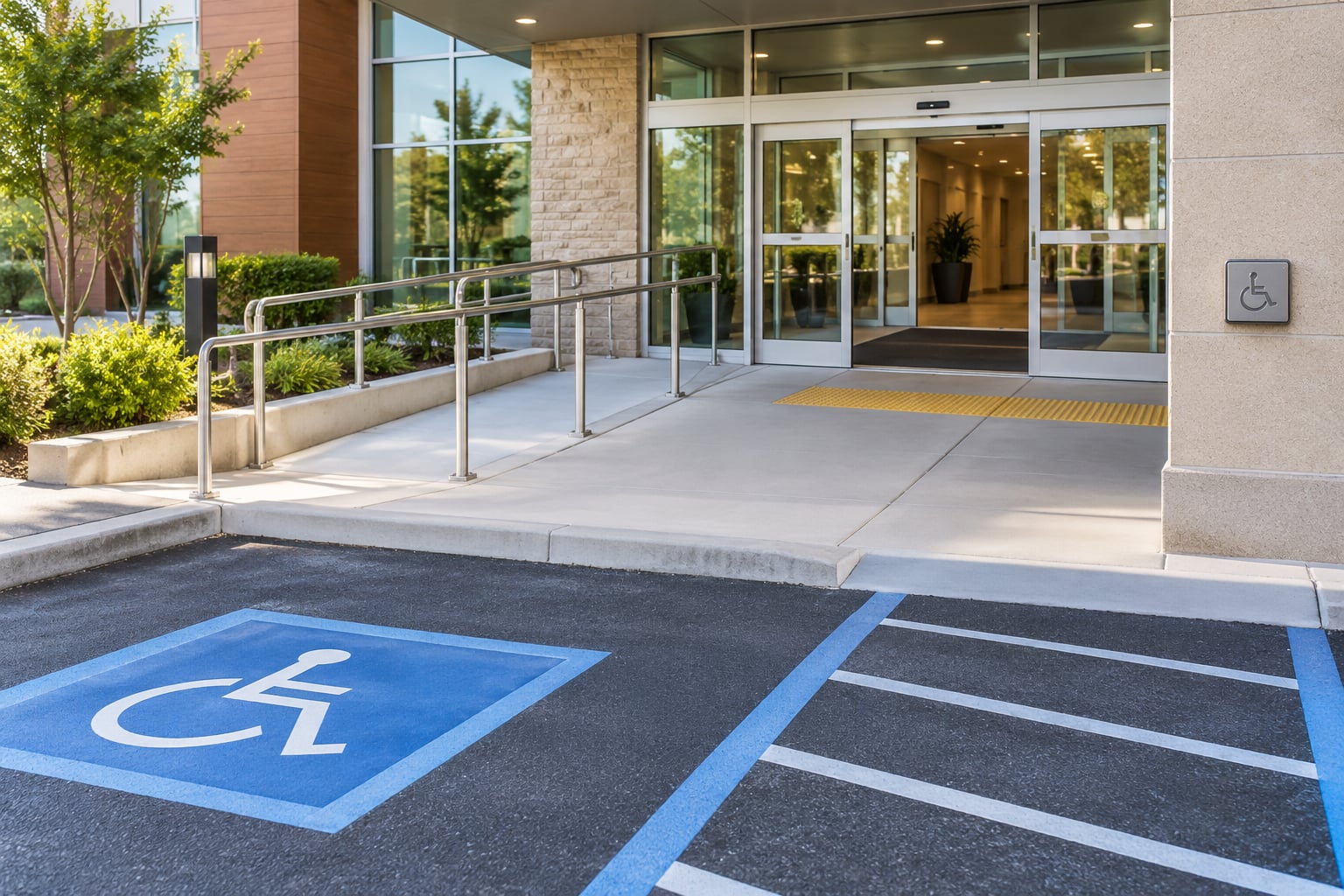
The Americans with Disabilities Act is a federal civil rights law, signed on July 26, 1990, that bars discrimination against people with disabilities in jobs, government services, businesses open to the public, transportation, and telephone and internet services. Understanding how the Americans with Disabilities Act works in daily life comes down to one idea: access is a right, not a favor, and it shows up in specific, checkable details on an ordinary Tuesday.
Most of those details are invisible when they are working. Nobody notices a bus that kneels to the curb or a pharmacy counter with a lowered section. People notice them the morning they are missing.
This guide walks through those details by setting — the entrance, the bus, the workplace, the clinic, the school, the website — then covers where the law stops. It is general information, not legal advice. Rules and deadlines change and vary by state, so for your specific situation, call one of the free federal helplines listed near the end.
Table of Contents
- What the Americans with Disabilities Act Covers
- What qualifies as a disability under the ADA
- The five titles and who enforces them
- How the ADA Applies to Buildings and Public Spaces
- How the Americans with Disabilities Act Works at Work
- How the ADA Applies to Schools, Healthcare, and Public Services
- What Accessibility Means Online and With Technology
- What the ADA Does Not Guarantee
- How to Respond When Access Is Missing
- Frequently Asked Questions
- Does the ADA require every business to be fully accessible?
- What counts as a reasonable accommodation under the ADA?
- Can a disabled person request an accommodation without explaining a diagnosis?
- What should I do if a public building or website is inaccessible?
- Does the ADA cover online services and mobile apps?
- What is the difference between the ADA and an accessibility building code?
- The First Step to Using the ADA in Daily Life
What the Americans with Disabilities Act Covers
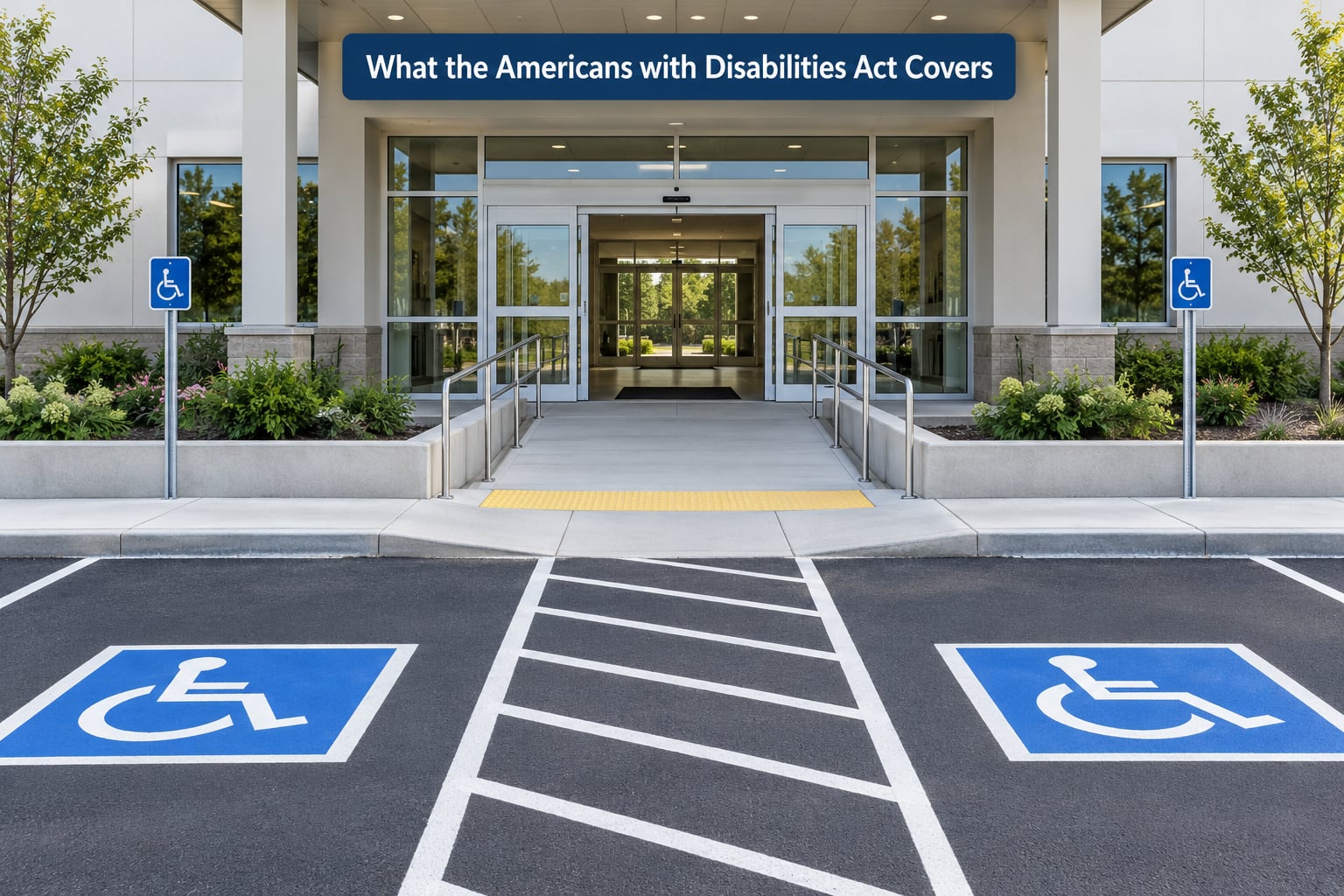
The ADA is one law with five titles, and each title attaches a different duty to a different kind of organization: Title I to employers, Title II to state and local governments, Title III to businesses open to the public, Title IV to transportation providers, and Title V to miscellaneous provisions including the requirement to make TV programming captioned and telephone relay available. It works through two mechanisms. The first is prohibition: covered organizations may not discriminate against a qualified person with a disability. The second is affirmative duty: they must make reasonable modifications to policies, practices, and procedures and remove barriers where doing so is reasonable.
What qualifies as a disability under the ADA
Federal guidance from the Department of Justice describes disability in three parts, and any one of them is enough. People often assume the law only covers people who use a wheelchair, which is one of the larger sources of confusion in daily life.
- A physical or mental impairment that substantially limits one or more major life activities. Major life activities include walking, seeing, hearing, breathing, eating, sleeping, concentrating, thinking, communicating, reading, learning, and working. Substantial limitation is assessed individually, and many chronic and invisible conditions qualify.
- A record of such an impairment. Someone who had the condition in the past, whether it is currently active or in remission, is still protected.
- Being perceived as having such an impairment. If other people treat you as disabled because of a condition, the ADA can apply even when the condition itself is not clearly limiting.
The third prong does a lot of quiet work in daily life. People with conditions such as POTS, hyperacusis, chronic fatigue, ADHD, or post-traumatic stress often qualify here even when the physical side is invisible at a counter.
The five titles and who enforces them
| Title | Everyday situation it governs | Agency that handles complaints |
|---|---|---|
| Title I | Job applications, hiring, pay, promotion, firing, and requesting an accommodation | Equal Employment Opportunity Commission (EEOC) |
| Title II | City halls, public schools, public hospitals, courts, parks, polling places, public transit | Department of Justice Civil Rights Division, or the Department of Education for school issues |
| Title III | Restaurants, stores, movie theaters, gyms, dentists, banks, pharmacies, places of worship | Department of Justice Civil Rights Division |
| Title IV | City buses, light rail, and intercity rail; accessibility plans for bus systems | Department of Transportation, Federal Transit Administration (FTA) |
| Title V | Captioned television, telephone relay and TTY availability, and enforcement provisions | Federal Communications Commission for relay; DOJ and EEOC otherwise |
One more distinction trips people up. The ADA’s federal accessibility standards and any state or local accessibility building code are two separate systems that run in parallel. A building can meet the building code and still fail the ADA, because the ADA standard for newly constructed facilities is its own technical document, the 2010 ADA Standards for Accessible Design. When the two conflict, the stricter one usually controls for ADA purposes.
How the ADA Applies to Buildings and Public Spaces
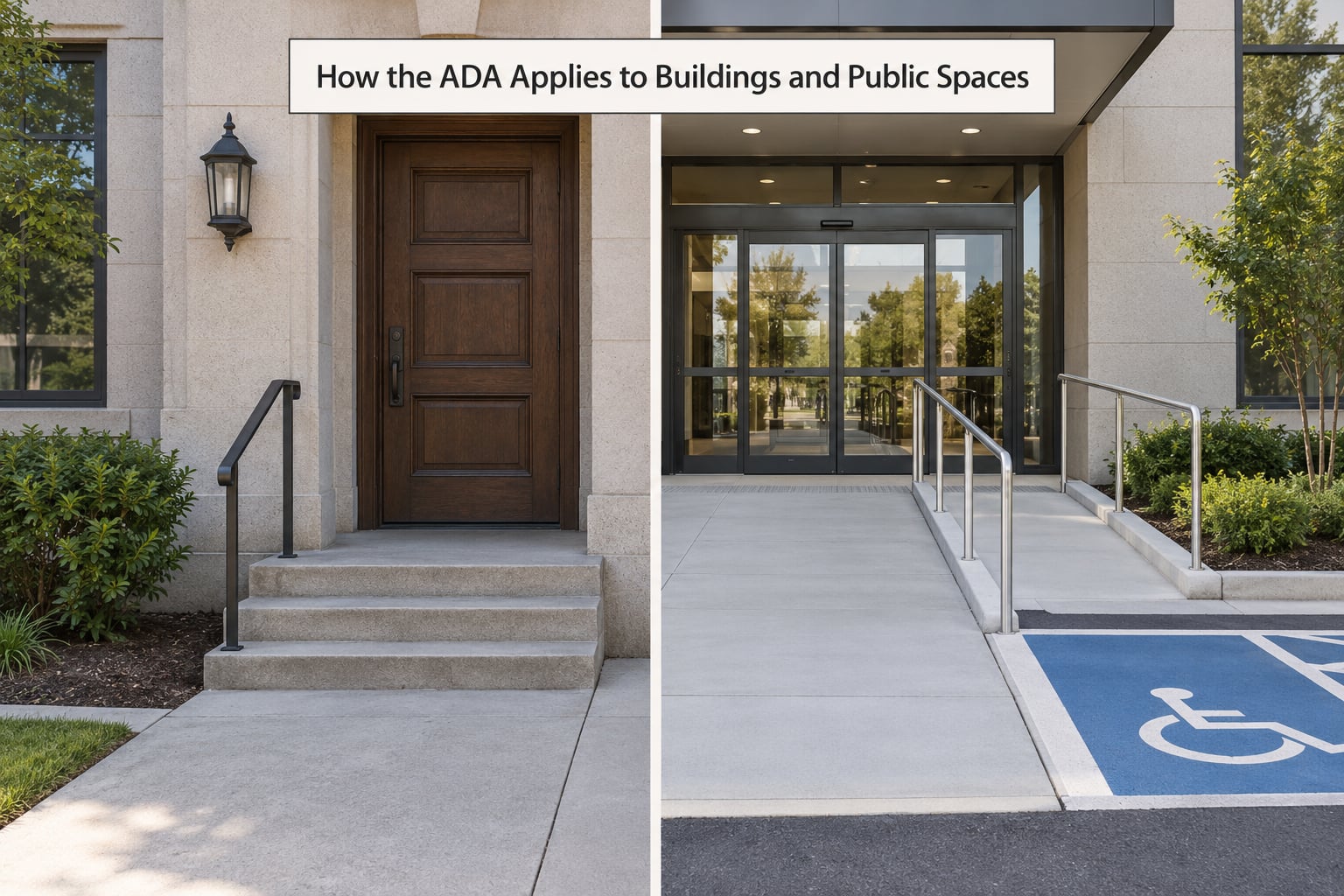
Title II and Title III cover most of what a person touches on a walk through a city. For a business open to the public, the obligations differ depending on when the building was built. Existing facilities must remove barriers when removal is readily achievable, a standard tied to the size of the business and the cost of the change. Facilities built or altered after the 2010 standards took effect must meet those standards for new construction and alterations, including accessible routes, accessible parking, and accessible restrooms.
| Common barrier | What access looks like | Where it shows up most |
|---|---|---|
| Steps at the only public door | A step-free accessible route of travel, or a ramp, with a landing and handrails | Older storefronts, small clinics, church halls |
| Heavy manual doors | Automatic doors, or a power-assist unit, with enough force to open | Libraries, courthouses, grocery stores |
| No usable parking | Marked accessible parking space, access aisle, signage at the correct height, van space where space allows | Shopping centers, medical office buildings |
| Narrow or locked restroom | Accessible stall, grab bars, clear floor space, faucet controls that can be reached from a seated position | Public restrooms in older buildings |
| Signage with no tactile or raised lettering | Braille and raised characters, high contrast, characters placed so they can be read from a seated position | Room and restroom signage, elevator controls |
| Counter or service window too high | A lowered section, or an alternative way to be served | Pharmacies, reception desks, ticket counters |
| Seating scattered with no reserved space | Designated seating, including wheelchair spaces in assembly areas and companion seating | Auditoriums, waiting rooms, classrooms |
| Alarms that cannot be heard | Visual fire alarms and strobes, plus an evacuation chair and an area of refuge on upper floors | Hotels, schools, apartment common areas |
Two rules in this area come up constantly. First, a business open to the public may allow a trained service animal in place of a service, and it is allowed to ask only two questions: whether the animal is a service animal, and whether it is trained to perform work or tasks. It may not ask for documentation, a doctor’s note, or a diagnosis.
Second, effective communication is required at no charge. A dental office that cannot hear a patient asking to stop needs a way to communicate, and so does a hospital front desk with a Deaf customer. Auxiliary aids can include a sign language interpreter, written materials, a relay call, exchange of written notes, or a qualified reader, and the entity pays for the aid.
How the Americans with Disabilities Act Works at Work
Title I protects job applicants and employees. It applies to employers with 15 or more employees, which is the threshold people most often miss. Hourly workers at a small shop can fall outside Title I and still have protections under state law, so it pays to check what your state requires.
Three different sets of duties apply, and they are not the same. A job applicant does not yet have to ask for an accommodation, but an employer cannot screen out or refuse an applicant because of a disability, and it cannot ask about disability before making an offer. Pre-offer medical examinations are off limits.
An employee is entitled to a reasonable accommodation if the disability or its effects substantially limit a major life activity and the employee is otherwise qualified. A reasonable accommodation is a modification that lets the person perform the essential functions of the job. Common examples include a flexible or remote schedule, an ergonomic workstation, alternative input software or a headset in place of a keyboard and mouse, a modified leave or intermittent leave schedule, restructuring the job, reassignment to a vacant position as a last resort, modified testing or training materials, and reordering of a self-sterilizing or cleanroom procedure.
An independent contractor generally is not covered by Title I, though the contractor may be covered under Title III if the work is a service the public can obtain, and other federal contractor rules can apply. This is a genuinely gray area and one worth asking about rather than assuming.
Employers may refuse an accommodation in only a few situations. The usual test is undue hardship, meaning significant difficulty or expense, judged by factors such as cost, nature of the operation, and effect on the business. An employer may also rely on a direct threat assessment based on objective medical evidence about a significant risk that cannot be reduced, and a job applicant may be required to demonstrate job-related, business-necessary qualifications the employer can name.
Two protections matter enormously in practice. Information about a disability, including medical documentation, is confidential and is kept in separate files. And an employer may not retaliate against someone for requesting an accommodation or for enforcing a right under the ADA. Retaliation claims are among the most common charges filed with the EEOC, and people describe on employment forums that the fear of being seen differently after disclosing is the real obstacle, far more than the paperwork.
One thing worth knowing before you ask: the EEOC’s Job Accommodation Network (askjan.org) publishes cost estimates for most accommodations, and a large share of them come out at zero dollars to the employer. Scheduling changes, a flexible start time, and modified written materials are all low-cost fixes, which weakens the argument that a request is disruptive.
How the ADA Applies to Schools, Healthcare, and Public Services
A public school day is covered from three directions at once. Section 504 of the Rehabilitation Act applies to any school or agency receiving federal funds and requires equal opportunity and a free appropriate public education. Title II covers public entities. Title III covers private schools that receive federal funding, and for pre-K through 12 education the practical result is that a child is entitled to a free appropriate public education, with accommodations and modifications implemented by adults who are assigned the job of doing it. Students describe on disability forums that the written plan is usually the easy part and the daily follow-through is where it falls apart.
In higher education, the same titles cover admissions, academic programs, and campus facilities. Section 504 remains relevant to federally funded programs, and colleges have no general obligation to admit a student who cannot perform the essential requirements of the program, though they do have an obligation to provide an accommodation that would allow it if one exists.
Healthcare access runs on effective communication. Hospitals, clinics, dental offices, and pharmacies must provide auxiliary aids such as qualified interpreters, and many of them now default to video interpreting, which the courts have generally accepted as an effective aid. A clinic also cannot refuse a patient for using a wheelchair, or require a companion to act as the interpreter because of a preference for a family member who is also a child.
Public services bring their own details. A polling place must be accessible and, in many states, have a voting system usable independently; if a ballot marking device is inaccessible, the standard remedy is a curbside ballot or an accessible voting machine. Libraries must provide accessible materials and, where they borrow from other systems, accessible versions of what they circulate. Courts, including traffic court, must provide an interpreter or other aid at no cost when needed for meaningful access. Air travel is covered by the Air Carrier Access Act, which requires advance notice for most accommodations, though boarding assistance and accessible seating can be requested up to the time of the flight.
What Accessibility Means Online and With Technology
Everyday life increasingly runs through screens, and this is where the ADA is least understood. Title III applies to websites and mobile apps offered by businesses open to the public, and courts read a website as a place of public accommodation. The technical test generally references the Web Content Accessibility Guidelines, but the legal standard is effective access rather than passing an audit.
In practice, that means a site has to be usable with a screen reader and keyboard navigation alone: logical heading structure, alt text on meaningful images, form fields that are labeled, visible focus, and adequate color contrast and text size. Videos need captions. A time-limited transaction needs a way to complete it that does not depend on fine motor control.
Consumers reported to the Department of Justice in 2023 that websites without these features were effectively shut off from shopping, banking, or appointment booking, which is how the argument is usually framed: not that the site is ugly for some users, but that those users are excluded from the service entirely.
The regulatory picture is unsettled. The Department of Justice issued a Title II web and mobile accessibility rule in 2024 covering state and local governments, and as of 2026 its implementation schedule has been repeatedly litigated and modified. Businesses that want a stable reference point should follow the federal web guidelines and, where state law is stricter, the state rule. Physical kiosks, ATMs, ticketing machines, and check-in screens fall under Title III and fall under the same reachability and operability principles as a website.
Assistive technology is the other half. Screen readers, magnification, speech-to-text, refreshable braille displays, and alternative input devices are what make the digital world usable, and Universal Design is the idea that building for the widest range of people from the start costs less than retrofitting later.
What the ADA Does Not Guarantee
This is the section readers search for most often, and it is the one almost every competitor leaves out. The ADA is a civil rights law with real limits, and knowing where they are saves months of frustration.
- It does not cover private homes. Owner-occupied single-family homes and most private residential dwellings are outside the ADA, unless they operate a business or are covered by the Fair Housing Act or state law instead.
- It does not cover most housing. Rental apartments built before the Fair Housing Act’s design requirements, or without any federal or state subsidy, fall mainly to the Fair Housing Act’s accessibility-in-advertising and reasonable-modification rules rather than to the ADA.
- It does not cover private clubs or religious organizations in their internal governance or ministerial activities, though public-facing and employment provisions can still apply.
- It does not guarantee the specific change you asked for. A request has to be reasonable. A fully renovated new building at an old facility may not be required if a readily achievable lower-cost barrier removal would give access.
- It does not promise unlimited accommodations. An employer can deny a request that would impose an undue hardship, and the analysis considers cost, operational impact, and resources.
- It does not replace building codes, state law, or an individual education plan. A 504 plan or an individualized education program is a separate legal instrument with its own process.
- It does not cover every online service. Coverage of a specific app or website depends on whether the entity is a covered entity and whether it offers the service to the public, and courts have not yet settled every question.
- It does not end stigma. Physical access has improved faster than attitudes, which is the gap people describe most often in their accounts of using the law.
How to Respond When Access Is Missing
When access fails, the pattern that works is simple: document, name the organization, ask in writing for the specific modification, and keep the deadline in view. This is a general sequence, not legal advice for your situation.
- Document the barrier. Date and time, the exact location, what happened, and who you spoke to. Take a photo or video of the physical condition. For a website, save the page and note what a screen reader or keyboard could not reach, and keep the confirmation email that shows the transaction could not be completed.
- Identify the right organization. The store, the transit agency, the school district, the employer, or the website operator. For a city or county service, that is the state or local government; for a federally funded school, the Department of Education.
- Ask for a specific change in writing. Email or a letter beats a conversation, because it creates a record. Name the modification: a lowered counter section, an interpreter, a lift-equipped vehicle, a page made keyboard accessible.
- Keep a copy and follow up in a defined way. Say when you expect a response and follow up if you do not get one. Undue delay is itself a complaint, and a written record strengthens the later claim.
- Check the deadline before filing. Employment discrimination charges generally must be filed with the EEOC within 180 days of the event, and that deadline can be extended for certain state-level reasons. Title II and Title III complaints do not share that exact filing window, but prompt filing matters, and the relevant administrative deadlines vary.
- Use mediation and free help before a lawsuit. Many EEOC resolutions come through voluntary mediation, which is faster and free to both sides.
Free, phone-based help is available, and it is the most recommended first step by advocates and on disability forums alike. The ADA National Network answers general questions at 1-800-949-4232, the EEOC takes employment discrimination charges at 1-800-669-4000, and the Department of Justice ADA Information Line at 1-800-514-0301 handles general ADA questions. The Job Accommodation Network at askjan.org will work out a specific accommodation for a specific job.
It also helps to know what to say in the moment, because the language matters more than people expect. “I use a wheelchair, and I need an accessible entrance. Is there one?” “I am Deaf, and I need a qualified interpreter to understand what you are saying.” “My service animal is trained to assist me, and under the ADA it is allowed in unless you can explain a specific exception.” “I need this in large print, or I need you to read it aloud, because that is the effective communication I am entitled to.” Asking for the specific thing usually gets a result; saying only “this is discriminatory” rarely does.
Frequently Asked Questions
Does the ADA require every business to be fully accessible?
Not exactly. Under Title III, businesses open to the public must remove barriers where removal is readily achievable, meaning it is easy and inexpensive relative to the size and resources of the business. Buildings constructed or altered after the 2010 ADA standards took effect must meet those standards. There is also an undue hardship limit on what can be required, and state and local accessibility codes can impose additional obligations.
What counts as a reasonable accommodation under the ADA?
A reasonable accommodation is a modification to policies, practices, or procedures that enables a qualified person with a disability to participate, without imposing an undue hardship on the covered entity. In employment, examples include a flexible or remote schedule, an ergonomic workstation, alternative input software, modified leave, restructured duties, or reassignment to a vacant position. Outside employment it is called a reasonable modification and covers interpreters, accessible routes, and similar changes.
Can a disabled person request an accommodation without explaining a diagnosis?
Usually, yes. Most situations require only a plain statement that a disability or its effects substantially limit a major life activity, and documentation of the limitation rather than of a specific diagnosis. Employers may ask reasonable documentation about functional limitations and may seek job-related information in some hiring situations, but they may not ask for the employee’s specific diagnosis. Any medical information received must be kept confidential.
What should I do if a public building or website is inaccessible?
Document the barrier with dates, locations, photos, or saved pages and confirmation emails. Put the specific request for a modification in writing to the organization responsible, keep a copy, and note a date to follow up. For employment issues, note that the EEOC charge deadline is generally 180 days from the event. For help, call the ADA National Network at 1-800-949-4232 or the DOJ ADA Information Line at 1-800-514-0301.
Does the ADA cover online services and mobile apps?
Generally yes. Courts treat a business’s website and mobile app as a place of public accommodation under Title III, so they must be perceivable, operable, understandable, and robust. The 2024 Title II web and mobile accessibility rule covers state and local government entities, and its implementation schedule has been litigated and changed since it was issued. Following the federal web guidelines is the most stable approach for private businesses.
What is the difference between the ADA and an accessibility building code?
They are separate systems that run in parallel. A building code sets minimum construction requirements and is administered by state or local building departments, while the ADA sets federal civil rights obligations measured against the 2010 ADA Standards for Accessible Design. A building can meet the local code and still fail the ADA, and the stricter requirement usually governs for ADA purposes. State accessibility codes may go further than the federal standard.
The First Step to Using the ADA in Daily Life
If something is blocked today, write down four things: the setting you were in, the specific barrier, the rule that applies to that setting, and the organization responsible for changing it. That sequence turns a vague frustration into a specific request, and a specific request is the thing the law actually responds to.
Then make the request in writing and keep the record. If it stalls, the free federal helplines will tell you which agency handles it and how long you have to act.