To learn how to apply for a small community grant, you match your project to a program that funds work like it, check the eligibility rules, write a one-page project description with a simple budget, attach a few supporting documents, and submit before the deadline. Most of these programs do not ask for 501(c)(3) status, so a neighborhood group or parent network is a real candidate. A first application usually costs two to four hours of work and a two-to-eight-week wait for a decision.
That last part matters. Small grant programs reward groups that read the guidelines closely and send exactly what was asked for, not the most polished prose you can produce.
Table of Contents
- What You Need
- Step-by-Step: How to Apply for a Small Community Grant
- 1. Define the community need and project
- 2. Check eligibility and choose the right funder
- 3. Build a realistic project budget
- 4. Write a clear and persuasive grant narrative
- 5. Gather supporting documents and letters
- 6. Review and submit your small community grant application
- Common Mistakes
- Frequently Asked Questions
- Do I need to be a registered nonprofit to apply for a small community grant?
- How much funding should a small community group request?
- What expenses are usually allowed in a small community grant?
- How far in advance should I submit a community grant application?
- Can a first-time applicant request a grant without a track record?
- What should I do if my grant application is rejected?
- Conclusion
What You Need
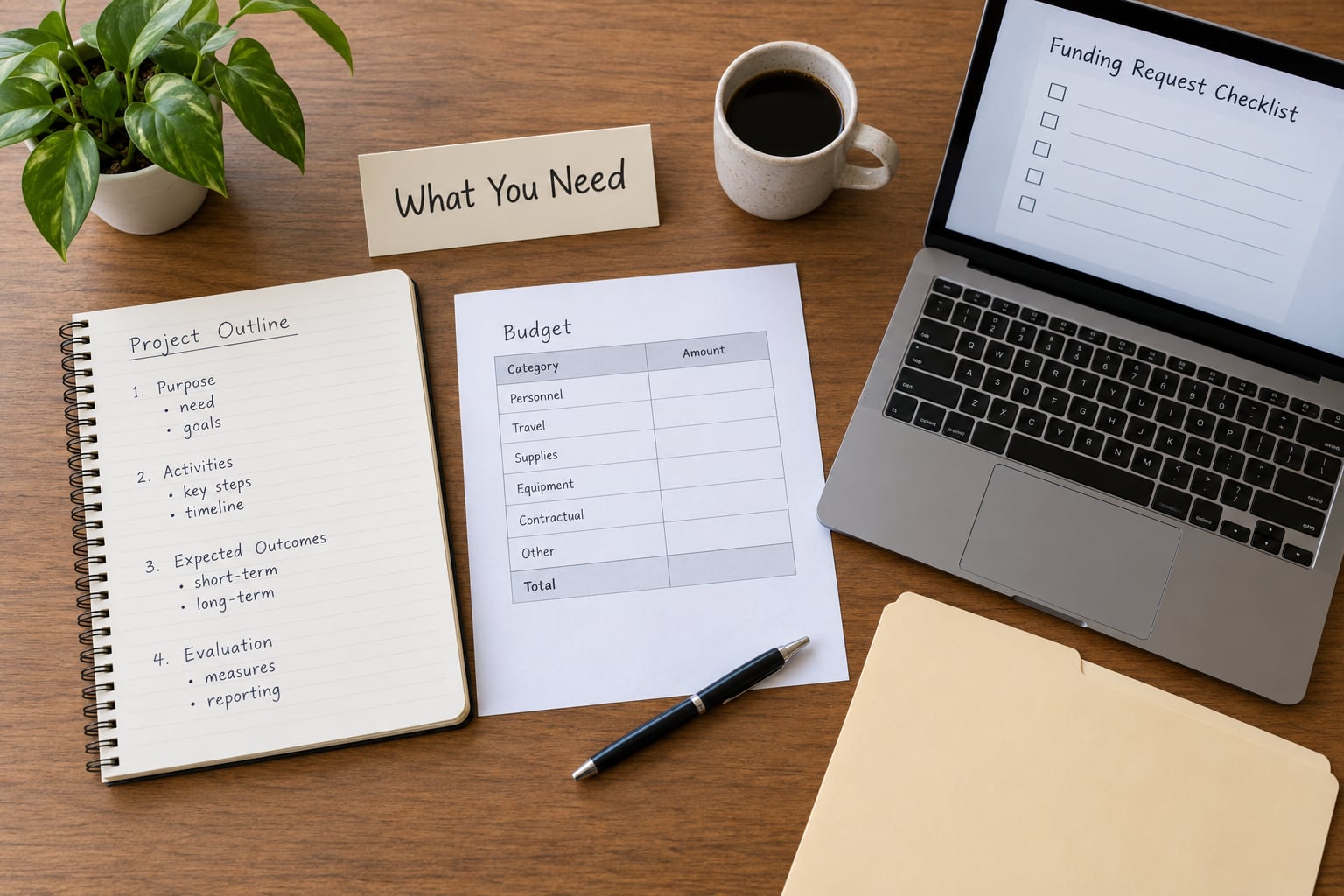
Before you write a single paragraph of the narrative, assemble the materials the program will ask you to attach. Most small-grant applications need fewer documents than applicants expect, but they need every one of them in a clean format.
- Organization details. Your group’s legal or informal name, mailing address, primary contact, phone, and email. Informal groups use the name people actually know them by.
- Mission and need statement. Two or three sentences on who you serve and what the gap is.
- One-page project description. The problem, the activities, the timeline, and what changes when the money arrives.
- A simple line-item budget. What you will buy and what each item costs, with the total you are requesting.
- Eligibility evidence. An IRS determination letter and current filings if you have tax-exempt status, a certificate of good standing, articles of incorporation, or your bylaws. Groups without any of these say so plainly and point to the fiscal sponsor or bank account option instead.
- Letters of support. Usually one to three, often from residents, partner schools, or local businesses. Some programs require exactly three, so count before you start asking.
- Who signs. The name and title of the person authorized to bind the group. Informal groups often name a treasurer or coordinator.
- Funder requirements. The guidelines page itself, read twice, plus any match requirement, public-benefit rule, or reimbursement structure.
- A project timeline. Start date, key milestones, and the date you would report results.
- Bank details. Usually needed only at the award stage, and many programs ask you to upload them through a secure portal rather than email them.
Get the name of the contact person listed on the guidelines page. A two-minute question to them about an ambiguous requirement saves a rejected application.
Step-by-Step: How to Apply for a Small Community Grant
1. Define the community need and project
Funders fund projects, not grievances, so turn a broad concern into something with a beginning and an end. “The neighborhood has no safe space for kids” becomes a supervised after-school homework hour for 25 students, three days a week for six months, in the basement of the church on Elm Street.
Write down five things: who specifically benefits, what problem exists now, what you will actually do with the money, what will be different in six months, and how your work connects to the funder’s stated priorities. Numbers help, but only ones you can defend. Saying you’ll reach 60 families is fine when 60 families are already on your sign-up list.
Aim for a project you could complete with the money you are asking for. A group asking for 10,000 dollars to run a summer program that its 3,000-dollar pilot proved works has a much stronger case than one asking for 40,000 on a hunch.
2. Check eligibility and choose the right funder
Read the eligibility criteria before anything else, because they cost you nothing and rule out most dead ends. Check geography, legal status, tax status, project type, whether individuals may apply, the deadline, and whether matching funds are required. A program restricted to 501(c)(3) organizations with two years of operating history is not a fit for a group that started last spring, no matter how good the idea is.
Small grants generally come in four flavors, and asking for the right one matters. Microgrant or seed money funds a first, one-time thing: a block party, a small equipment purchase, a starter project. Programmatic money funds a defined activity with participants, like tutoring or a cultural event series. Capacity-building money pays for things that make the group stronger, such as bookkeeping help, insurance, or training. General operating money is unrestricted and lets the group cover rent, phone bills, and the coordinator’s hours.
Where do these come from? City and county community development offices, community foundations, corporate giving programs, hospital and utility community funds, service clubs, faith-based networks, and state agencies working in aging, disability, youth, or public health. Local foundations in particular hold money and often want to fund their own community, so they get overlooked by applicants who search only federal databases. If a foundation files a Form 990, ProPublica’s nonprofit explorer shows what it has actually funded and how much, which tells you whether your project is in its lane.
Track opportunities in one spreadsheet with columns for the funder, deadline, amount requested, amount awarded last cycle, and status. Deadlines cluster in fall and spring, which is exactly when a group with a working board gets busy.
3. Build a realistic project budget
Small-grant reviewers read the budget the way they read a receipt, so keep it simple and consistent with your narrative. List direct costs by category, then administration, then any indirect or overhead the program allows, then the amount you are requesting. Round to the nearest sensible figure; a budget padded with $12 line items reads as guessing.
| Line item | Example amount |
|---|---|
| Space rental, six months | 1,200 dollars |
| Program supplies and materials | 900 dollars |
| Two part-time facilitators | 2,400 dollars |
| Insurance and permits | 300 dollars |
| Administration and bookkeeping | 200 dollars |
| Total requested | 5,000 dollars |
Check the ineligible-use list before you fill it in. Small programs routinely exclude salaries for existing staff, rent and utilities, retroactive spending, anything benefiting one individual, and costs incurred before the award date. If the rules say no salaries, do not put your coordinator’s hours on the line and hope nobody notices.
Ask how the money arrives. A reimbursement grant means you spend first and submit receipts afterward, so a group with no cash reserves needs the full amount on hand before it starts. An advance grant sends part of the funds up front. If the program is reimbursable and you cannot cover the gap, say so in the budget narrative and ask whether a smaller first draw is possible.
Match requirements deserve a close look. Cash match is money you contribute. In-kind contributions are things like donated space, equipment, or volunteer hours, and some programs cap them or refuse them entirely. Volunteer time is the weakest match in most reviewers’ eyes, so treat it as a bonus, not a foundation of the match.
4. Write a clear and persuasive grant narrative
Answer each question in the order asked, using the space provided. Reviewers often skim, and a paragraph that buries the answer in the fourth sentence reads as a group that did not read the prompt. Most narratives run through the same beats: the need, your approach, your goals, your activities, your impact, your organization’s capacity, and how the work continues after the grant ends.
Keep sentences short enough to lift out of context. Specific beats sweeping: 80 residents attended last year’s event and 63 came back, versus “we serve the community.” One concrete detail from your own history does more than a page of general description.
There are things funders do not want to read. Skip mission statements that could belong to any organization, long explanations of national social problems the reader already knows, guilt about what your group cannot do without the money, and invented statistics. They also do not want praise aimed at them, a promise that this money will transform everything, or a narrative with no budget logic behind it.
A useful check is the five R’s: realistic about what the money buys, relevant to the funder’s priorities, results-driven in how you measure, reasonable in the timeline, and relationship-based in how you speak about the community you serve. If a paragraph fails one of those, it usually gets cut.
On AI tools: using them to tighten structure or check your budget arithmetic is fine, but every claim in the final document has to be true and yours. Fabricated participant numbers or a confident paragraph about outcomes you invented will fail a verification call. Read the submission yourself, word by word, before you send it.
5. Gather supporting documents and letters
Typical attachments include an IRS determination letter, articles of incorporation or bylaws, proof of good standing, recent Form 990s or financial statements when asked, board minutes authorizing the request, staff or volunteer resumes or bios, partner letters, vendor quotes for major equipment, and your outcome measures.
Send what is requested and nothing more. A forty-page appendix attached to a two-page request does not impress anyone; it reads as an inability to follow instructions.
Asking a letter from someone who has never heard of your group is normal. Give them a short paragraph you wrote about the project, the date, and what you need in the letter, then follow up once. A neighbor, a school principal, or a local business owner who has seen the work is a stronger signer than a name-dropped celebrity.
6. Review and submit your small community grant application
Run a final pass on the numbers first. Check that every total matches the budget, that the amount requested appears consistently, and that any percentage or match calculation is right. Then check names, titles, dates, and signatures. Confirm file formats, file size limits, and how many files the portal accepts. Upload early: portals fail, and a midnight deadline is usually in the funder’s time zone, not yours.
Save a copy of everything you submit and the confirmation screen or email you receive. If nothing arrives within a few days, call and ask for a receipt.
Then wait. Reviews typically take two to eight weeks, longer for foundations with fixed committee calendars. If you are awarded, expect a grant agreement, spending only on what you proposed, keeping receipts, and a short final report describing what happened and what you learned. Reports on small grants are usually one page, and groups that send them well are the ones funders remember next cycle.
Common Mistakes
Most rejections come down to a handful of fixable problems. Here are the ones that come up repeatedly, with what to do instead.
- Vague outcomes. “Improve the lives of youth in the neighborhood” proves nothing. Write a number, a timeframe, and a measure you already know how to collect.
- An unsupported budget. Every line needs a reason, even a one-sentence note. If you cannot justify the amount, lower it.
- Budgeting ineligible costs. Salaries for existing staff, rent, and costs incurred before the award date are excluded by most small programs. Read the list, not the assumption.
- Missed eligibility rules. Wrong geography, wrong tax status, wrong fiscal year. This is the cheapest mistake to fix and the most expensive to ignore.
- A generic mission statement. Reviewers fund community voice, not boilerplate. Say what your group does that no one else on the list does.
- Overlong writing. If a prompt allows 500 words, 500 words is the limit. Padding reads as filler.
- Extra attachments and mismatched files. Submit the requested documents in the requested format, and nothing else.
- Late submission. Portals close on the funder’s schedule and do not wait. Submit two days early and confirm receipt.
- Ignoring the cash-flow reality of reimbursement. Know whether you get paid first or paid last before you promise anyone a start date.
One more piece of honest guidance: a small grant is a portfolio activity. Reviewers look at the whole set of applications, and an experienced nonprofit advisor’s rule of thumb is to treat any single small grant as uncertain and apply to several. A 2,500-dollar award that takes 40 hours may not be worth it; a 2,500-dollar award that opens a two-year youth program usually is.
Frequently Asked Questions
Do I need to be a registered nonprofit to apply for a small community grant?
Usually no. Many city, county, and community foundation programs fund neighborhood associations, parent networks, service clubs, and informal groups that have no tax-exempt status. What they usually require instead is a fiscal sponsor, a dedicated organizational bank account, proof of good standing where relevant, and a named person authorized to sign. A smaller set of programs, especially larger foundation grants, do require 501(c)(3) status and sometimes two years of operating history. Read the eligibility section before you assume either way.
How much funding should a small community group request?
Ask for what the project costs, not a round number. Small community grants usually run from about 250 to 10,000 dollars, with many local programs capping a single award well below that. If your project costs 4,800 dollars, request 4,800. Under-requesting signals you have not done the work, and over-requesting invites reviewers to cut the budget for you. Build the budget from real costs first, then confirm the program’s minimum and maximum before you submit.
What expenses are usually allowed in a small community grant?
Direct project costs: supplies, equipment, space rental, program fees, insurance, permits, and sometimes limited staff time directly tied to the project. Commonly excluded: salaries for existing employees, rent and utilities, fundraising costs, alcohol, retroactive spending, and anything benefiting a single individual. Some programs also exclude salaries entirely, so check the ineligible-use list before building the budget and note the restriction in your narrative if it limits the project.
How far in advance should I submit a community grant application?
Two weeks for a rolling program with a quick review, and six to ten weeks for a fixed annual cycle with a committee meeting. Small foundation programs often decide on a monthly or quarterly schedule, while city programs usually have two or three deadlines tied to the fiscal year. Work backwards from the deadline: find out the review window, then your own proofreading and board approval time, then the letter requests. If you can, email the program contact before you start so you are not writing to the wrong criteria.
Can a first-time applicant request a grant without a track record?
Yes, but you need evidence rather than history. A pilot event with 63 attendees, a sign-up list with 40 names, a letter from a partner school, and photos from last year’s block party are all track record. Microgrant and seed programs are designed for exactly this stage, and their reviewers know a brand-new group. Frame the request as the next step from something you already did small and successfully, and explain how you will report results on this one.
What should I do if my grant application is rejected?
Ask for feedback, briefly and without frustration. If the funder offers it, a note asking what would have made the application stronger is often answered. Reviewers usually point to something structural: an unclear outcome, a gap in the budget, an ineligible cost, or a mismatch with their priorities. Fix that one issue, then wait at least one funding cycle before returning to the same funder, and apply elsewhere in the meantime. A rejection is common, and the second application is almost always better than the first.
Conclusion
Pick one project you could actually finish, find a program whose eligibility rules your group meets, and build a budget from real costs rather than a wish list. Then write the story in the funder’s order of questions, keep the attachments to what was requested, and submit early enough to check the confirmation. The rest is repetition: track what you apply to, keep your receipts, report honestly, and go back to the same funders next cycle.