
A coalition is an agreement between two or more organizations to pursue a shared goal none of them can reach alone, with written rules for who decides what, how the work gets done, and how credit is shared. Building one that lasts takes months of relationship work and clear decision rights, not a launch email.
If you are trying to learn how to build a coalition between organizations, the sequence matters more than the idea. Get internal authorization first, name the problem that genuinely requires more than one actor, then earn commitments one conversation at a time.
The framework below runs seven steps, from defining the shared problem to reviewing what actually worked. It draws on what nonprofit practitioners and community organizers describe in practice, including the parts that are tedious: mapping partners, setting governance, and deciding in advance who gets the microphone at the media moment.
Table of Contents
- What You Need
- Coalition, alliance, network, or partnership?
- Step-by-Step: How to Build a Coalition Between Organizations
- 1. Define the shared problem and a mutually beneficial purpose
- 2. Map potential members and the resources they can contribute
- 3. Build relationships before asking for commitments
- 4. Agree on a shared mission, principles, and decision process
- 5. Choose one early initiative with visible results
- 6. Create a transparent communication and decision system
- 7. Review results, learn, and strengthen the coalition
- Common Mistakes
- Frequently Asked Questions
- How long does it take to build a coalition between organizations?
- How do you recruit organizations to join a new coalition?
- Should a coalition have a dedicated coordinator or staff position?
- Who should make decisions in a coalition of organizations?
- How do coalition partners handle disagreements or unequal resources?
- How should a coalition measure its impact?
- Conclusion
What You Need
Six things have to be in place before you approach a single partner. Missing any one of them turns outreach into a favor request instead of an invitation.
A credible reason to collaborate. Write one sentence naming the problem and the reason no single organization can solve it. If one organization could handle it alone, a coalition adds meetings and takes away speed.
Candidate member organizations. A list of five to eight organizations with complementary missions, not thirty names copied from a directory. You should be able to say what each one adds.
A facilitation lead. Someone neutral who can run meetings, follow up on action items, and hold the line on ground rules. This is often a staff member, a consultant, or a rotating role among members.
Meeting infrastructure. A shared workspace or document folder, a mailing list, a standing call slot, and a way to circulate agendas in advance. Nothing destroys momentum faster than scheduling a call for the fourteenth time.
A simple working agreement. A one or two page document covering purpose, roles, decision rights, meeting cadence, and how members leave. It can be a Memorandum of Understanding, but it does not need to be a legal document to work.
One achievable first initiative. A bounded project with visible results in a defined window. This is the proof that collaboration produces more than meetings, and it is what keeps members showing up after the novelty fades.
Add a seventh prerequisite that guides often skip: authorization inside your own organization. Your board, executive director, and affected staff should know you are pursuing this before you recruit anyone, because partners will ask what authority you have and what happens if your leadership changes.
Coalition, alliance, network, or partnership?
Choosing the wrong form is an early, avoidable failure. The differences are mostly about duration, structure, and decision rights.
| Form | Purpose | Duration | Decision rights |
|---|---|---|---|
| Coalition | Coordinate around a shared outcome | Defined, often with an end point | Agreed rules, often consensus or a steering group |
| Partnership | Deliver something together, usually two parties | Project-based | Defined by the agreement, often bilateral |
| Alliance | Align positions and share credibility | Open-ended | Minimal by design |
| Network | Connect people who share a field | Open-ended | None, membership is self-directed |
If you only need shared visibility, an alliance or network is lighter and faster. If you need to share staff time, money, or data, you need the governance of a coalition.
Step-by-Step: How to Build a Coalition Between Organizations
1. Define the shared problem and a mutually beneficial purpose
A coalition should start with a problem that crosses organizational boundaries, not with a list of organizations that would like to work together.
Test the problem against three questions. Does solving it require more than one sector or type of expertise? Does each member gain something it could not get alone? Can you state the public benefit in one sentence a funder, a board member, and a resident would all accept?
Then draft a purpose statement focused on shared outcomes rather than shared process. “Improve coordination among local youth programs” describes a meeting. “Every young person leaving our programs has a documented next step in education, training, or work within 30 days” describes a result.
The readiness test is simple. Before moving on, every participating organization should be able to state both the public benefit and its own reason for joining. If someone can only offer the first, they are a supporter, not a member.
2. Map potential members and the resources they can contribute
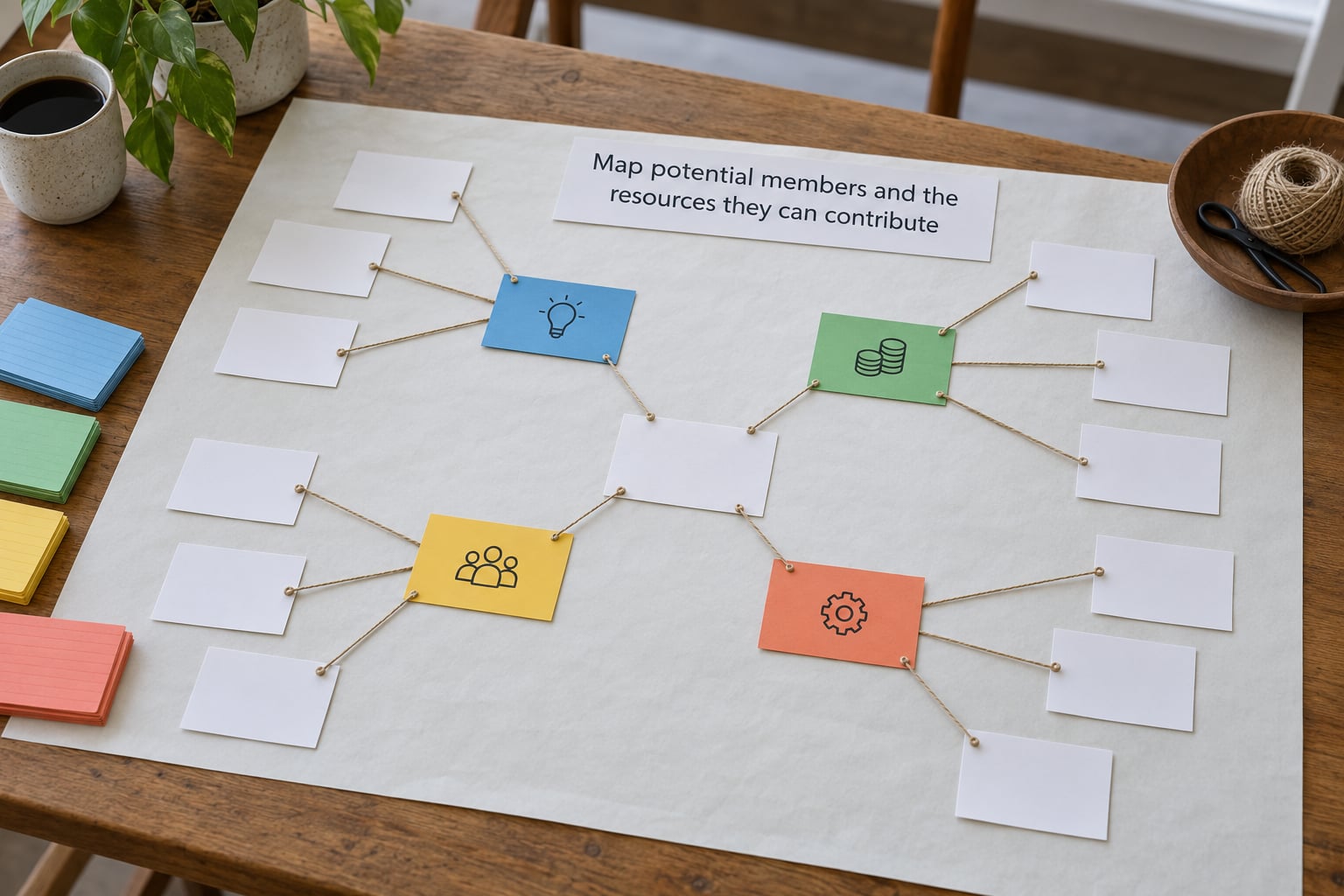
Mapping is where most coalitions quietly get stuck, because organizers list organizations rather than what those organizations actually hold.
Look for six resource categories: subject expertise, money, access to decision-makers, communications reach, service delivery capacity, and constituency voice. Organizations that bring only one thing can still be useful, but you should know which one before you invite them.
A practical exercise is a one-page canvas. Across the top write the shared problem, down the side list resource categories, and for each candidate place a card showing what they contribute and what it costs you. Costs are real: staff hours, meeting load, brand exposure, and the chance your members will disagree publicly.
Keep the map visible as a document rather than a diagram on a whiteboard. Gaps matter. If no member can reach the state legislature, that is a hole in the map, and no amount of enthusiasm fills it.
Also watch for the trap of treating members as interchangeable. Two organizations doing the same work in the same geography are usually a duplication problem or a competitive problem, and neither improves with a coalition.
3. Build relationships before asking for commitments
Do not recruit before you understand. The step that decides whether a coalition lasts happens in ordinary conversations before any meeting is scheduled.
Start with introductory calls, ten to fifteen minutes, framed as learning rather than asking. What is this organization trying to change this year? What has already failed? What constraints does its board, funding cycle, or staff capacity impose? What would make this work worth their time?
Identify respected connectors. One person who is trusted by a small organization can open a door that six cold emails never will, and asking a partner for a warm introduction costs nothing.
Surface overlapping concerns early. In practice, alignment rarely appears as agreement; it appears as two organizations that have been describing the same problem in different words. Those descriptions are worth writing down side by side.
A first conversation is successful when the person on the other end recognizes real value in continuing, not when they agree to join. If you walk out of every call with a commitment, you are recruiting, not building a coalition.
4. Agree on a shared mission, principles, and decision process
This is the step where most coalitions either become real organizations or quietly dissolve. The written commitments should cover six things: purpose, member roles, decision rights, meeting practice, conflict resolution, and how member input reaches public statements.
On principles, keep them short. One to three points that members can state from memory beat a page of aspirations. Whatever you write, someone will be asked to defend it against a decision that is uncomfortable.
On decision-making, pick one model deliberately rather than defaulting to “we’ll figure it out.” Three models cover most cases.
Modified consensus means no one is blocked indefinitely by a single objection, but any member can register a formal objection that must be recorded in the notes. It suits coalitions that need to move without letting a large member steamroll a small one.
Steering group with delegated authority means a smaller group decides within a charter, and the full membership ratifies big decisions. It is efficient and it is where power quietly accumulates.
Majority vote, one member one vote is the fairest on paper and the most fragile in practice. A large organization with one staff seat ends up outvoted by three small groups, then disengages, then the coalition loses the resource it needed most.
A decision-rights table is worth writing explicitly, so nobody is surprised later. Fill in who decides for each category before you start.
| Decision | Who decides | How it is settled |
|---|---|---|
| Annual priorities and budget | Full membership | Modified consensus |
| Public statements and press inquiries | Agreed spokesperson plus steering group | Advance review by members |
| Joining and leaving membership | Membership against written criteria | Simple majority of members present |
| Meeting agenda | Facilitator or convener | Open for member additions |
| Working group deliverables | Working group lead | Lead decides, reports to membership |
| Ending the coalition | Full membership | Sunset clause, reviewed on schedule |
Define a leave clause too. Organizations exit coalitions for funding reasons, leadership changes, and strategic shifts, and a process for that is cheaper than a slow rupture.
5. Choose one early initiative with visible results
The first project should be small enough to finish and public enough that people notice it happened.
Give it five components: a shared definition of success, named responsibilities, the resources each member contributes, a timeline, and decision points where the group can change course. Success means something a non-member can verify, not a count of meetings held.
Choose an initiative that creates public value in its own right. A coalition whose first act is purely internal, such as producing a strategy memo, gives members no reason to stay engaged and no story to tell outsiders.
Watch the timeline shape too. Projects that take several years usually belong to a movement rather than a coalition. Campaigns that can be delivered in six to eighteen months are the right size for a first initiative.
Then protect it. The first project should not be derailed by a big member’s unrelated priority, and if it is, that tells you something important about the coalition that a framework step would not.
6. Create a transparent communication and decision system

Clear systems are what keep a coalition from depending on whoever happens to have institutional memory.
Split the internal roles three ways. A convener schedules, circulates materials, and keeps the records. A coordinator does the small work nobody wants to do, so a rotating role stays real. Working group leads own deliverables between meetings. Distributing these prevents one organization from quietly becoming the coalition’s operations department.
Circulate agendas at least a few days ahead, keep standing meetings to an hour, and send short notes afterward with decisions and action items. If one person does most of the talking, redistribute the speaking slots on purpose.
Set rules for public statements. Decide in advance who speaks to media, who approves shared messaging, and how long members have to comment before publication. Getting this right in advance prevents the most common breach of trust in coalitions, where one member announces a position the others learned about from the news.
Watch for domination rather than waiting to feel it. Signs include the same three organizations setting every agenda item, one language or meeting time that suits only some members, and minutes written in a way that flatters one side. If any of these show up, change the practice rather than naming a person in the room.
7. Review results, learn, and strengthen the coalition
After the first initiative, review five things: outcomes, member experience, equity, unexpected benefits, and what collaboration cost.
Outcomes should be measured with indicators the group agreed on at the start. Keep contributions and attribution distinct. A coalition usually gets credit for outcomes it helped cause and gets blamed for outcomes it did not control, and a short shared measurement statement prevents both.
Member experience is where coalitions learn what to fix. Ask each member what they contributed, what they got back, and what they would change. The smallest and youngest organizations usually give the most useful answers, because they have the least to lose.
Then set the review rhythm. Decide at the outset whether the coalition will continue, revise, expand, or close when the first initiative ends. A coalition with no sunset clause tends to limp along after its purpose is gone, which damages the organizations that keep showing up.
Sunsetting is not failure. Closing a coalition deliberately, documenting what worked, and leaving the infrastructure intact, the contact list in order, and the relationships intact for the next campaign is a good outcome.
Common Mistakes
These are the failures that show up repeatedly, with the correction that fixes each one.
Vague purpose. “Improve community outcomes” recruits nobody because nobody can tell whether it worked. Replace it with a goal that names who changes and what changes for them.
Recruiting before relating. Cold outreach to a list of names produces a mailing list, not a coalition. The correction is the one in step 3: learn first, and let commitments follow a useful conversation.
Unequal power left unaddressed. A coalition where a large member holds the money, the media contact, and the meeting time will accumulate resentment that shows up as quiet disengagement. The correction is written decision rights plus a spokepeople rule that is agreed before any campaign, not after.
Treating members as interchangeable. When a group lists organizations rather than what each contributes, the coalition ends up over-coordinated and under-capable. The correction is the resource map in step 2.
Overloading the agenda. Strategic planning, budget review, and campaign updates in a ninety-minute meeting means nothing is decided. The correction is a hard time limit per item and a parking lot for what does not need the group.
Public statements without consent. A member announcing a position the group never agreed on ends most coalitions eventually. The correction is a review window, defined in advance, that anyone can trigger before something is published.
Measuring activity instead of results. Meeting counts and email volume are inputs. The correction is two or three outcome indicators the group picked at the start, reported honestly even when they are disappointing.
Free-riding. Practitioners in nonprofit communities describe this plainly: organizations that join, take the value, and contribute little. It is usually a design failure, not a character failure, because no one agreed who does what. The correction is narrow, specific, written contributions attached to membership, revisited at review time.
Two habits keep momentum. Schedule the next meeting before the current one ends, which removes an entire category of drop-off. And rotate small roles, such as note-taking or facilitation, so no single member permanently owns the invisible work that makes a coalition function.
One warning worth stating plainly: not everyone treats coalitions as legitimate. Some organizers argue that forming institutions centralizes power and smooths away the conflict that movements need. That objection has force, and coalitions built for a narrow, time-bound objective answer it better than open-ended ones.
Frequently Asked Questions
How long does it take to build a coalition between organizations?
Plan on four to nine months from first conversation to a working coalition, and one to two years before it operates smoothly. The slow part is relationship-building and setting governance, not the first agreement. A coalition formed for a time-bound campaign can function within about three months if the members already trust each other.
How do you recruit organizations to join a new coalition?
Recruit through relationships rather than mass outreach. Hold short introductory calls framed as learning, identify connectors trusted by the organizations you want, and let each conversation run past a second meeting before you ask for anything. The ask is easier once the organization has seen that its priorities came up in the conversation.
Should a coalition have a dedicated coordinator or staff position?
Someone has to do the coordination work, but it does not always need to be a paid full-time role. Small coalitions often split scheduling, note-taking, and follow-up across a rotating group. Fund a coordinator as soon as the number of working groups, members, or deadlines grows beyond what volunteers can carry reliably.
Who should make decisions in a coalition of organizations?
A steering group holding delegated authority usually decides day to day, with the full membership ratifying priorities, budget, public statements, and the decision to end. Write a decision-rights table naming who decides each category. Modified consensus keeps a single member from blocking without letting the largest member outvote everyone.
How do coalition partners handle disagreements or unequal resources?
Agree in advance on how disagreement is handled, and include a formal objection mechanism and a path for escalation. When resources are unequal, compensate: share meeting costs, pay community members for their time, and give smaller organizations rotating leadership. Unequal contribution is a design problem to solve, not a complaint to absorb.
How should a coalition measure its impact?
Pick two or three outcome indicators at the start, alongside a few process measures like working group delivery rates. Track contribution and attribution separately, since a coalition usually influences outcomes it does not control. Add member experience to the review so you learn whether the collaboration itself is working, not only the campaign.
Conclusion
To build a coalition between organizations, start smaller than feels sufficient. Name one problem that genuinely needs more than one actor, invite four or five organizations whose strengths genuinely differ, and convene one conversation about one achievable initiative that can finish inside a year.
Everything that decides whether it lasts happens before the first meeting: your own authorization, a purpose statement a funder would accept, and a decision-rights table nobody is surprised by later.
Then keep the promise the coalition made. Durable coalitions are built from a shared purpose, relationships that get maintained, and repeated evidence that working together produced something none of the members could have delivered alone.