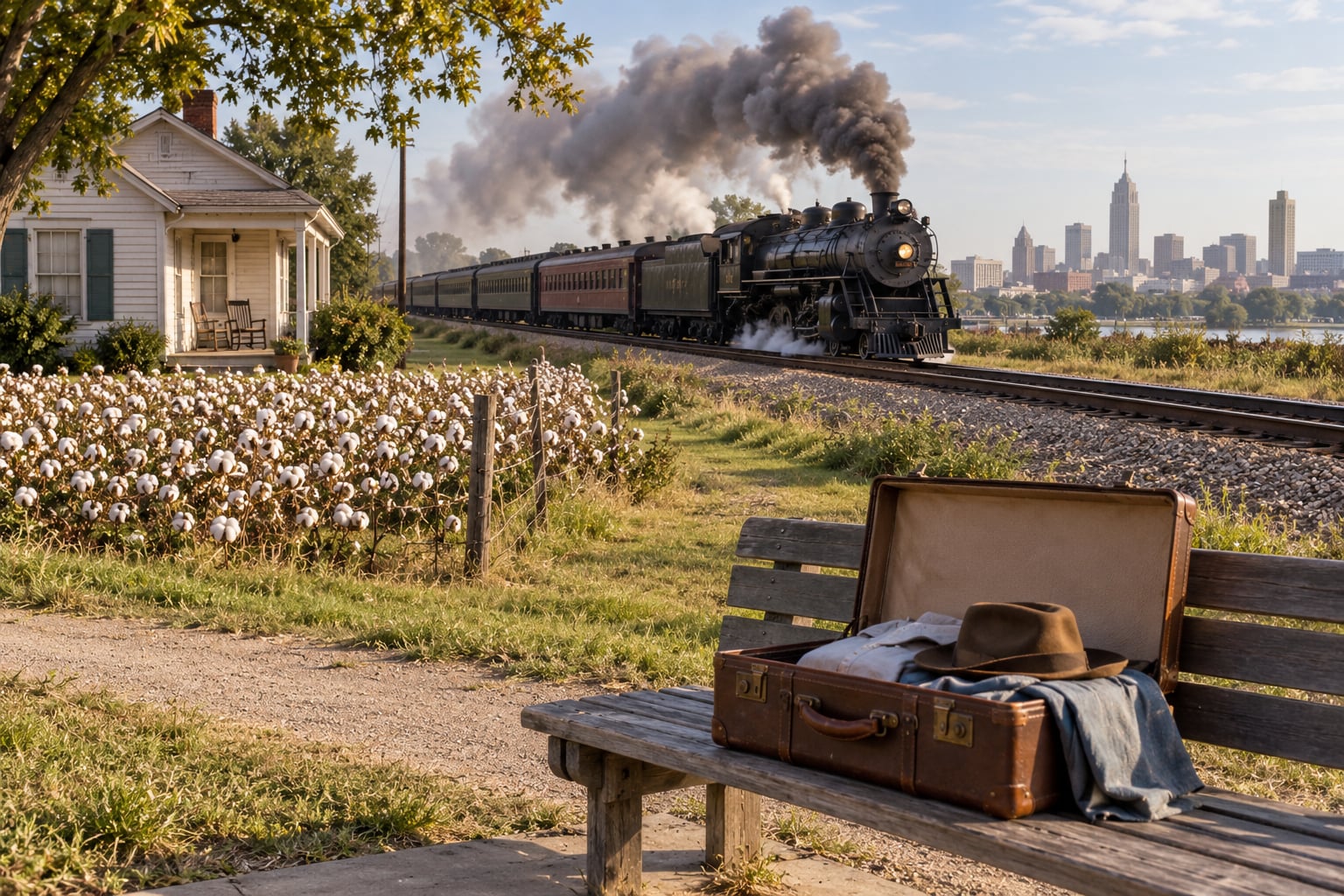
The Great Migration was the movement of roughly six million African Americans out of the rural South and into cities in the North, Midwest and West between 1916 and 1970. It ran in two waves, driven by industrial jobs that paid several times more than southern farm labor, and by the search for something Jim Crow would never allow: ordinary safety and freedom to vote.
If you have an ancestor who went from Alabama to Chicago, or Georgia to Philadelphia, this history of the Great Migration explained below will give you the reasons, the routes and the daily reality behind that move. It is one of the most consequential population shifts in American history, and it is still being lived out.
Last updated for 2026.
Table of Contents
- What Was the Great Migration?
- Why historians call it “great”
- It was not the first Black movement out of the South
- Why Did African Americans Leave the South?
- Five push factors that drove people out
- The South was not one experience
- How Did the Great Migration Change in Waves?
- Where Did People Move During the Great Migration?
- Why particular cities became magnets
- What Were the Living and Working Conditions Like?
- Work
- Housing
- Education, transport and community
- Women did the hardest work
- How Did the Great Migration Change Black Communities and Culture?
- What Barriers and Harassment Did Migrants Face?
- Red Summer of 1919
- What Were the Great Migration’s Lasting Effects?
- The road back South and the New Great Migration
- How Does the History of the Great Migration Explained Today Differ From Common Myths?
- Frequently Asked Questions
- What is the Great Migration and why is it important?
- Where did most African Americans live before the Great Migration?
- Why did Black people not leave the South earlier?
- What were the causes and effects of the Great Migration?
- What was Red Summer 1919?
- How is the New Great Migration different from the original?
- Conclusion: Why the Great Migration Still Matters
What Was the Great Migration?
The Great Migration was the largest internal movement of people in American history. Between 1916 and 1970, about six million Black Americans left farms, small towns and rural counties across the South and settled in cities in the North, Midwest and West.
Two numbers frame everything else. In 1900, roughly 90 percent of Black Americans lived in the South. By 1970, only about half did. That shift rearranged American politics, music, religion and work inside a single lifetime.
Why historians call it “great”
Other migrations in American history moved far more people. The Irish came in the millions, and the forced relocation of Indigenous peoples cannot be compared to anything voluntary. Historians use “great” here in a specific sense: the Great Migration was great in scale, in its geographic reach, and in the way it reshaped the country rather than just adding to it.
It was also an internal migration, meaning people crossed state lines inside the United States rather than arriving from abroad. That distinction matters, because it made the movement far less voluntary than the word suggests. Most migrants could not afford to choose their destination, their job or their housing.
It was not the first Black movement out of the South
Black Americans had migrated before, including forced moves under the domestic slave trade and the post-emancipation labor system, and a scattering of individuals and small groups moved north in the decades before 1916. Those earlier movements were real. But the Great Migration was different in kind: it was large, sustained, industrially organized, and it permanently changed the national balance of Black population.
Why Did African Americans Leave the South?
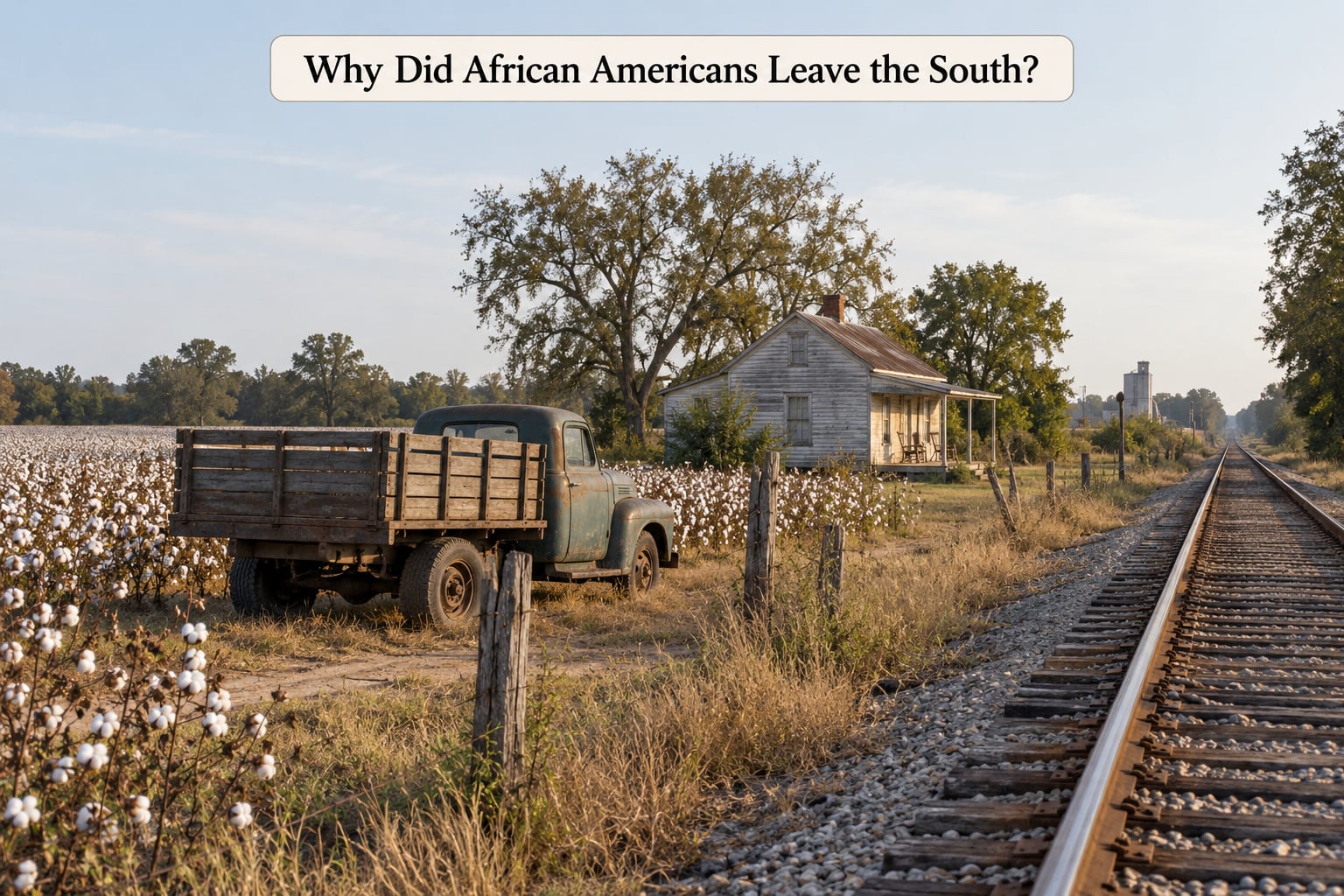
People left because staying had become genuinely dangerous and economically hopeless. The reasons stack on top of each other, and none of them alone would have emptied a county.
Five push factors that drove people out
- Sharecropping and debt peonage. After emancipation, most Black farmers in the South worked land they did not own under crop lien contracts. A bad year, a dishonest count at the weigh scale, or a contested lease could put a family into debt for a generation, and there was no legal way out.
- Jim Crow laws. Segregation was enforced through state law, local ordinance, separate public facilities, voting rules designed to disenfranchise, and unequal school funding. The system made it plain that a Black person’s rights depended on local tolerance.
- Lynching and racial violence. Extrajudicial killings of Black Americans were common enough in some states to function as a tool of control, and the Ku Klux Klan had a large, active membership in parts of the South. Many families left out of direct fear.
- Mechanized agriculture. The boll weevil had ruined cotton across much of the region, and mechanical cotton pickers spread in the 1940s, removing exactly the labor that had kept Black sharecroppers employed. A farm that no longer needed hands was a farm with no work.
- Cotton farming was a dead end. Southern wages were not merely low, they were unresponsive. Historian Isabel Wilkerson found that northern industrial wages could be roughly three times what Black southern farm labor earned, and that gap held for decades.
The South was not one experience
Treating “the South” as a single place is the most common mistake in short summaries. A sharecropper leaving cotton country in Mississippi in 1922 faced something different from a small business owner in Atlanta who stayed put and prospered, or a Texas family who moved to California during the war.
Some people could not afford to leave. Rail fare cost money, employers sometimes controlled advances to workers, and a family with several children and no cash could not simply buy a ticket. Not everyone who wanted out got out.
How Did the Great Migration Change in Waves?
The movement came in two main waves separated by the Great Depression, and the second wave was larger than the first. Conditions, destinations and the reasons people moved all shifted over fifty years.
| Period | What was happening | Main destinations |
|---|---|---|
| 1916 to 1929 | First wave. World War I cut off European immigration, leaving Northern factories short of labor. Recruiters went south, and Black newspapers ran job ads and train schedules. | Chicago, New York, Philadelphia, Detroit, Cleveland, Pittsburgh, St. Louis |
| 1929 to 1940 | Great Depression. Job growth in the North stopped, and migration fell sharply. Many who had moved went home again. | Existing northern cities, with less new arrival |
| 1940 to 1945 | Second wave begins. Wartime defense production pulls workers to West Coast and Midwest plants, with the federal government actively removing barriers to defense-plant hiring. | Los Angeles, Oakland, Seattle, Detroit, Chicago |
| 1945 to 1970 | Largest period of movement. Veterans buy homes under the GI Bill, suburbanization spreads Black homeowners outward, and manufacturing jobs peak in the 1950s. | All major destinations, plus suburban areas around them |
| 1970 onward | Manufacturing jobs decline in the Rust Belt. Reverse migration begins, later joined by a New Great Migration to the South and Southwest. | Atlanta, Houston, Dallas, Phoenix, Las Vegas |
The first wave is usually dated from 1916, when movement began climbing sharply, through 1930. The second, larger wave runs from about 1940 to 1970, and most of the six million people who moved did so after 1940.
Where Did People Move During the Great Migration?
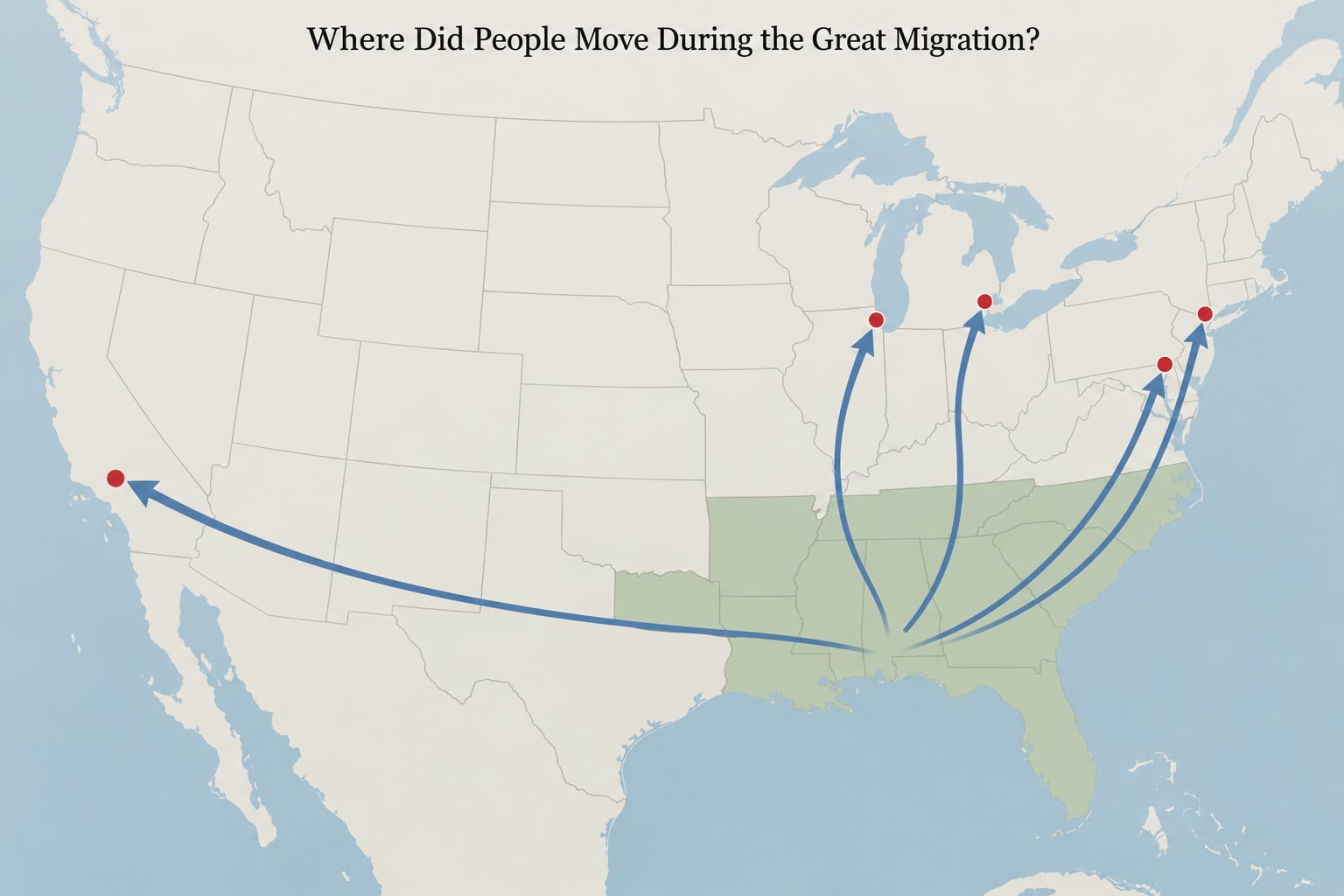
Most migrants moved north along rail lines and highways through Chicago, Detroit, Buffalo and New York. A smaller but important stream went west to Los Angeles, Oakland and Seattle for defense-plant work.
The cities that drew the most people were the ones with industrial jobs open to Black workers, which mostly meant steel, automobile assembly, meatpacking, foundries and railroads.
Why particular cities became magnets
Chicago attracted migrants from Mississippi, Alabama, Georgia and Arkansas, and its South Side became known as the Black Metropolis, with Robert S. Abbott’s Chicago Defender serving as its voice and billboard. Detroit’s auto plants drew heavily from Louisiana and Mississippi.
New York received migrants largely from the Carolinas, Virginia and Georgia, and the concentration in Harlem produced the Harlem Renaissance. Philadelphia, Cleveland, Pittsburgh, St. Louis, Baltimore and Buffalo filled in the map between the biggest destinations.
| City | Black population growth, 1910 to 1920 |
|---|---|
| Detroit | 611 percent |
| Philadelphia | 500 percent |
| Chicago | 148 percent |
| New York | 66 percent |
Percentages like these describe growth from a very small base, and that is part of the story. Migrants arrived in neighborhoods that had been all-white weeks earlier, which is exactly why Northern residents reacted the way they did.
What Were the Living and Working Conditions Like?
Arriving in a northern city did not mean arriving in a promised land. Wages were higher and lynching had stopped, but housing was scarce and work was often hard physical labor on a dangerous schedule.
Work
Most men went into steel mills, foundries, slaughterhouses, automobile plants, stockyards and railroads. Shifts ran long, and injury and illness were common. Employers used Black workers as a buffer against layoffs, so Black workers were hired first when production rose and fired first when it fell.
Housing
Housing is where Northern life turned hostile. Banks would not lend to Black buyers in many neighborhoods, real estate agents steered Black families away from white areas, and landlords used every available trick, including outright refusal to rent.
Black tenants ended up in the oldest housing stock, overcrowded and in disrepair. This pattern, repeated across city after city, is why historians treat housing policy as the sharpest dividing line between the Great Migration’s promises and its results.
Education, transport and community
Northern public schools were often better funded than southern ones, which drew families who saw schooling as the point of the whole move. Commuting was long and crowded, and streetcars and the elevated rail shaped where people lived. Churches became the organizing center of new neighborhoods, and they handled everything from childcare to political endorsement.
Women did the hardest work
Women migrated as much as men, and their work is the least visible part of the story. Many arrived as domestic workers, live-in maids and cooks for white households, jobs that paid a fraction of what a man might earn in a mill. Others worked in garment factories, laundries, hospitals and offices.
Domestic work meant long hours at a stranger’s house, no weekends and an enforced intimacy that left little privacy. Yet women also carried the practical mechanics of settling a family: finding housing, managing childcare on shift work, and stretching a small budget across the trip.
How Did the Great Migration Change Black Communities and Culture?
The arrival of millions of people transformed Black life from a largely regional Southern culture into a national one. A man from Mississippi and a woman from South Carolina, both living in Cleveland, had to build a community that neither had before.
That community took shape in Black churches, in schools where teachers were hired and protected by local politics, and in businesses funded by what migrants could afford rather than by banks. The Black press grew with it, and the Chicago Defender, Pittsburgh Courier and Amsterdam News served as job boards, real estate guides and political forums at once.
The Harlem Renaissance was the most visible expression of that new concentration, with writers and artists producing work that is still taught in schools today. Music traveled the same routes people did. Blues spread out of the Delta, jazz came up the Mississippi and through Chicago, and the audiences for both were largely migrants themselves.
Politically, the shift was decisive. In the South, Black citizens were largely disenfranchised. In Northern cities they could vote, and the numbers turned out. Black voters in key Northern cities became a national political force within a generation, electing Black officials, influencing presidential elections and later funding civil rights organizations from the North.
Sports followed the same path. Major league integration in 1947 was possible partly because Black athletes and fans had concentrated in Northern cities, and Jackie Robinson’s career unfolded in Brooklyn, not in the Jim Crow South.
What Barriers and Harassment Did Migrants Face?
The North’s racial order was informal, and that is what made it so effective. There were fewer laws enforcing separation, but landlords, employers, police and real estate agents enforced the same result without ever writing a rule down.
Employment discrimination ran through hiring, pay scales and promotion. A Black woman cleaning an office could be paid less than a white man in an entry-level job in the same building. Housing discrimination, through lending policy and restrictive covenants written into deeds, kept Black families out of whole neighborhoods for decades.
Red Summer of 1919
Violence was the limit migrants kept hitting. Red Summer of 1919 saw attacks on Black residents in more than 26 cities. The Chicago Race Riot of 1919 was the most violent of them: 38 people killed, more than 500 injured, and about 1,000 Black families left homeless.
When white workers lost jobs, some employers responded by hiring Black workers as strikebreakers, which turned a labor dispute into a racial one. The Klan also reconstituted in the North and Midwest, with a large presence in Indiana and Illinois. Migrants discovered that moving had changed the rules of racism without removing it.
This is where accounts that treat the North as freedom run into trouble with the record. Anyone arguing that the Great Migration was a clear improvement has to sit with the Chicago Race Riot numbers, and anyone treating the North as equally oppressive has to sit with the higher wages and the vote.
What Were the Great Migration’s Lasting Effects?
Demographically, the Great Migration is the reason America’s Black population is urban today, and the reason political power shifted out of the South and into city halls.
Culturally, it produced the Harlem Renaissance, the Chicago Defender and the Black church as political institutions, and a Black music tradition that grew out of movement between Mississippi, Chicago, New York and Los Angeles.
Economically, the results were uneven in a way that shows up to this day. Migrants left low wages for higher ones, and Black families built wealth through housing and steady industrial work for a generation. Then deindustrialization hit the Rust Belt from the 1970s onward, removing exactly the union jobs that had made the move worthwhile.
The road back South and the New Great Migration
From the 1970s, Black families began moving south and west again, toward Atlanta, Houston, Dallas, Phoenix and Las Vegas, a shift some historians call reverse migration. The reasons are the mirror image of the original ones: jobs leaving the North for the Sun Belt, and a desire to live closer to extended family and Southern culture.
The New Great Migration also brought a different kind of traveler, including immigrants from the Caribbean, Africa and Latin America settling in the same cities, which has reshaped the Black populations of New York, Miami and Houston in ways the original movement did not.
How Does the History of the Great Migration Explained Today Differ From Common Myths?
Four claims come up constantly, and each one fails against the record.
Myth: everyone who could leave the South went. Rail fare was expensive, employment controlled advances, and families with many children often had no cash to move. Some stayed for decades, and some moved repeatedly.
Myth: it was one event. It ran over fifty years in two waves with a decade-long interruption in the 1930s, and the second wave was the larger one.
Myth: migration ended Black life in the South. The South stayed the largest region of Black population after 1970, and its Black communities changed during the migration rather than disappearing.
Myth: the North was a promised land. Higher wages were real, and so were restrictive covenants, redlining, police violence and the 1919 riots. Most families describe a trade rather than a rescue.
One more deserves naming, because readers raise it constantly. Yes, plenty of descendants tie their family’s economic mobility to the Great Migration, and that is a fair reading of the wages. It is also fair to say the move put a different set of walls around the same people.
Frequently Asked Questions
What is the Great Migration and why is it important?
The Great Migration was the movement of about six million African Americans from the rural South to cities in the North, Midwest and West between 1916 and 1970. It matters because it permanently changed the nation’s racial geography, cut the Black population share of the South from about 90 percent in 1900 to about half by 1970, and created the political base for Black urban leadership, the Harlem Renaissance and the civil rights movement.
Where did most African Americans live before the Great Migration?
Almost all of them. Roughly 90 percent of African Americans lived in the South in 1900, most in rural areas of the Deep South and in small towns rather than cities. The share had dropped to about half by 1970, which is the single clearest measure of how completely the Great Migration reversed the country’s Black population geography.
Why did Black people not leave the South earlier?
Some did, in small numbers, for generations. What kept larger numbers in place was cost rather than contentment: rail fare was expensive, employers controlled worker advances, and sharecropping debt made even the trip hard to finance. Others stayed because a large family could not move at once, and migrants often returned south during downturns. The Great Migration began at the moment northern wages finally made leaving possible, not the moment leaving became tolerable.
What were the causes and effects of the Great Migration?
The main causes were sharecropping debt, Jim Crow segregation, racial violence, mechanization of cotton farming, and far better industrial wages in the North, made more attractive when World War I cut off European immigration. The main effects were a redistributed national Black population, new Black political power in Northern cities, a flowering of Black culture in Harlem and Chicago, and decades of housing and employment discrimination in the North.
What was Red Summer 1919?
Red Summer was the name given to racial violence across the United States in the summer of 1919, when attacks on Black residents broke out in more than 26 cities. The worst was the Chicago Race Riot of 1919, which killed 38 people, injured more than 500 and left roughly 1,000 Black families homeless. The violence grew partly from labor disputes, as some employers hired Black strikebreakers.
How is the New Great Migration different from the original?
The original Great Migration moved people from the rural South to Northern and Midwestern cities between 1916 and 1970, driven by higher industrial wages. The New Great Migration describes later movement, largely from the 1980s onward, out of declining northern manufacturing cities and into southern and southwestern metros such as Atlanta, Houston and Phoenix. It has also drawn large numbers of Caribbean, African and Latin American immigrants into those same cities.
Conclusion: Why the Great Migration Still Matters
The Great Migration began with people doing arithmetic. A family weighed a southern wage of a few dollars a day against a northern factory wage roughly three times higher, weighed a lynching outside the county line against an unknown city, and often decided to go. Millions of them made that decision, and they carried their churches, foodways, music and expectations with them.
It did not go the way anyone promised. The North offered wages and the vote, and it also offered restrictive covenants, redlining and the 1919 riots. Both halves of that sentence belong in any honest telling, because families lived both halves at once.
Which brings up the most practical way to meet this history. If a relative of yours went north, the record exists, and it is findable: the 1940 census lists who lived where and in what occupation, city directories and obituaries fill in the years between, and the digitized run of the Chicago Defender carries job ads, notices and community news for much of the period.
Family memory is a good place to start and a poor place to stop. Dates drift, names change, and a story that everyone repeats can turn out to be ten years off. Check it anyway. Reading Isabel Wilkerson’s The Warmth of Other Suns after you have found your own ancestor’s name tends to land very differently.