A small group mission statement is one or two sentences the members write together, naming who the group serves, what changes for them, and what the group will actually do about it. The whole job takes about an hour of group time plus thirty minutes of editing, and it works only if you settle purpose before anyone touches wording.
Most small groups do not need a mission statement in the corporate sense. They need something they wrote themselves, in words they already use, that a new member can read once and repeat back to you in under a minute. Everything below is built for groups of three to fifteen people with no budget, no staff, and one meeting.
The written version also survives the things an assumed purpose does not. A founding member moves away. The group has a quiet month. Two members argue about whether to take on the next block. A newcomer asks why anyone bothers. An unwritten purpose falls apart exactly when it is most needed, because nobody remembers agreeing to it.
Order matters more than wording. Groups that brainstorm sentences first and back-fill the purpose end up with something that sounds professional and belongs to nobody. Groups that settle purpose, people, values, and priorities first end up with language they can defend, because the sentence already has a job to do.
Every usable small group mission statement has five parts:
- The reason the group exists, stated as a purpose rather than a task.
- The specific people or community the group serves.
- The change the group works toward for those people.
- The work the group will actually do, named plainly.
- The lines the group will not cross, so the mission can rule something out.
If a draft is missing the fifth part, it is a description of good intentions, not a decision filter. That is the whole difference between a statement that sits on a wall and one a group can use on a Tuesday night.
Table of Contents
- What You Need
- Bring these five things
- What you do not need
- Step-by-Step: How to Write a Mission Statement for a Small Group
- 1. Define Why the Group Exists
- 2. Describe Who the Group Serves
- 3. Choose Three to Five Guiding Values
- 4. Set the Group’s Main Priorities
- 5. Draft Two or Three Mission Statement Options
- 6. Test the Statement for Clarity and Usefulness
- 7. Agree on the Final Version and Next Actions
- Common Mistakes
- Writing an activity list
- Using vague values
- Making it too long
- Ignoring tradeoffs
- Letting one person write it
- Adopting wording nobody can explain
- Frequently Asked Questions
- How long should a mission statement be for a small group?
- Who should write the mission statement?
- What is the difference between a mission statement and a vision statement?
- How do you get a group to agree when members disagree?
- Should a mission statement be measurable?
- Can you change your mission statement later?
- Start With One Clear Sentence
What You Need

You need less than most people expect: a room, the people who are actually in the group, and one piece of paper each. There is nothing to buy and nothing to print unless your group prefers paper to a shared document.
Bring these five things
A plain answer to why this group formed. Not a mission statement, just a sentence. If nobody can finish “we came together because…” in one breath, sort that out in conversation before you schedule anything.
A short list of what the group already does. Projects, campaigns, regular gatherings, the things on the calendar. You need this later to tell purpose apart from task.
Names of the people served. Be concrete. “People” is not an answer. “Renters in the four blocks around Beaumont and Cedar” is.
Three to five decisions the group will face this year. Write down real pending questions: do we run the food drive again, do we take on the next street, do we keep the membership fee. The statement has to survive these.
A quiet space and a timekeeper. One person watches the clock and asks the questions, without authority over the answer. The member who organized the group usually volunteers.
What you do not need
You do not need borrowed language. Consultant phrasing and nonprofit jargon are the most common reason a group statement sounds like it belongs to a different organization. Practitioner threads on community and ministry work keep describing the same pressure: a six-person group handed professional language it never uses, and the members going quiet afterward.
You also do not need agreement on the first pass. Plan for real disagreement, because you will hit it around the third step, and the session works better when nobody is surprised by it.
Step-by-Step: How to Write a Mission Statement for a Small Group
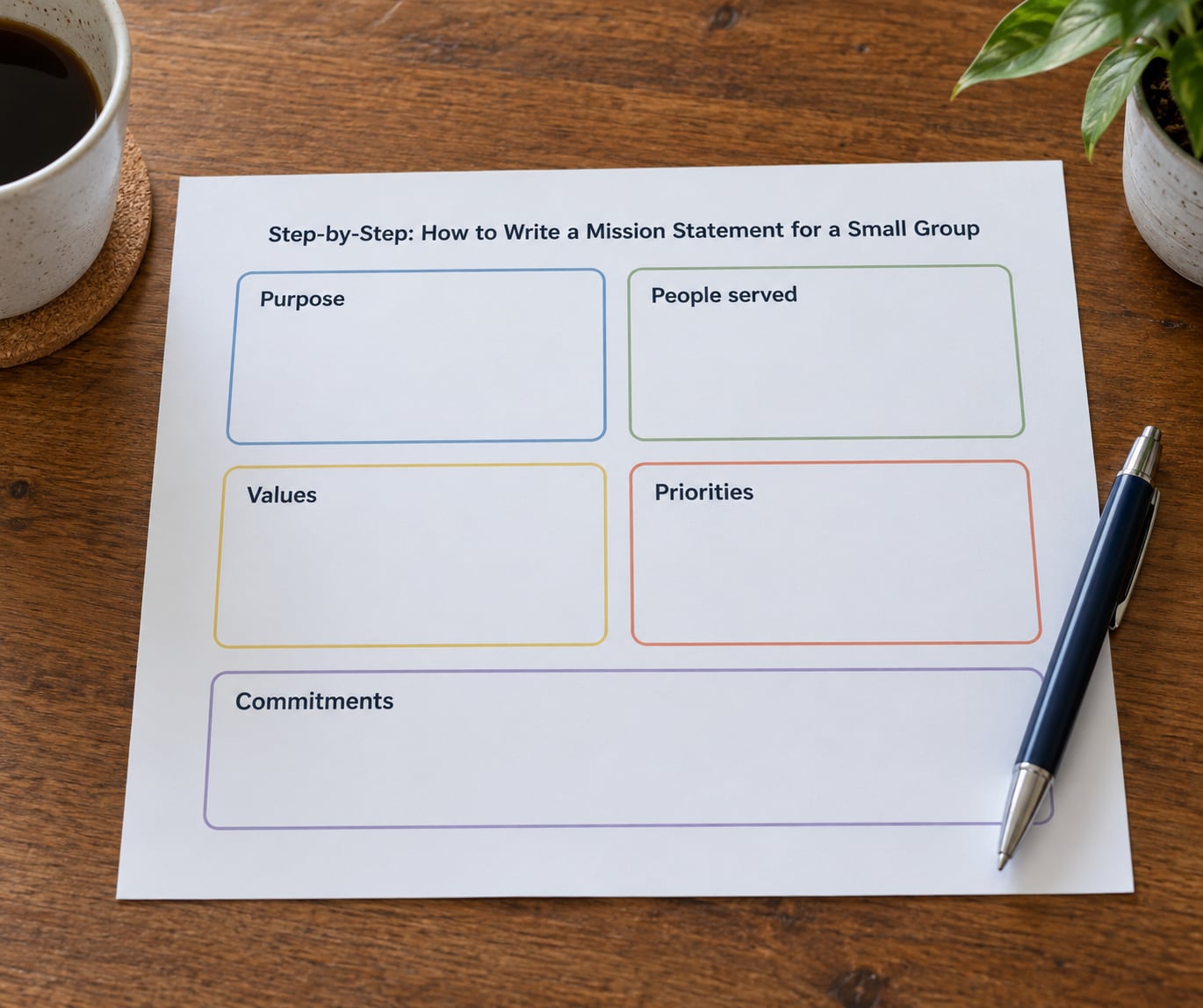
The process runs in seven steps and fits inside one hour. Do them in order. Each step answers a question the next one depends on, and skipping ahead is exactly how a statement ends up describing activities instead of purpose.
The hour in brief. If your group has one meeting and nothing else, this is the shape of it:
| Minutes | What the group does |
|---|---|
| 0-5 | One person reads the five pending decisions from the calendar. No discussion. |
| 5-13 | Silent writing: everyone completes “We exist to…” on paper, then reads it aloud in a round with no commentary. |
| 13-21 | Second silent round on who the group serves, using language the people themselves use. |
| 21-29 | Values: pull three to five adjectives out of the group’s own speech and force each into a behavior. |
| 29-37 | Priorities: each member writes two, the group finds the overlap, and cuts the rest. |
| 37-47 | Two independent ten-minute drafts, compared out loud, one chosen and edited. |
| 47-60 | Readback test on the quietest member, then agree on wording and one next action. |
If you cannot finish in an hour, split it across two meetings and carry the unfinished questions forward in writing. What kills the process is not running out of time, it is leaving step two until the end.
1. Define Why the Group Exists
Ask every member to complete the sentence “We exist to…” silently, on paper, in about three minutes. Silent first, no talking. The reading round comes afterward, and each person reads their sentence without anyone commenting yet.
You are hunting for the underlying reason, not the current activity. “We exist to run a food co-op” is an activity. “We exist so nobody in this neighborhood skips a meal in a month when hours are thin” is a reason. If most written sentences name a task, run one more round: “and if that task stopped tomorrow, what would still be worth doing?”
You know it worked when you can write one sentence every member recognizes as true, even if they would word it differently.
2. Describe Who the Group Serves
Name one specific group of people, in language the people themselves would use. The point of this step is practical, not poetic: when a proposal lands on the table, a member should be able to point at the sentence and say “that is our people” or “that is not.”
Two failure modes show up here. A statement that names everyone names nobody. A statement that names the easiest people to reach quietly justifies work that never reaches the ones who need it most.
Check the room while you draft. Who in this group is closest to the people named? Ask them to test the wording against real conversations rather than against assumptions. If the group serves people who are not present, that check matters more than anything else you will do today. If two members want different beneficiaries, agree on the smaller promise and note the other one as a later question.
You know it worked when a member can look at a proposed activity and decide membership of the served group from the sentence alone.
3. Choose Three to Five Guiding Values
Values describe how the group wants to work, not what it wants to achieve. Three to five is the working range; past five, none of them will ever guide a decision.
Take the adjectives the group already uses. Inclusive. Responsible. Steady. Then force each one into a behavior. “Inclusive” becomes “we move the meeting time when half the group cannot make it” or “we never speak for a community we are not part of without asking them first.” If a value has no behavior behind it, it is a word the group likes, and it should be cut.
You know it worked when each value can be restated as something a member did, or refused to do, in the last year.
4. Set the Group’s Main Priorities
Priorities are what separate a mission from a project list. A priority is something the group pursues across years. A project is something it does once. If it sits in the calendar and then ends, it is a project.
Ask each member for their top two, then look for the overlap. Where three or more people wrote the same thing, that is a priority. Cut back to two or three, and say out loud what the group is not doing this year.
This is also where mission drift gets caught. Groups formed around one urgent campaign tend to name that campaign as the mission, then lose coherence when the urgency fades and the next hard thing shows up. If your group exists because of one crisis, write the mission a level underneath the crisis.
You know it worked when you can state plainly what the group is not doing this year, and nobody objects.
5. Draft Two or Three Mission Statement Options
Now write. Two members draft independently, in ten quiet minutes, using the same four inputs: purpose, people served, values, priorities. They do not confer while drafting. Independent drafts surface disagreement that a group conversation would smooth over before it was visible.
Each draft is one or two sentences and holds three things: who is served, what changes for them, and what the group will actually do. Aspirational language is fine as long as real work sits inside it.
Read both drafts aloud. Rather than merging them word by word, which produces mush and satisfies nobody, pick the one the group prefers and edit that one. Cutting is faster than combining, and the members who wrote the other draft will still own the parts that survive.
You know it worked when you can read the statement aloud and nobody winces at a phrase that sounds borrowed.
Two things often get drafted alongside it. A short list of three to five values with a behavior attached to each, and a one-sentence version for the group chat and for onboarding new members. Keep both beside the statement, never in place of it.
For groups that cannot meet, the same sequence runs in a shared document over two or three days: one prompt per day, everyone writes in the same file, and the facilitator posts a summary the next morning. Drafting must still be silent and independent. Asynchronous conversation is where the most articulate voice tends to take over.
6. Test the Statement for Clarity and Usefulness
Run the readback test on whoever was quietest during the round. Ask three questions and write down the answers as they come:
- What does this group serve, in your own words?
- What change does it work toward?
- Name one thing this group will refuse to do.
If that member cannot answer all three, the statement is not finished. If they paraphrase it well but cannot name a refusal, the statement is missing its fifth part.
The second test is the decision filter. Take one real proposal from the calendar and run it against the sentence. Ask whether the statement’s priorities are served, not whether the idea is a good idea. A statement that approves everything has failed, however well it reads out loud.
You know it worked when a member who missed part of the session can still explain the group’s purpose and its limits after one reading.
7. Agree on the Final Version and Next Actions
Revise line by line, out loud. When somebody objects to a word, ask which of the five parts that word serves. That moves the argument from taste to function, which is the only way a group of eight resolves a wording fight without a vote.
Then record it. Put the approved text in the group’s shared document with the date, name one person as owner rather than author, and attach one concrete next action.
A statement with no action attached is decoration. Ask the group what decision in the next thirty days this sentence will settle, and pick that decision now, before anyone leaves the room.
The one-sentence version fills the same worksheet, ready to copy:
[Group name] exists to [change] for [specific people], by [the work the group will actually do]. We will not [the line the group will not cross].
Fill it in during the session, not after. A blank template discovered on a search is worth less than a half-finished sentence on the table, because the group has to argue over the wording either way.
Common Mistakes
These failures repeat across groups of every size, and most are fixable in the same session that reveals them.
Writing an activity list
The mistake: the statement describes what the group does this season, so it expires in a year and says nothing about why.
The fix: take each activity and ask what it is for, then write the statement a level underneath the calendar.
Using vague values
The mistake: values like inclusive, impactful, and passionate turn up in every statement and guide nothing.
The fix: attach a behavior to each value and cut the ones that have none. Three honest values beat six aspirations.
Making it too long
The mistake: two paragraphs that nobody outside the group can summarize in a sentence.
The fix: one to two sentences for the statement itself. If the group wants more, keep the values and priorities beside it as separate lines.
Ignoring tradeoffs
The mistake: a statement so generous that it cannot rule anything out, so every yes looks consistent with it.
The fix: add the line the group will not cross. A mission that never says no is a description, not a commitment.
Letting one person write it
The mistake: the most articulate member drafts, everyone nods, and the group adopts language it would never have chosen.
The fix: independent silent drafts before discussion, then the readback test with the quietest member in the room. When one person announces a finished statement instead, the group has adopted their priorities rather than agreed on its own.
Adopting wording nobody can explain
The mistake: a paragraph lifted from an organization template, worded in a register that quietly excludes members who do not talk that way.
The fix: run the readback test on the exact sentence a newcomer would read. If a member has to explain it twice, rewrite it in words the group already uses.
Frequently Asked Questions
How long should a mission statement be for a small group?
One or two sentences, roughly 40 to 60 words. That is enough to name who the group serves, what changes for them, and what the group will do, and short enough that a new member can repeat it after a single reading. Keep your values and priorities beside the statement rather than folded into it.
Who should write the mission statement?
The group writes it. One person keeps time and asks the questions, but the wording belongs to everyone present. Have two members draft independently and silently before anyone discusses language, then read the drafts aloud and pick one to edit. A statement announced by a single person carries that person’s priorities, not the group’s.
What is the difference between a mission statement and a vision statement?
A mission statement describes what the group does now and commits to: who it serves and what changes for them. A vision statement describes the condition the group wants to exist later. A group agreement or covenant describes how members treat each other instead. Write the mission first, and add a vision only once the mission has held up for a season.
How do you get a group to agree when members disagree?
Expect disagreement about scope, not wording. When two members want different beneficiaries, put both on the board and ask which one the group can serve well for a year, then write the smaller promise. Record the deferred scope on paper so it does not reopen every meeting, and set a date to revisit it when the group has the capacity to grow.
Should a mission statement be measurable?
Not inside the statement. Numbers belong in the goals that sit beside it. A mission statement carrying targets gets rewritten every quarter, and each rewrite drains the group of the one sentence everyone had memorized. Keep the wording stable for a year, then check whether it still describes what the group actually does.
Can you change your mission statement later?
Yes, and expect to. A group formed around one urgent campaign usually needs new wording when that urgency fades, and a change of leadership is a good moment to revisit it. Date every version and keep the old one in an archive instead of deleting it, so members can see what the group was doing at the time and why the wording moved.
Start With One Clear Sentence
Do not schedule a workshop this month if the group cannot agree on “we came together because…” in one breath. That single sentence is the whole job, and a group that has it can finish in an hour.
Draft it in one sitting, revise it with the group, and attach one action: the next decision the sentence settles. A statement nobody will use on a Tuesday night is a poster, and the group already knows what it does on Tuesday nights.