A civil case and a criminal case differ in four ways that matter: who starts the case, how much proof the side trying to win must have, what the loser can lose, and who pays for a lawyer. A civil case is one person suing another for money or an order. A criminal case is the government prosecuting someone for breaking a law, with punishment on the table. The same event can produce both.
This guide is written for US courts. Rules on filing fees, evidence, and sentencing change from state to state, so treat everything here as the general shape of the system rather than the rule that applies to your case.
Table of Contents
- How a Civil Case Differs From a Criminal Case at a Glance
- What Is the Difference Between a Civil Case and a Criminal Case?
- What makes a case criminal
- What makes a case civil
- Key terms in plain English
- Who Brings the Case and Who Defends It?
- How Does the Burden of Proof Differ?
- What Happens If the Defendant Loses?
- How Do the Court Processes Differ?
- Can a Civil Case and a Criminal Case Involve the Same Facts?
- Which Type of Case Matters More Legally?
- Frequently Asked Questions
- Can the same person be both a witness and a defendant in a case?
- Is a criminal case always more serious than a civil case?
- Can a civil case result in jail time?
- Does a criminal conviction automatically prove civil liability?
- Can one court case be both civil and criminal?
- How long does a civil or criminal case usually take?
- Conclusion: Start by Identifying the Type of Case
How a Civil Case Differs From a Criminal Case at a Glance
| Criterion | Civil case | Criminal case |
|---|---|---|
| Who starts it | A private person or business, the plaintiff | A government prosecutor, on behalf of the state |
| Who is harmed | The plaintiff, who wants compensation or an order | The public as a whole, whether or not anyone was hurt |
| Burden of proof | Preponderance of the evidence, more likely than not | Beyond a reasonable doubt |
| Possible outcome | Money damages, an injunction, specific performance | Fines, probation, incarceration, restitution |
| Right to a free lawyer | No, in most civil cases | Yes, for many people charged with a crime |
| Losing side pays | Often the loser’s own legal fees and costs | The court, though a conviction can trigger fees or fines |
| Record | Usually private | Usually public, and a conviction is permanent |
| Settlement | Common; most civil cases end without a trial | Common too, through a plea agreement |
What Is the Difference Between a Civil Case and a Criminal Case?
The difference comes down to what the case is trying to accomplish. A civil case tries to resolve a dispute between private parties and, when one side loses, compensate the other or make it do something or stop something. A criminal case tries to establish that a person broke a criminal law, and it does that on behalf of the state, not on behalf of anyone who was hurt.
That single distinction cascades into everything else. Because a criminal case protects the public, the process leans hard on the defendant’s rights. Because a civil case settles a private score, the process leans on money and proof.
What makes a case criminal
A criminal case begins when a law is broken in a way the criminal code covers. The offense is against the state, so a conviction does not require a complaining victim. Someone can be convicted of a crime with no identifiable person harmed.
Crimes are usually sorted by how serious they are. Felonies are the most serious and carry the longest potential prison terms. Misdemeanors are less serious, with shorter terms and less loss of rights. Many states also have summary offenses for minor violations, where you typically cannot ask for a jury trial.
What makes a case civil
A civil case begins when one private party decides another private party owes them something, caused them harm, or violated their rights. The plaintiff does not need permission from the government to file. Personal injury claims, contract disputes, divorce, custody, property damage, defamation, wrongful termination and unpaid bills all sit here.
A civil judgment does not find anyone a criminal. It finds someone liable, meaning responsible, and usually leaves the question of punishment to the parties themselves through money or an order.
Key terms in plain English
- Plaintiff — the person who starts a civil case.
- Defendant — the person being sued in a civil case or accused in a criminal case.
- Prosecutor — the government lawyer who brings a criminal charge and represents the state, not the victim.
- Complaint — the civil document that starts the case and states the claims.
- Indictment — the formal document, usually from a grand jury, that charges a felony.
- Discovery — the phase where each side gets evidence from the other and from third parties.
- Damages — money awarded to compensate the plaintiff.
- Injunction — a court order requiring someone to do something or stop doing something.
- Settlement — an agreement that ends the case without a trial.
- Verdict — the jury’s answer on the questions it was asked.
- Liability — responsibility, in the civil sense.
- Acquittal — a not-guilty verdict in a criminal case.
One terminology trap worth clearing up early: civil law as a legal system, used in France and in Louisiana, is not the same idea as a civil case in a US court. US courts run on the common law tradition, where civil and criminal are two kinds of case rather than two kinds of legal system.
Who Brings the Case and Who Defends It?
In a civil case, the plaintiff hires a lawyer or represents themselves, and the defendant answers. If the plaintiff wins, the defendant pays what the court orders. In a criminal case, the defendant is arrested or summoned, a prosecutor takes over the case, and a judge or jury decides guilt.
The victim’s role is the part people most often misread. A victim in a criminal case can be heard, can receive notice, and can seek restitution at sentencing, but the prosecutor controls the case. The prosecutor can drop a charge. A victim cannot.
Rights differ sharply here too. A criminal defendant has the right to remain silent, the right to counsel, and the presumption of innocence. A civil litigant has no automatic right to a free lawyer and no Fifth Amendment protection against self-incrimination in the same way, because the civil rules of discovery are built around disclosure rather than silence.
You can represent yourself in a civil case, and in a criminal case too, but the two self-representation situations carry very different risk. Losing a civil case costs money. Losing a criminal case can cost your liberty and, in some situations, your job, housing, immigration status or custody of your children.
How Does the Burden of Proof Differ?
This is the difference that catches people most often. In a criminal case, the prosecution must prove every element of the charge beyond a reasonable doubt. In plain English: the evidence has to leave no honest, reasonable doubt about guilt. If a juror is still not sure after hearing everything, the verdict has to be not guilty.
In a civil case, the plaintiff only has to prove the claim by a preponderance of the evidence, usually described as more likely than not. Imagine twelve jurors, and the plaintiff needs only a fraction more than half of them persuaded.
So a jury can be fully not persuaded beyond a reasonable doubt while also being more likely than not persuaded that the defendant did it. Both conclusions can be true at once, because the standards are measuring different things.
Example: a store owner claims a shopper walked out with unpaid merchandise, and a camera shows the person leaving without a receipt but the footage does not show whether payment was made somewhere off camera. A criminal theft charge likely fails, because the doubt about payment is real. The same footage in a civil suit is enough to win, because the judge finds it more likely than not that the goods were not paid for.
Some civil claims, such as fraud or clear-and-convincing punitive damage questions, ask for a higher standard between the two, called clear and convincing evidence. That means a stronger than ordinary certainty. It is still far easier to satisfy than beyond a reasonable doubt.
One more standard appears when a criminal conviction is repackaged as proof in civil court. A judge may let the fact of the conviction be treated as proof of the underlying facts, which effectively gives a civil case a very strong piece of evidence it would otherwise have to build from scratch.
What Happens If the Defendant Loses?
In a civil case, losing usually means paying money. Damages can cover medical bills, lost wages, repair costs, and in some claims punitive damages meant to punish rather than compensate. A court can also issue an injunction, which is an order to do something or stop something, such as returning a deposit or staying away from someone. In a contract case the court can order specific performance, which is the rare order to actually perform the promise rather than pay for breaking it.
In a criminal case, losing means a conviction and a sentence. That can be a fine, probation, community service, incarceration, restitution to the victim, or some combination. Certain convictions also carry consequences outside the courtroom: loss of a professional license, a firearm restriction, deportation, permanent custody decisions, or a record that employers and landlords can see.
Money works differently too. In a civil case the plaintiff may recover their legal fees if the law allows it or the parties agree, so a genuine claim has real financial leverage. In a criminal case there is no fee award, and a person who cannot afford a lawyer may be given a court-appointed one at state expense, with no bill for it either way.
How Do the Court Processes Differ?
A criminal case generally moves through these stages:
- Arrest or charging. The person is arrested, or a prosecutor files charges. Felonies usually go to a grand jury, which returns an indictment; misdemeanors are often charged by a document called an information.
- Arraignment. The defendant is formally told the charges and enters a plea.
- Discovery. Both sides exchange evidence. The prosecution has to turn over required material, including exculpatory evidence.
- Plea negotiations. This is where most criminal cases actually end. A guilty plea usually comes with a recommended sentence.
- Pre-trial motions. The defense can move to suppress evidence or dismiss charges.
- Trial. A jury is sworn in, witnesses testify, and the prosecution presents its case first. The defendant is presumed innocent throughout.
- Sentencing and appeal. If convicted, a sentence is imposed, and the defendant can appeal to a higher court arguing legal error.
A civil case generally moves through these stages:
- File and serve. The plaintiff files a complaint and formally delivers it to the defendant. This is the deadline people miss, and missing it can have real consequences.
- Answer. The defendant responds to each claim, often denying them and raising defenses.
- Discovery. The exchange of documents, interrogatories and depositions. Depositions are sworn statements taken outside court.
- Mediation or settlement. Most civil cases end here rather than at trial.
- Summary judgment. A request for the judge to resolve the case without a trial, when one side has no case a jury could accept.
- Trial. A jury may be used in some civil cases depending on the claim and the state.
- Judgment and appeal. The court enters a judgment, which can be enforced by wage garnishment, liens or levying on property if the defendant does not pay.
Discovery is where the two systems feel most different to a civilian. People post on legal forums not realizing a civil case has its own document-gathering phase, and that police may already hold records they could get through a public records request or a subpoena.
Two separate clocks run at once if both cases exist, and each has its own deadlines. A criminal case may be over while a civil suit is still in discovery, or the civil suit may be filed and stalled while the criminal case moves to trial. Statutes of limitations differ between the two as well, generally shorter for criminal charges in many states, and always state-specific.
Can a Civil Case and a Criminal Case Involve the Same Facts?
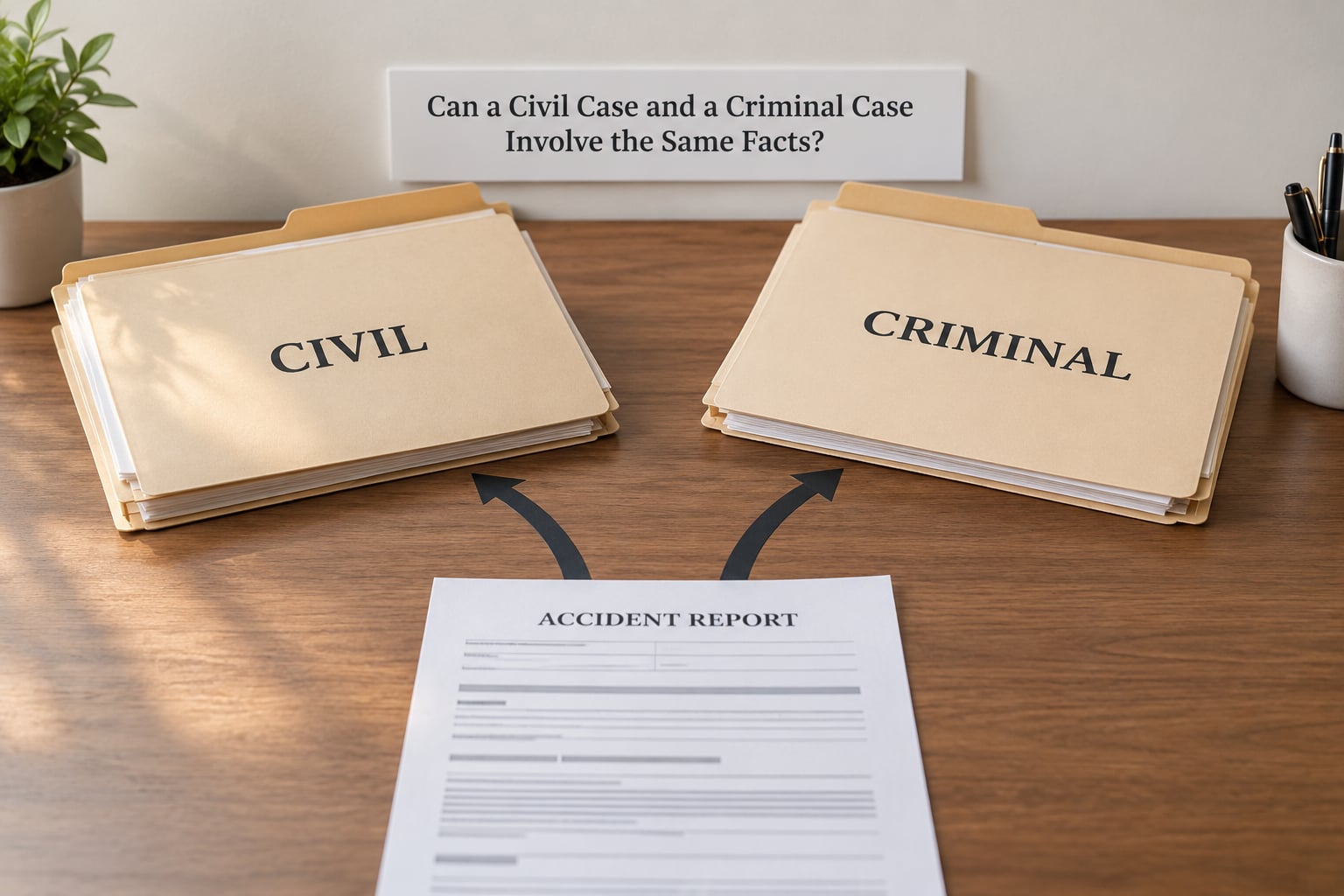
Yes, and this is where readers are most often surprised. Take a car crash on a Tuesday night. The driver is suspected of driving under the influence and leaves the other driver with a broken collarbone.
The criminal case starts because a law was broken. Police arrest the driver, a prosecutor charges DUI, and the state must prove the offense beyond a reasonable doubt. If the breath test is contested or the arresting officer cannot testify, the charge can be dismissed.
The civil case starts for a different reason. The injured driver sues to recover medical bills, lost wages and pain, and only has to show the collision and the harm were more likely than not caused by the defendant’s conduct. That case is not the criminal case, is not stopped by it, and can proceed on its own schedule.
So an acquittal in criminal court does not stop the civil suit. It means the government could not prove guilt to a very high standard. The civil side can still win by a much lower one, sometimes using less evidence than the prosecutor had.
The reverse also happens. A civil verdict is not automatically a conviction, and a private settlement may contain terms that keep the facts out of the criminal case entirely. But civil findings can feed a criminal case: documents uncovered in civil discovery, sworn deposition testimony, and police reports generated by the civil claim all show up in the criminal file.
Other situations where both tracks open: an assault where one person presses charges and the other seeks a protective order, a fraud case where the defrauded business sues for its losses while the state prosecutes, a workplace incident where an employee sues for wrongful termination while the employer faces harassment charges, or a traffic stop where the driver pays for property damage in civil court while the state handles the driving offense.
Which Type of Case Matters More Legally?
Neither one is automatically more important, and the comparison is not really about gravity. Criminal cases serve a public-safety function that civil cases cannot: they punish, they deter, and they express what a community refuses to tolerate. Civil cases serve a different function, resolving private rights and putting someone back where they were, as near as money allows.
Where the weight sits practically is different. A criminal conviction follows you permanently into job applications, licensing, background checks and immigration. A civil judgment usually stays private, but it can be collected for years and, if it comes from unpaid medical bills, can follow someone into later finances.
On this site we write about who gets heard and who does not, and there is a fair critique available here. In a criminal case, the burden of proof is deliberately set so high that some guilty people walk free, and the victim has no control over whether the case moves. In a civil case, a person can be found responsible on thin proof and still lose property. Neither system is comfortable, and each is uncomfortable in a different way.
This is general information, not legal advice about your situation. If you are facing papers in either kind of case, a licensed attorney can tell you how your state’s rules apply.
Frequently Asked Questions
Can the same person be both a witness and a defendant in a case?
Yes. Someone can testify in a case and also be a party to it, and they can appear as a witness in a case against someone else. If you are a defendant, your right to remain silent means you cannot be forced to testify about the facts of your own case, and testimony given in a civil case can sometimes surface in a later criminal case against you. Naming witnesses yourself is handled differently in each system, so talk to a lawyer before relying on any version of this in your situation.
Is a criminal case always more serious than a civil case?
No, though criminal cases usually carry heavier consequences. Severity depends on the facts: a felony drug charge can be more consequential than a car accident lawsuit, while a civil claim for permanent injuries can cost more than a misdemeanor. The categories measure different things. A criminal case asks whether someone broke the law and deserves punishment, while a civil case asks who owes what to whom.
Can a civil case result in jail time?
No. A civil court cannot impose jail time for losing a civil case, and it cannot punish anyone as a criminal. Its remedies are money, orders to do or stop something, and orders to perform a contract. Jail time appears only in criminal cases, through a plea agreement or a sentence after a conviction. A contempt citation in civil court can carry a jail sentence in some states, but that is punishment for defying the court rather than for losing the case.
Does a criminal conviction automatically prove civil liability?
Often yes, though not always completely. In most states a criminal conviction can be offered in a later civil case as proof that the underlying facts happened, which saves the civil plaintiff the burden of proving them again. The convicted person still usually has to prove that the conduct caused the harm and that damages are owed, so the civil case is not simply finished. Rules on this vary by state and by the type of claim.
Can one court case be both civil and criminal?
No single case is both at the same time. Courts keep civil and criminal jurisdiction separate, and the same set of facts produces two distinct cases filed separately, often before different judges on different schedules. What can cross over is evidence. Police reports, documents from civil discovery, and deposition testimony can move from one case into the other, which is why the two proceedings usually have to be coordinated carefully.
How long does a civil or criminal case usually take?
Ranges vary widely by state, court, and complexity, but as a rough guide a simple civil case often runs six months to two years, a contested personal injury case two to three years, and a criminal case from charge to verdict commonly takes six months to eighteen months. Misdemeanors move fastest and complex felonies slowest. If both a civil and a criminal case exist, they rarely finish together, so the civil case frequently outlasts the criminal one.
Conclusion: Start by Identifying the Type of Case
The distinction is straightforward once you name it. A civil case is one private party against another, resolved by money or a court order under a lower standard of proof. A criminal case is the state against a person, resolved by punishment under a much higher standard of proof, with the defendant’s rights built into the process.
Your first move is to work out which one you are actually in, or whether you are in both. Look at who sent the papers. If a prosecutor’s office is involved, or the document mentions a charge, an arraignment, or a probation violation, it is criminal. If a complaint was served on you and it asks for money or an order, it is civil. Then note every deadline immediately, because the two systems keep different clocks and missing a response date in a civil case can be as damaging as missing one in a criminal case.
If you have been served with anything, a state or local bar referral line, a legal aid organization, or the self-help center at your local courthouse can tell you what kind of case you have and what the first step is. Court clerks cannot give legal advice, but they can tell you the type of case, the next scheduled date, and where the forms are.