How oral history projects preserve community memory is a chain of small, deliberate acts: record a person’s recollections in their own words, document the circumstances around each story, secure informed consent, store redundant preservation-quality copies, and hand the material back to the community through transcripts, exhibits, and classrooms. Any link left weak weakens the whole thing.
Most of the work sits between the microphone and the archive, and it is quieter than people expect. This guide walks through that middle: what the recording actually captures, what has to travel with it, and how communities keep control of the result long after the grant money runs out.
Table of Contents
- What Is Community Memory?
- What gets left out of the written record
- How Oral History Projects Preserve Community Memory
- The seven stages of a community oral history project
- How oral history projects preserve memory across generations
- Recording Voices and Firsthand Experiences
- Preserving the Context Behind Each Story
- How Community Review Shapes the Record
- How Oral Histories Are Organized and Archived
- Consent, Privacy, and Ethical Preservation
- How Communities Can Access and Reuse Oral Histories
- What Makes an Oral History Project Successful?
- Frequently Asked Questions
- How do you choose whose stories to collect in an oral history project?
- Do oral history transcripts need to include every word of an interview?
- How accurate are memories recorded in oral history projects?
- Who owns an oral history recording after it is collected?
- How long does it take to complete a community oral history project?
- Conclusion
What Is Community Memory?
Community memory is the shared store of experience a group carries together: what happened on a particular street, how a factory closing felt at the dinner table, which words a family used for the old neighborhood once it was gone. It lives in conversation, in the phrase a neighbor uses, in the pause before someone answers a question about a hard year.
It is not the same as official history. Minutes from a city council meeting record that a decision was made, not what the decision cost the family who lost its lease. The useful part of community memory is often exactly what the institutional record skipped.
What gets left out of the written record
Archival researchers have described the historical record as a box filled by whoever had the resources and the authority to document their own lives. That produces a lopsided archive: owners, officials, and institutions are well represented, while tenants, shift workers, recent arrivals, and young people are present mainly as statistics.
That gap is why a block association recording why it formed, or a youth group interviewing the grandparents who watched the block change, produces something the existing record cannot supply. The narrator’s memory is the only surviving copy of that experience.
How Oral History Projects Preserve Community Memory
Preservation is not one action. It is a sequence where each step protects something the previous step could not: the recording protects the voice, the context protects the meaning, the consent record protects the narrator, the redundant copies protect the file, and the public access protects the memory from becoming private again.
The Oral History Association treats oral history as a field and a method of gathering, preserving, and interpreting the voices and memories of people and communities, and it insists that interviews be planned rather than opportunistic. Most working projects follow seven stages, and the chain breaks wherever one gets skipped.
The seven stages of a community oral history project
- Define the scope. Name the story, the period, and the people the existing record misses. A project with no defined gap becomes a pile of unrelated tapes.
- Recruit narrators. Start with two or three trusted connectors who will introduce you, then let their networks widen the list.
- Get consent in writing. Explain the recording, the intended uses, and the narrator’s options before the recorder is switched on.
- Interview with open questions. Ask for narrative rather than yes-or-no answers, and stay quiet long enough for the story to continue.
- Preserve the recording. Capture uncompressed audio as the master, keep every original file untouched, and back it up in separate places.
- Document and deposit. Transcribe, describe, name, and store the material somewhere that will still hold it in decades.
- Return it. Publish transcripts, host listening sessions, build classroom materials, and show the community what came of their hours.
How oral history projects preserve memory across generations
An interview is only preserved when someone can find it, understand it, and quote it without inventing context. That is the transmission link: a teenager using the transcript in a school project, a neighborhood association replaying a recording at a meeting, a family listening to a grandmother hear herself again. Each reuse is a fresh act of remembering.
The Smithsonian Institution Archives frames oral history as a technique for generating original primary source material from personal recollections through planned recorded interviews. The word that does the work there is planned. Improvised conversation gives you atmosphere; planned questions give you a record that survives scrutiny.
Recording Voices and Firsthand Experiences
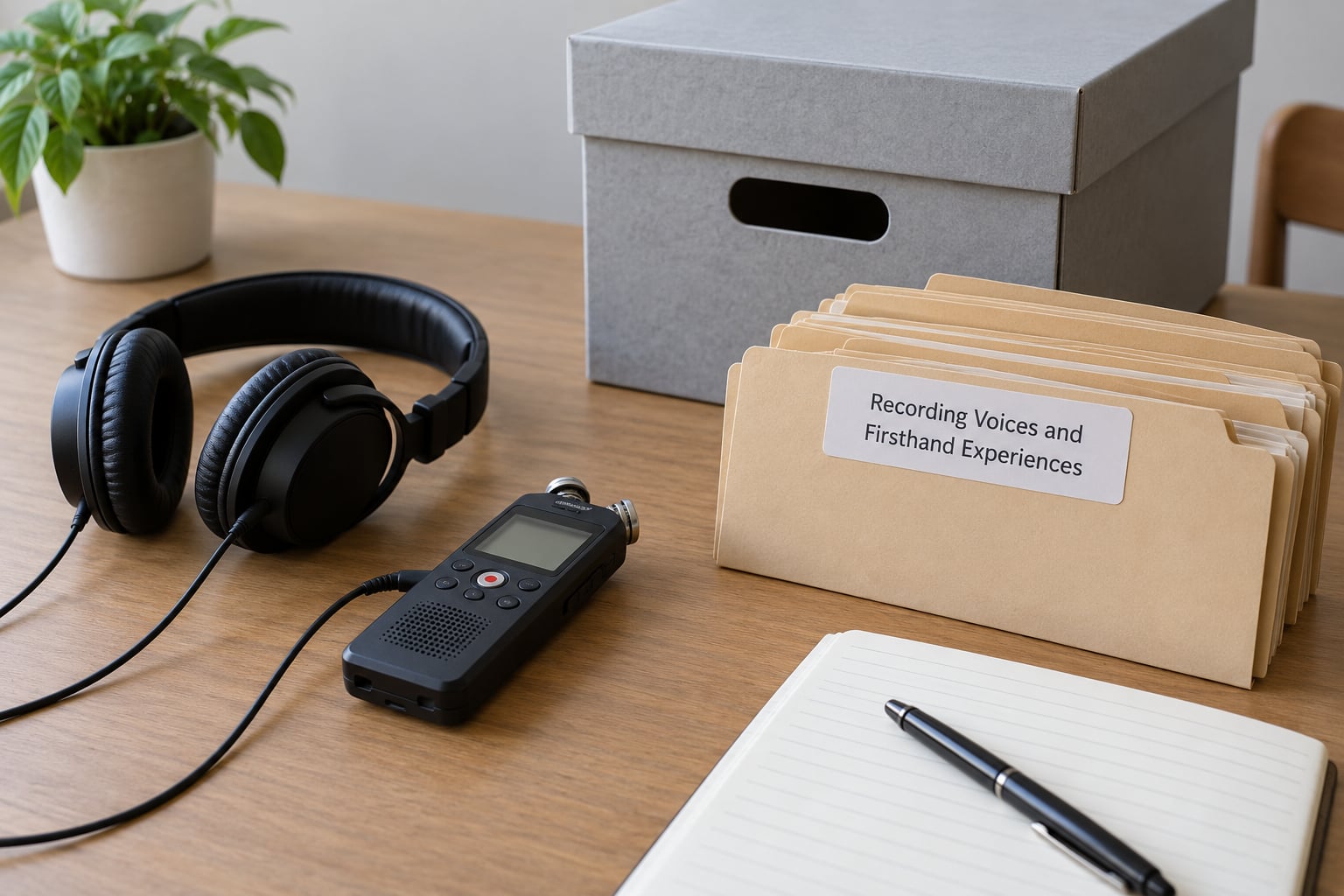
Written records flatten a voice. A transcript can tell you that a narrator’s rent doubled in two years, but not how long the pause was before the answer, or the joke that made three people laugh in the room and never made it into the minutes. Tone, hesitation, humor, and the order in which a person reaches for events are part of the evidence.
Recording quality matters for a practical reason. Compression artifacts and a rumbling room make a file expensive to restore later, and every generation that waits before digitizing makes restoration harder. Most projects capture uncompressed WAV audio at 24-bit, or a lossless format the archive accepts, and keep the raw files without trimming.
A wired external microphone placed on the table between two people, a recorder that runs on mains power or fresh batteries, and a quiet room get you most of the way. Expensive equipment buys polish, not accuracy.
Interviews usually run one to two hours in a single sitting, with breaks. A thread on conducting oral history returned a piece of advice worth repeating: ask the narrator to tell the story chronologically and you will have more usable material than the recording can hold.
Martha Ross’s Six R’s for interviewers — research, rapport, restraint, retreat, review, respect — come from the Smithsonian’s guidance and are worth learning. Restraint means not steering. Retreat means stepping back when the narrator wants silence. Review means giving them a chance to correct what you captured.
Preserving the Context Behind Each Story
A memory without a frame is a riddle. The date it was told, the place it happened, the language used, the questions asked, and the surrounding events all change how the story reads. Projects preserve context by capturing it at the same time as the audio, while the interviewer still remembers.
For every session, capture the narrator’s full name and any preferred name, the interviewer or interviewers, the date and place, the language used, and whether anyone else was present. Keep a copy of the question list. Ask about dates out loud rather than guessing later, and mark the places the narrator was unsure.
Background notes earn their keep. A short paragraph on what was happening in the community that month, the local terms the narrator used for buildings or jobs, and any events the narrator referred to without explaining let a researcher thirty years from now read the story accurately instead of guessing.
Record uncertainty as data. If two narrators place the same closing in different years, note both in the metadata. Alessandro Portelli’s point about oral history moving from a concern with data to a concern with text applies here: the value is in the account as spoken, not in a corrected version of it.
How Community Review Shapes the Record
Community review means letting the people in the recording check the record before it goes public. Narrators correct names, dates, and spellings. Advisors verify terminology, chronology, and whether a description of a neighborhood is fair to the people who still live there.
The line that matters is between correction and rewriting. A narrator may fix a misspelled surname, clarify that a term was a nickname rather than an insult, or ask that a passage about a named person be removed. A reviewer may not smooth a narrator’s rough sentences into more articulate ones, and may not drop a story because it is uncomfortable for the institution holding the tape.
Build review into the schedule with a defined deadline, because transcripts sitting in an inbox for a year often never get returned. Send the transcript and a plain-language summary of what happens with the file, set a response window of two to four weeks, and record what changed and who asked for it.
Some material should never be reviewed publicly, and some should never circulate at all. Where a narrator has asked that a story stay within the family, the record is kept under restriction and the finding aid says so.
How Oral Histories Are Organized and Archived
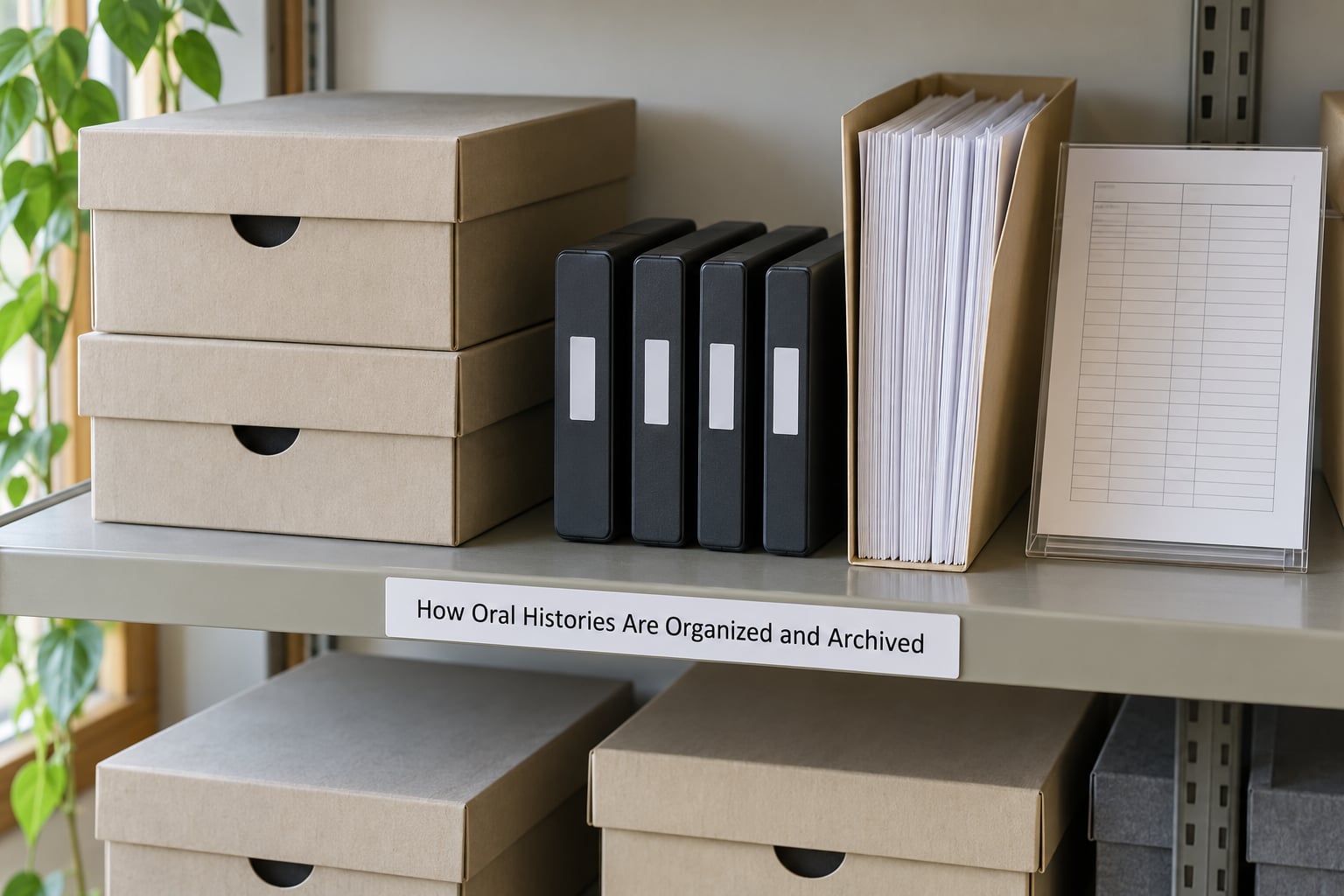
An archive nobody can search is a box of tapes. Describe each interview with enough metadata that a stranger can find it: who is speaking, where and when, what the interview covers, who interviewed them, which languages appear, and what access conditions apply. Most projects use a simple Dublin Core style set of fields, which is what the Library of Congress and most finding aids expect.
A consistent file naming scheme matters more than a clever one. Something like project code, narrator surname, date of interview, and session number stays sortable and readable decades later.
The University of California, Irvine toolkit recommends keeping the original files, any edited copies, a transcription in PDF, the signed consent forms as PDF, the project description, and the metadata. That list is short enough to follow.
Backups follow the same logic as LOCKSS, Lots Of Copies Keeps Stuff Safe. Keep at least three copies on two kinds of storage, with one copy offsite, and check periodically that the copies still open. A single drive is a bet, and drives fail quietly.
Depositing with an archive adds what an independent project cannot supply alone: fixity checks, format migration when a file stops opening, and a named person responsible for the collection. Omeka and similar open-source systems handle public exhibits; a regional or university archive handles the long-term custody.
Consent, Privacy, and Ethical Preservation
Consent is a conversation before it is a signature. Narrators need to know what is being recorded, who will hear it, where it will live, whether it will be published online, how long any embargo lasts, and what they can do later if they change their mind.
A release form grants permission to record, copy, and publish. A deed of gift transfers the physical and digital files to a repository. A deed of restriction limits uses, such as forbidding commercial reuse or requiring permission for sensitive passages. Some narrators also want copyright to remain theirs, which is a different arrangement again, and one worth offering.
Agree in advance how takedown requests work. Who receives the request, who decides, whether the recording stays restricted or is deleted, and how the narrator learns the outcome. A promise you cannot keep is worse than an honest limit, so write down what your project can actually do.
Some stories should stay out of an archive altogether. The Oral History Association notes that cultural, political, and social reasons sometimes mean interview material should not be archived, and that communities should be part of those decisions. Withholding a recording is a preservation decision, not a failure.
How Communities Can Access and Reuse Oral Histories
Preservation is not finished when the file is safe. Access is where memory becomes community property, and where the people who gave their hours find out whether it was worth it.
Start close to home. Hold a listening session where the recordings play and narrators are present to answer questions. Publish transcripts online so the recordings are searchable by name, place, and topic, since audio alone cannot be found by anyone who does not already know it exists. Put excerpts in a physical exhibit at the library, the church, the school, or the housing office where people already walk in.
Reuse is what keeps an archive alive. Middle-school students working from transcripts, a local history podcast built from interviews, a church group researching its founding families, a documentary crew tracing a building’s past: each one gives the collection a new audience and often brings new narrators forward.
Watch the barriers. Provide transcripts and captions, translate for narrators who gave interviews in another language, and treat transcripts as the primary access point rather than an afterthought. A recording nobody in the community can follow is not access, whatever the archive calls it.
What Makes an Oral History Project Successful?
A project succeeds when the memory is still available, still understandable, and still in community hands years later. That is a measurable bar, not a feeling.
- Clear purpose. One defined collection beats an open-ended archive of everything.
- Representative participation. Compare the narrator list against the community you set out to document and notice who is missing.
- Accurate records. Metadata complete, names verified, transcripts returned and corrected.
- Informed consent. Signed forms, stated embargoes, a working takedown process.
- Durable preservation. Redundant copies, a documented deposit, a named custodian.
- Real use. Transcripts opened, listening sessions held, classroom material built, narrators attending their own premiere.
Plan for the end early. Grants end, volunteers move away, and self-hosted websites disappear. Decide before launch who owns the files, where they will live, and who answers the phone in three years.
Frequently Asked Questions
How do you choose whose stories to collect in an oral history project?
Start with the gap, not a list of famous names. Map what your existing record already covers, then select narrators whose experience is missing from it. Two or three trusted connectors usually open more doors than a flyer or a social media post, and leave room for whoever arrives later.
Do oral history transcripts need to include every word of an interview?
Not every word, but the unedited audio should always survive. Most projects produce a lightly edited transcript that removes filler and false starts while leaving the speaker’s own wording intact, plus the raw recording as the record of authority. Name everyone who touches a transcript and give the narrator a chance to correct names and dates.
How accurate are memories recorded in oral history projects?
Memory is reconstructive, so accounts hold gaps, shifts, and details informed by later events. Treat those differences as information rather than failure: date what the narrator knows and when, compare accounts against documents and other narrators, and record contradictions openly. A community archive that hides disagreement is less trustworthy than one that documents it.
Who owns an oral history recording after it is collected?
Under US law the narrator generally keeps copyright in the words they spoke, so you need written permission to record, copy, and publish. A release form grants permission, a deed of gift transfers the files to a repository, and a deed of restriction limits uses. Some narrators also ask for copyright to stay with them, which is worth offering.
How long does it take to complete a community oral history project?
A small collection of ten to fifteen interviews usually takes six to nine months, and most of that time goes to recruiting and scheduling narrators rather than recording them. Larger projects with translation, exhibits, and a formal deposit agreement take longer. Budget against the slowest task, which is rarely the interview itself.
Conclusion
Oral history projects preserve community memory through care at every stage: honest interviewing, recorded context, written consent, redundant copies, and genuine public access. Skip any one of those and the memory thins out, no matter how good the stories were.
If you are starting from nothing, keep the first project small. Write one sentence about the story your community is losing, gather five people who can connect you to narrators, record a single pilot interview end to end including consent and backup, and see how it feels before scaling up. Updated for 2026, and revised whenever a narrator asks for a change to their own recording.