A family communication plan is a written set of instructions that tells everyone in your household how to reach each other, where to meet, and who to call when phones die, towers go down, or roads are blocked. Building one takes about an hour on a slow Sunday, and it removes a surprising amount of panic from the worst days of your life.
Most households have a go bag somewhere and a vague idea about a meeting place. What they are missing is the layer in between: how to confirm everyone is alive, who passes messages when the group text thread stalls, and what happens at 8 p.m. if nobody has checked in. That layer is what this guide builds, in seven steps, using the same structure that local emergency management offices and the American Red Cross hand out, written in plain language you can actually follow.
You do not need a printed FEMA binder to start. A single sheet of paper, filled in honestly, tested once around a kitchen table, will do more for your family than a binder nobody opens.
Table of Contents
- What You Need
- Step-by-Step: How to Make a Family Communication Plan for Emergencies
- 1. Identify Family Members, Needs and Likely Emergencies
- 2. Build a Contact Tree and Choose Backup Options
- 3. Select Communication Methods and Check-In Times
- 4. Establish Meeting Places, Shelter Options and Routes
- 5. Record Essential Information and Accessibility Needs
- 6. Test the Plan and Practice as a Family
- 7. Share, Protect and Update Copies
- The One-Page Template to Copy
- Common Mistakes
- Frequently Asked Questions
- What should a family communication plan include during emergencies?
- How do you make a family communication plan for emergencies without mobile service?
- Who should be the family’s emergency contact?
- How often should a family communication plan be updated?
- What if family members are at school or work during an emergency?
- How should families plan for children, pets, or relatives with disabilities?
- Conclusion: Put Your Family Plan in Place Today
What You Need
Before you write a single instruction, gather what the plan will be built from. Ten minutes of setup here saves an hour of arguing later.
- A current household roster. Everyone who lives with you or spends regular time in your home: children, older adults, a parent with mobility limits, a roommate, a relative staying long-term, and every pet with a name and a carrier.
- Your local risk picture. Check your county emergency management page and your state alerts site for the hazards that actually happen where you live, then write down the top two or three.
- Evacuation and shelter details. Your two routes out, your shelter-in-place options, and the nearest hospital. Walking distance matters more than miles.
- Medical information. Medication names and doses, prescribing doctors, insurance details, allergies, and any equipment that runs on electricity with a battery backup window.
- Communication devices and backups. Charged phones, a power bank, a battery or hand-crank NOAA radio, and any device a family member does not read messages on.
- Language and accessibility needs. Preferred language, sign-language use, relay service, whether anyone needs large print or plain-language instructions, and who needs mobility help to leave a building.
- Backup locations. Whose house could your kids reach on foot, and whose house is far enough away to help if the neighborhood is cut off.
- Offline copies. One paper copy in a wallet or backpack, one saved to a shared cloud folder, and one given to your out-of-town contact.
- One adult who owns the plan. Not a committee. A named person who updates phone numbers and keeps the drill date on the calendar.
Keep the paperwork somewhere boring and obvious: a drawer everyone in the house can reach, and a copy on the refrigerator. A plan filed in a folder on a high shelf is a plan that does not exist.
Step-by-Step: How to Make a Family Communication Plan for Emergencies
Each of the seven steps below produces something written down. If a step ends without paper or a shared note, it does not count yet.
1. Identify Family Members, Needs and Likely Emergencies
Start with the roster, not the disasters. Write one line per person with their age, phone number, and any need that would slow them down: medications, oxygen, a wheelchair, hearing devices, anxiety, a service animal.
Then narrow the hazard list to what your address is actually exposed to. Someone in a floodplain, a wildfire zone, and a coastal surge area each get three different plans, and adding tornado and chemical spill to a coastal list only makes the document harder to use.
Write down what each person does in the first ten minutes. “Maya gets the toddler and the dog carrier. Devon takes the go bags and checks the front door.” Named jobs beat vague instructions every time, and they stop you from all heading in the same direction at once.
Include the people who are easy to forget: the child who spends Tuesdays at grandma’s, the adult who works nights and sleeps through alarms, the relative who never answers their phone. Knowing how to reach those people takes effort while nothing is happening.
2. Build a Contact Tree and Choose Backup Options
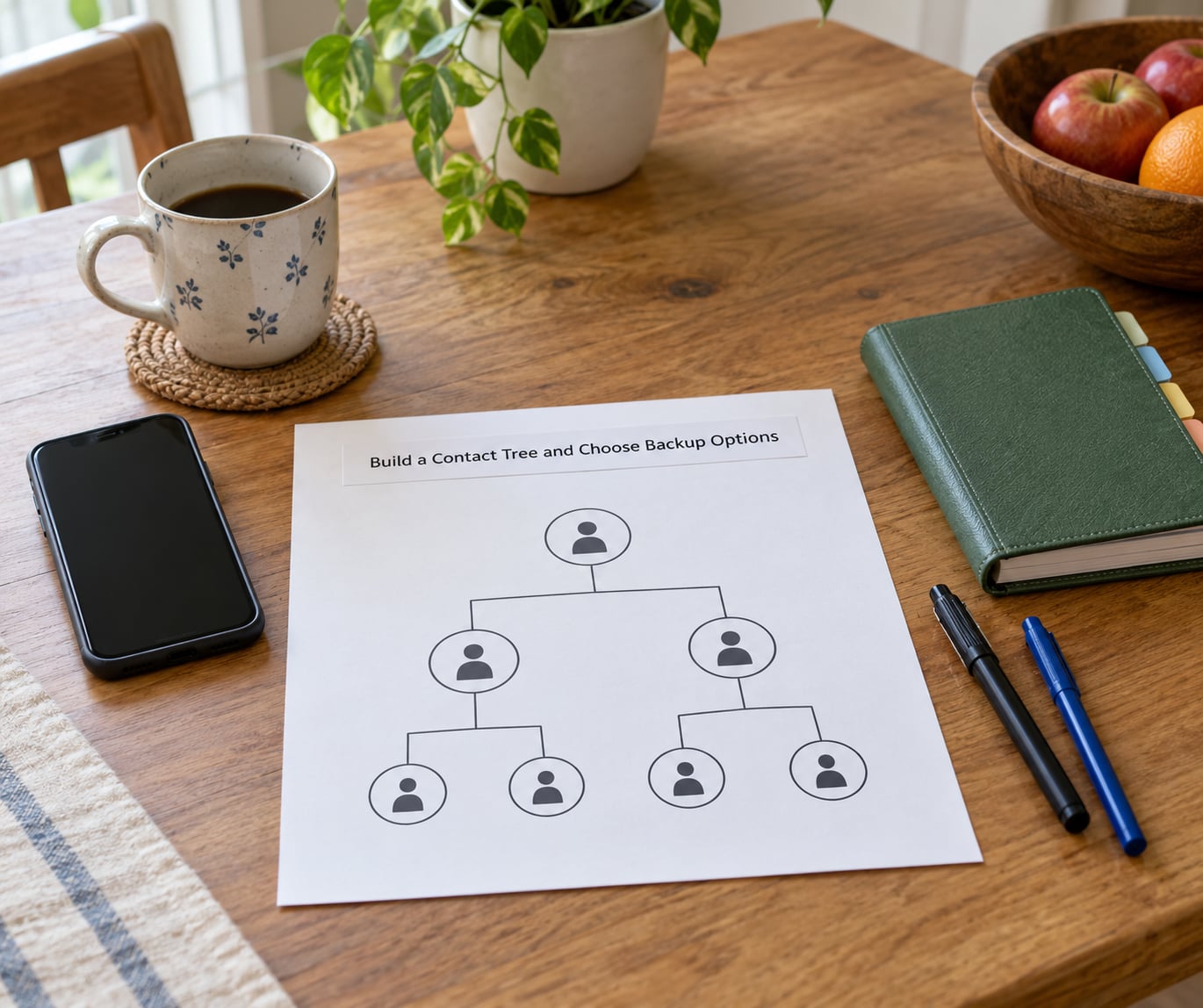
A family communication plan for emergencies needs three contacts before it needs anything else: one primary local contact, one secondary who is not in the same neighborhood, and one out-of-town contact who is far enough away that local congestion will not touch them.
The out-of-town contact is the piece most families skip, and it is the piece that matters most in a real outage. Calling a few miles away often fails because those towers share the same congestion; calling three hundred miles away often works. Many county preparedness offices say the same thing, and it surprises people who have only ever tested local calls.
Now tell that person they are the contact. Ask once, clearly, and put it in writing: “If our family calls you, it may be an emergency. Here is what we might need, here is what we will tell you, here is how to reach us.” A contact who has not been briefed treats a call as a nuisance and goes back to their evening.
The contact tree itself is simple. Everyone in the household texts or calls the same out-of-town contact. That person relays messages back down the list. One channel to maintain, one person to brief, and it keeps working when your local group text is choking.
| Level | Who | What they do |
|---|---|---|
| Primary | Out-of-town contact | Holds the full plan, relays messages, keeps a list of who is accounted for |
| Secondary | A relative outside your neighborhood | Reaches the out-of-town contact if the first two household adults are unreachable |
| Tertiary | A neighbor, building manager, or co-parent | Checks on people who cannot check on themselves |
Print this tree. Put the phone number on the fridge and a copy in each adult’s wallet. In the middle of a bad afternoon, nobody is searching a group thread for a name.
3. Select Communication Methods and Check-In Times
Every household needs three methods, in order. Method one is the everyday group text. Method two is a single direct text or call to the out-of-town contact. Method three is the one that works with no network at all: a battery or hand-crank NOAA radio, a landline, a neighbor with a working handset, or a walk to the meeting place.
Know the failure mode of each one before you need it. During a disaster, towers are overloaded: voice calls often fail while short texts still squeeze through, because a text needs less network capacity than a call. That is why a plan built around group voice calls falls apart exactly when it is needed.
| Method | Best for | How it fails |
|---|---|---|
| Group text | Routine check-ins, quick all-clear messages | People stop reading it, especially older relatives |
| Voice call | Complex updates, checking someone is really okay | Drops first under tower congestion |
| Text to out-of-town contact | Reaching someone outside the affected area | Fails if your phone is dead, lost, or flat |
| Battery or hand-crank radio | Official alerts when cell service is gone | Receives official broadcasts only, not personal messages |
| In-person check-in | Neighbors, homebound neighbors, anyone without a phone | Only useful within walking or short driving distance |
Then set check-in times, which is where most plans quietly fail. Not “we’ll keep in touch” but a deadline. For example: anyone travelling more than an hour away checks in by text on arrival and again every six hours; everyone checks in the morning of a declared emergency whether or not anything has changed.
Three rules make it work. Someone is always responsible for initiating, so it never depends on the most anxious person. Every check-in carries a deadline and a content format, such as “here, safe, no help needed.” And there is a defined response when a deadline passes, because silence is data, not a reason to assume the worst.
Agree in advance what happens when someone misses a deadline. Most families pick something calm: one person tries twice, then the secondary contact tries once, then the out-of-town contact starts calling around. Deciding this now keeps step two from turning into twenty unanswered calls to the same voicemail.
One practical trick: set the phrases you will use in advance and store them as a text replacement on every adult’s phone. One keyword like “SAFE” or “NEED HELP” saves thirty seconds of typing when your hands are shaking and the screen is cracked.
4. Establish Meeting Places, Shelter Options and Routes
Pick three things, and write them as names, not concepts. A near meeting place everyone can walk to in under fifteen minutes, such as the corner park or the school across the street. A far meeting place outside your neighborhood, chosen because a fire, flood, or police line does not need to block it.
Out of the area is not optional either. If your house is unusable, where do you go? A relative’s home, a designated shelter, or somewhere out of the region, with the address written down rather than remembered.
Two routes out beat one, because the obvious road is the road everybody else is on. Walk both at some point, at different hours, so you know whether the bridge is a fifteen-minute detour or a two-hour one at school pickup time. Note which one is usable for a wheelchair or a stroller, and say plainly if neither is.
Account for where people are when it happens. Write down your school’s pickup procedure, whether anyone is authorized to collect your children, the childcare handover time, and how to reach your workplace. Assumptions here are the ones that turn into missing children.
Then decide, in advance, when separating is safer than traveling. If there is fire, smoke, flooding, or an active shooter, going to the meeting place is the wrong move. Write one sentence your family can remember under stress: if the house is not safe, we do not meet, we leave.
5. Record Essential Information and Accessibility Needs
This is the section that fails silently when cell service is gone. Write down the facts you would otherwise look up: medication names, doses, prescribers, insurance details, allergies, doctor names, school pickup rules, and pet medication and vet details.
Add the access details that decide whether someone gets helped or does not. Does anyone need sign-language interpretation, relay service, text-based communication because they cannot hear, large print, or a language other than English? Write the exact wording a responder needs, such as “Mina is deaf and reads English and Spanish; communicate by text or in writing.”
Note mobility and medical equipment honestly. If someone uses oxygen concentrator equipment, a powered wheelchair, or a refrigeration-dependent medication, write who has the backup power and how long it lasts. If the answer is nobody, that is a gap to close this month, not in an emergency.
For children, list allergies, medications, who can authorize care, and the one adult who is allowed to make medical decisions. For pets, list the vet, the medications, and the person who handles the carrier. For separated or blended families, write plainly who gets contacted first and who has custody, so nobody has to make that decision while standing in smoke.
Keep it concise and keep it secure. A single sheet holds the essentials. Store it in an encrypted folder or password manager with an emergency contact set up, and keep the paper copy somewhere that is not taped to the front door for anyone to read.
6. Test the Plan and Practice as a Family
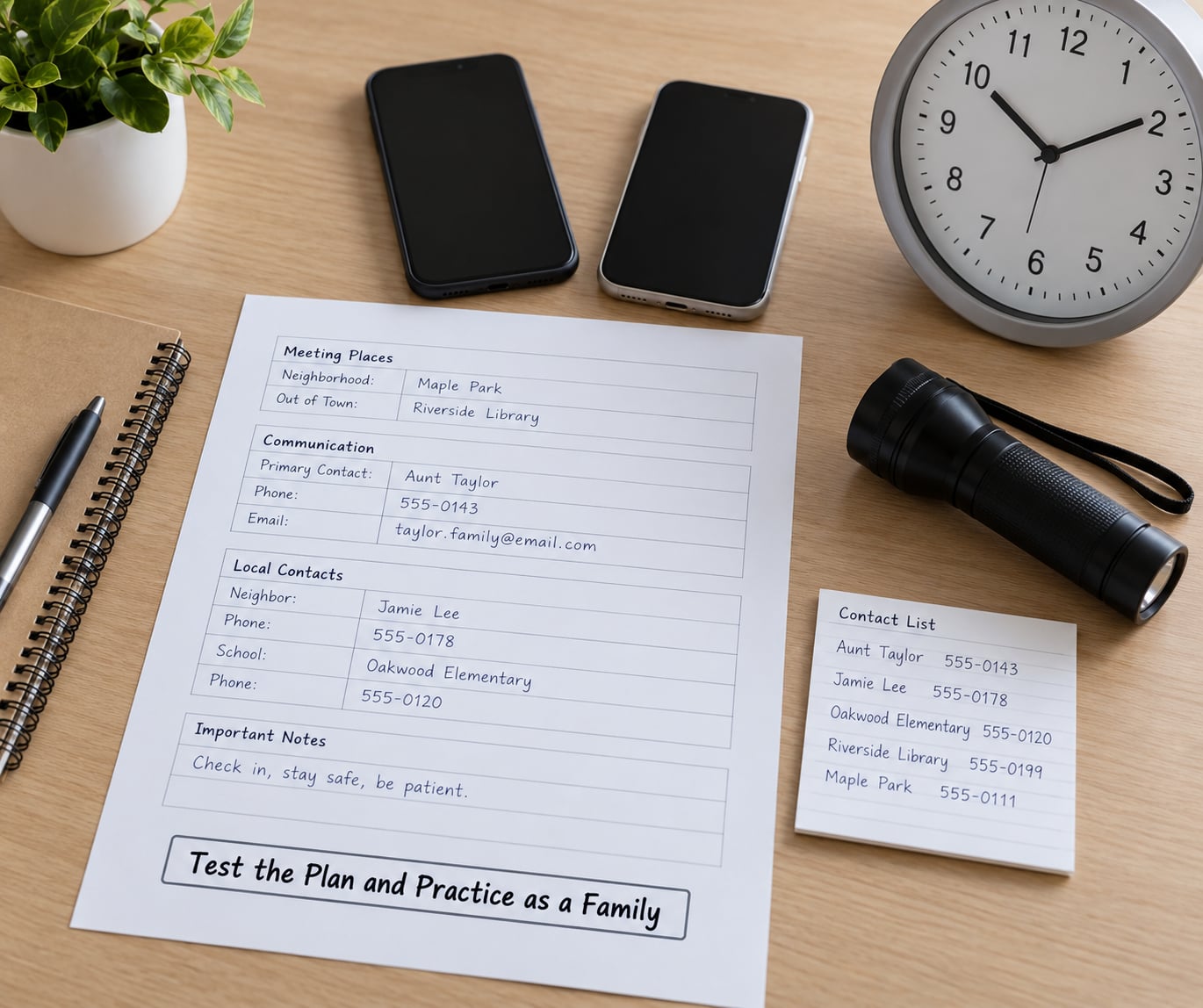
A plan nobody has run is a wish. The first test is a tabletop drill: pick a fictional scenario and talk it through for twenty minutes.
Use a scenario with real friction rather than a clean one. “The power is out, the group text is not sending, and Dad is two hours away” tests far more than “there was a storm.” Some scenarios worth running: a house fire with a blocked exit, a flood evacuation with a route closed, a school lockdown during pickup, a power cut with someone on powered medical equipment, and a missing child reunion.
Give the drill one job each: who makes the calls, in what order, using which method, and what they say. Then have every person, including the children who can read, point to where the plan is stored and make one check-in to the out-of-town contact using the agreed phrase.
Expect to find problems. The typical findings are a phone number nobody has updated, a meeting place that is now under construction, a relative who does not read group texts, or a grandmother who needs a landline because she will not answer unknown numbers.
Write those findings down before you revise, and fix them the same day. Do not end the session with a reward that competes with the plan itself; end it with each person repeating the one thing they are responsible for. Repetition is what makes it automatic when adrenaline takes over.
Practice twice a year, and vary the scenario each time. Keep it short enough that nobody starts dreading it, because a plan that feels like homework does not get used.
7. Share, Protect and Update Copies
Give your out-of-town contact a copy. A single page is enough, and it should include the out-of-town contact’s own name and number at the top so the page is useful to whoever else holds it. Include the near and far meeting places, the medication list, and the one line about who calls whom first.
Store the master in three places: a shared cloud folder the whole household can open without your password, a paper copy in the kitchen drawer, and a smaller card with the essential numbers in each adult’s wallet and each child’s backpack. A child evacuated from school has a card and a phone number written down, and that is the version that matters.
Protect what you write down. Insurance numbers, medical details, and passwords should not sit on a sheet taped to a door. Use a password manager with a designated emergency contact rather than a sticky note with credentials.
Then set the update rhythm. Review the whole plan every six months, and immediately after any change in phone numbers, medication, address, school, workplace, vehicles, or the addition or loss of anyone in the household. Put both events on the calendar with a name against them, because a plan with no owner quietly goes stale.
The One-Page Template to Copy
Most families can finish this on one side of paper. Copy the blanks below, fill them in tonight, and stop there. Extra pages only add ways for someone to miss the line that matters.
Household members — name, mobile, any need (medication, mobility, hearing, language), school or workplace.
Local hazards for our address — the two or three that actually happen here.
Out-of-town contact — name, mobile, landline if they have one. Agreed on this date. They have a copy of this page.
Secondary contact — name, mobile, lives outside our neighborhood.
Meeting place, near — full address, and how long the walk takes.
Meeting place, far — full address, outside our neighborhood.
Out-of-area fallback — address or shelter, and how we get there.
Routes out — primary, secondary, and which one suits a wheelchair or stroller.
First ten minutes — who gets the children, who gets the go bags, who handles the pets, who handles the phones.
Check-in rule — when, who sends it, the exact words we use, and what happens if a deadline passes.
Method one / two / three — group text, text to out-of-town contact, radio or walk to the meeting place.
Alerts we receive — county and state alert sign-ups, Wireless Emergency Alerts on, radio station.
Medications and allergies — name, dose, who prescribes, pharmacy.
Medical equipment and backup power — device, who has the spare battery, how long it runs.
School and childcare pickup — address, authorized adults, code word if required.
Access notes — how to communicate with each person: language, sign, text, writing, large print.
Pets — name, vet, medication, carrier location.
Custody or contact order — who is called first, written down, so nobody decides this during a crisis.
Where the copies live — kitchen drawer, cloud folder, out-of-town contact, wallet cards, backpacks.
Next review date — written on the page, with an owner’s name next to it.
Two notes on the paperwork. Leave the copies somewhere boring and reachable, like the kitchen drawer and the refrigerator, because a plan filed on a high shelf is a plan that does not exist. And check it against the number of people on the roster every time someone moves in or out; the plan should never be longer than the household it serves.
Common Mistakes
Relying on one phone number. Phones get lost, wet, flat, and left at school. Keep a printed card in every wallet and backpack, plus the out-of-town contact’s landline where one exists.
Relying on one communication service. If your group text is the only plan, the plan has a single point of failure. Add a battery or hand-crank radio for official alerts and an in-person check-in route for neighbors and anyone without a phone.
Choosing only one meeting place. A fire, flood, or police perimeter can close the obvious spot. Always name a near place, a far place outside the neighborhood, and an out-of-area fallback.
Sending messages without deadlines. “Let me know you’re safe” invites silence and panic. Use fixed phrases and times: location, status, whether help is needed, next update time.
Building a plan nobody can read. Twelve pages of codes and acronyms fail at the moment of stress. One page, plain language, large print for anyone who needs it.
Leaving people out. Children, nonbinary relatives, elders, disabled family members, and anyone without a smartphone are usually missing from these documents. Write a line for each person, including how you will reach them without a text.
Treating printed documents as permanently current. A plan written two years ago with old numbers is worse than no plan, because it looks authoritative. Put a review date on the page itself.
Forgetting to brief the out-of-town contact. Ask them directly, in writing, and confirm they understand what they may be asked to do.
A few habits keep all of this alive. Review twice a year on the same two dates. Keep the language simple enough that a teenager could read it aloud to a stranger. Practice the backup method, not just the primary one. And when you update something, say out loud what changed, so nobody keeps working from a memory that has already changed.
Frequently Asked Questions
What should a family communication plan include during emergencies?
Include a current roster with phone numbers and medical needs, one out-of-town contact, two meeting places, alert sign-ups for your county and state, primary and backup communication methods, scheduled check-in times, school and workplace pickup arrangements, and access needs such as language or hearing support. Write it on one page and keep copies at home, in wallets, and with the out-of-town contact.
How do you make a family communication plan for emergencies without mobile service?
Put a battery or hand-crank NOAA radio in the plan for official alerts, assign one person per household to walk to the near meeting place if phones stay dead, and agree a check-in time at that location instead of a text. Local voice calls often fail before short texts get through during tower congestion, so try a text first, then a walk, then a neighbor with a working handset.
Who should be the family’s emergency contact?
Choose someone far enough away that local tower congestion will not affect them, ideally in another state or region, and someone calm and reachable. Tell them plainly that they are the contact, give them a copy of the plan, and explain what you will ask them to relay. A secondary contact outside your neighborhood covers the case where the first choice cannot be reached.
How often should a family communication plan be updated?
Review the full plan every six months, and update it immediately whenever a phone number, medication, address, school, workplace, vehicle, or household member changes. Give one adult the job of owning the plan and put both the review dates and any changes on a shared calendar so updates happen once instead of drifting apart.
What if family members are at school or work during an emergency?
Write down each school and workplace address, pickup authorization, office hours, and the phone number of the front office or reception desk. Agree who collects children and under what conditions, including the code word if your school uses one. Have your child carry a contact card, and agree a check-in rule: no news is not the same as bad news, so confirm status at a fixed time.
How should families plan for children, pets, or relatives with disabilities?
Give each child an age-appropriate job, a contact card for their backpack, and the meeting place address in writing rather than expectation. List pet medications, vet details, and who handles the carrier. For disabled relatives, record mobility needs, backup power for medical equipment, and how a responder should communicate, such as text, writing, or relay service.
Free national guidance is worth reading before you finalize anything: Ready.gov and your FEMA state office for the alert sign-ups, the American Red Cross for the go bag list, your county emergency management page for local hazards and shelter locations, and Smart911 for the medical and contact details that responders would need.
Conclusion: Put Your Family Plan in Place Today
Start with the boring half today: write down every household member’s real phone number, pick one out-of-town contact and tell them they are the contact, and choose a near and far meeting place. That takes twenty minutes and covers most of what actually goes wrong.
Then, before 2026 runs out, add the parts that need thought: the medication and accessibility notes, the school and workplace pickup rules, the backup communication method, and the check-in deadlines with phrases everyone can type quickly.
Finally, put a thirty-minute family session on the calendar. Run one fictional scenario, let the children show you where the plan is, fix whatever breaks, and write down what you learned. Two hours of work, twice a year, buys your family a plan that still works on the worst night of the year.